
 Worksheets
Physics - Midterm Review
Total questions: 61
Worksheet time: 53mins
Name
Class
Date
1.
A _____ is a pull or a push.
a)
force
b)
friction
c)
gravity
d)
speed
2.
_____ is the force that slows and stops motion between touching objects.
a)
Friction
b)
Gravity
c)
Pull
d)
Push
3.
Which has the least friction?
a)
snowboard on a snowy hill
b)
running on the playground
c)
sandpaper on wood
d)
a racer on a track
4.
Why is there less friction between two ice cubes touching than between sandpaper on wood?
a)
They have rough surfaces.
b)
They have loud surfaces.
c)
They have smooth surfaces.
d)
They have bright surfaces.
5.
What is one way to reduce friction?
a)
Put sandpaper between the surfaces that touch.
b)
Push the surfaces closer together.
c)
Shine a light on the surfaces.
d)
Put a slippery substance between the surfaces.
6.

In the image, what force is acting on arrow A?
a)
friction
b)
gravity
c)
push
d)
Jedi force
7.
Which would require the most force to move?
a)
a toy car
b)
a sleeping cat
c)
a science book
d)
a chair with a friend sitting in it
8.
A car traveled 120 km in 2 hours. Using this data, you can calculate its _____.
a)
speed.
b)
velocity.
c)
position.
d)
mass.
9.
What is the unit to MEASURE force?
a)
Kilogram
b)
Meter
c)
Pascal
d)
Newton
10.

What is the net force?
a)
20 N
b)
0 N
c)
400 N
d)
40 N
11.
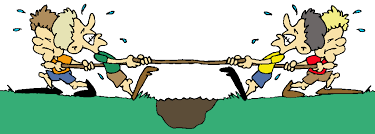
If these teams are pulling with the same amount of force what will happen?
a)
The boy in blue will win.
b)
They will not move at all.
c)
The boy in red will win.
d)
Both will fall down.
12.

Balanced or unbalanced?
a)
balanced
b)
unbalanced
13.
What will cause an object to move?
a)
Applied forces
b)
Balanced forces
c)
Unbalanced forces
14.

Balanced or Unbalanced?
a)
Balanced
b)
Unbalanced
15.
The force that pulls objects towards Earth.
a)
Gravity
b)
Friction
c)
Inertia
d)
Force
16.
When forces are _________ the object DOES NOT move.
a)
unbalanced
b)
balanced
c)
heavy
d)
light
17.
What is the net force of an object that is not moving?
a)
0 N
b)
100 N
c)
Upward force
d)
10 N
18.

When an object is getting faster, it is called....
a)
potential energy
b)
kinetic energy
c)
acceleration
d)
deceleration
19.

Inertia is....
a)
for every action, there is an equal and opposite reaction
b)
larger objects take more force to move
c)
an object in motion tends to stay in motion unless acted on by an opposite force
d)
a push that acts in the opposite direction and it slows down.
20.

Friction helps objects to move easier.
a)
true
b)
false
21.

John walks at 5 km in 10 minutes. If John walk s 2.5 km at the same speed, what is the BEST estimate of the time this will take?
a)
5 minutes
b)
10 minutes
c)
15 minutes
d)
20 minutes
22.

Hanna's mom drives north for 2 hours going 70 miles per hour. She then drives west for 3 hours going 50 miles per hour. how many miles has Hanna's mom driven?
a)
200 miles
b)
250 miles
c)
290 miles
23.

A car takes 3 hours to travel180 miles at a constant speed. How fast is the car traveling?
a)
30 mph
b)
50 mph
c)
60 mph
d)
90 mph
24.
What is the formula for force?
a)
F=M/A
b)
F=A/M
c)
F=M*A
d)
F=M*F
25.
When you tell the direction and speed of an object, you give its
a)
motion
b)
velocity
c)
acceleration
d)
mass
26.
If a 10 kilogram object accelerates suddenly at 15 m/s2, how much force was applied to the object?
a)
150 Newtons
b)
15 Newtons
c)
150 kilograms
d)
100 kilograms
27.
A baseball is thrown a distance of 50 meters. What is the speed if it takes 2 seconds to cover that distance?
a)
100 m/s2
b)
25 m/s2
c)
52 m/s2
d)
100 seconds
28.
Speed is equal to
a)
Distance/Time
b)
Time/Distance
c)
Time x Distance
d)
Acceleration
29.
Speed is different from velocity because
a)
Velocity has a direction
b)
Speed uses Distance /Time
c)
Velocity doesn't include time
d)
Velocity doesn't include distance
30.

What is this graph showing?
a)
Constant Speed
b)
Acceleration (speeding up)
c)
Deceleration (slowing down)
d)
No motion
31.
An object at rest will remain at rest or in the same uniform motion unless acted upon by an unbalanced force: law of inertia.
a)
Newton's First Law of Motion
b)
Newton's Second Law of Motion
c)
Newton's Third Law of Motion
32.
If one object exerts a force on a second object, the second object exerts a force equal in magnitude and opposite in direction on the object body; law of interaction
a)
Newton's First Law of Motion
b)
Newton's Second Law of Motion
c)
Newton's Third Law of Motion
33.
as mass increases, the acceleration has to decrease: the law of acceleration
a)
Newton's First Law of Motion
b)
Newton's Second Law of Motion
c)
Newton's Third Law of Motion
34.
What does the 1st law of motion say?
a)
F=ma
b)
An object at motion stays at rest until an unbalanced force acts upon it. An object at rest stays at rest until an unbalanced force acts upon it.
c)
I don't know so please don't ask me (This one is wrong so don't choose it)
d)
Every action has an opposite reaction
35.

What is Kinetic Energy?
a)
Energy stored in an object.
b)
Energy an object has because of its motion.
c)
F=ma
d)
Every action has an opposite reaction.
36.

What is potential energy?
a)
Stored energy
b)
Energy an object as due to motion.
c)
electrical energy
d)
chemical energy
37.

What kind of energy is in a rock at the edge of a cliff?
a)
Potential
b)
Kinetic
c)
Both potential and kinetic energy
d)
none of the above
38.
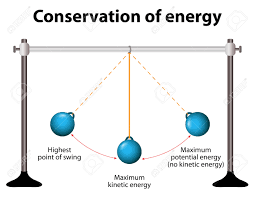
Conservation of energy states that energy cannot be ________ or ________, but can be altered from one form to another.
a)
created, destroyed
b)
gravity, force
c)
heat, created
39.

At which point is potential energy greatest?
a)
W
b)
X
c)
Y
d)
Z
40.
__________ is stored energy.
a)
Potential
b)
Kinetic
c)
None of the above
d)
All of the above
41.

What kind of energy is in a moving skateboard?
a)
Potential
b)
Kinetic
42.
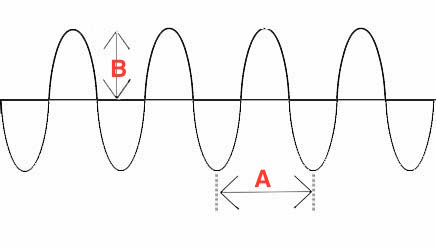
What property of this wave is represented by the letter "A"
a)
amplitude
b)
crest
c)
trough
d)
wavelength
43.
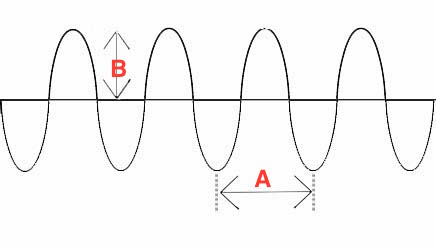
What property of the wave is represented by the letter "B"?
a)
amplitude
b)
crest
c)
trough
d)
wavelength
44.
The highest point on a wave is:
a)
the crest
b)
the trough
c)
the top
d)
the coast
45.
The lowest point on a wave is the:
a)
Amplitude
b)
Crest
c)
Trough
d)
Wavelength
46.
The type of waves that require medium to pass:
a)
Mechanical Waves
b)
Electromagnetic Waves
47.
The number of wavelengths that pass a point each per second is:
a)
frequency
b)
period
c)
longitudinal
d)
transverse wave
48.
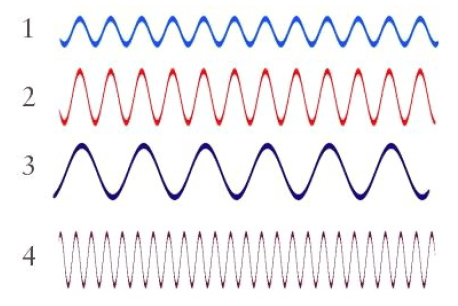
Which wave in the diagram has the greatest frequency?
a)
1
b)
2
c)
3
d)
4
49.
Which of the following can sound travel through?
a)
solid
b)
liquid
c)
gas
d)
all of the above
50.
Electromagnetic waves include the following except
a)
radio waves
b)
X-rays
c)
doing the wave at a football game
d)
microwaves
51.
which material does sound travel the fastest?
a)
solid
b)
liquid
c)
gases
52.
When a wave strikes and object and bounces off. (example echo)
a)
medium
b)
refraction
c)
reflection
d)
interference
53.
When a wave bends as it passes through at an angle from one medium to another.(example: pencil in a glass of water-)
a)
medium
b)
refraction
c)
reflection
d)
interference
54.

_____________________light is the only type of EM wave detected by the human eye.
a)
Red
b)
Gamma
c)
Microwave
d)
Visible
55.

Which type of EM wave has the highest frequency?
a)
gamma ray
b)
radio waves
c)
microwaves
d)
infrared rays
56.
Dependent variable means
a)
the scientist controls what to test
b)
educated guess
c)
ask a question
d)
what is being measured
57.
If you increase the amount of spinach you eat, then you will increase the iron in your blood.
What's the dependent variable?
What's the dependent variable?
a)
increase the amount of iron in your blood
b)
spinach you eat
58.
If I listen to Mr. Castro's instructions, then I will have less accidents in the lab. What is the independent variable?
a)
Yes
b)
Maybe
c)
Listening or not listening to instructions
d)
Likelihood of having an accident in lab
59.
You will want your experiment to have ____ independent variable(s) in it for the experiment to be valid.
a)
1
b)
2
c)
3
d)
4
60.
An experiment is performed on plants to see how different liquids affect plant growth. Each plant in the experiment is given a different liquid; water, apple juice, or milk. Each plant has the same amount of soil, sunlight, and listens to the same music. In this investigation, the independent variable is ...
a)
The type of plant
b)
The amount of sunlight
c)
The type of music
d)
The type of liquid
61.
A student wants to test the effects of type of exercise on heart rate. What is the dependent variable?
a)
heart rate
b)
type of exercise
c)
amount of exercise
d)
time of day exercise occurs
100 %

