wayground logo

Free Printable Worksheets

NEW

Font size

S
M
L
XL
Worksheets

Chemical Bonding

Total questions: 40

Worksheet time: 30mins

Name
Class
Date
1.

This atom will

a)

lose 2 electrons

b)

gain 2 electrons

c)

lose 6 electrons

d)

gain 6 electrons

e)

do nothing

2.

This atom will

a)

lose 1 electron

b)

gain 1 electron

c)

lose 7 electrons

d)

gain 7 electrons

e)

do nothing

3.

What charge will this atom have when it satisfies the octet rule?

a)

+2

b)

-2

c)

+6

d)

-6

e)

8

4.

Anions have a ________ charge.

a)

positve

b)

negative

c)

neutral

5.

What charge will iodine (#53) have when it satisfies the octet rule?

a)

+17

b)

+7

c)

-7

d)

+1

e)

-1

6.

Which family of elements does not form ions or bond with other elements?

a)

alkali metals

b)

halogens

c)

alkaline earth metals

d)

rare earth elements

e)

noble gases

7.

What charge will this atom have when it satisfies the octet rule? Assume it is neutral in this diagram.

a)

+5

b)

-5

c)

+3

d)

-3

e)

8

8.
The electron configuration of an atom is 1s22s22p6.  The number of electrons in the atom is 
a)
3
b)
6
c)
8
d)
10
9.
What atom matches this electron configuration?
1s22s22p63s2
a)
Neon
b)
Magnesium
c)
Aluminum
d)
Potassium
10.
Which element has an electron configuration of 2.5?
a)
Oxygen
b)
Nitrogen
c)
Phosphorus
d)
Carbon
11.

What is an isotope?

a)

An element with the same number of neutrons and different number of protons

b)

An element with the same number of protons and different number of neutrons

c)

An element with the same number of protons and different number of electrons

d)

An element with the same number of neutrons and different number of electrons

12.

What is the charge and mass of a proton?

a)

+1 charge, 1 amu

b)

0 charge, 1 amu

c)

0 charge, 0 amu

d)

-1 charge, 0 amu

13.

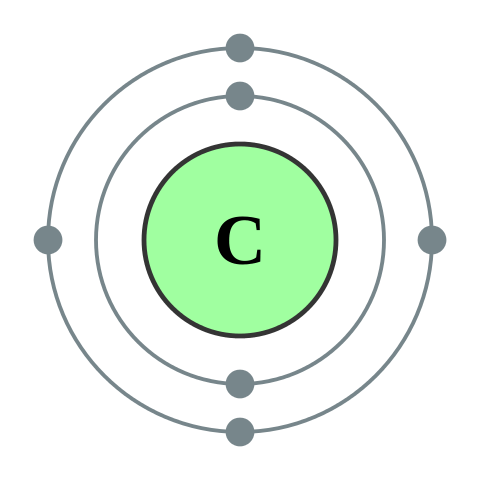
How many electrons are in the 3rd energy level of Carbon?

a)

2

b)

1

c)

0

d)

4

14.

The correct electron configuration for Chlorine is

a)

1s22s22p5

b)

1s22s22p63s2

c)

1s22s22p63s23p4

d)

1s22s22p63s23p5

15.

How many valence electrons are in Chlorine

a)

4

b)

5

c)

6

d)

7

16.
How many electrons can the 2nd electron shell hold?
a)
2
b)
3
c)
8
d)
18
17.

How many valence electrons does carbon have?

a)

4

b)

5

c)

6

d)

7

18.
How many valence electrons does Helium have?
a)
1
b)
2
c)
3
d)
4
19.

How many valence electrons do elements in Group 1 have?

a)

1

b)

2

c)

3

d)

4

20.
Are the atoms more stable when they are bonded together or when they are apart? 
a)
Bonded Together
b)
Apart
21.
Ionic Bonding involves...
a)
The transfer of protons
b)
The transfer of nuetrons 
c)
The transfer of electrons
d)
None Of the above
22.
What do atoms that form positive ions tend to do?
a)
Tend to lose electrons 
b)
Tend to lose protons
c)
Tend to gain electrons
d)
Tend to gain protons
23.
What usually forms the negative ion?
a)
nonmetals
b)
metal
c)
none
24.
Covalent compounds
a)
Share electrons
b)
transfer electrons
c)
contain a sea of electrons
d)
conduct electricity
25.
What charges attract?
a)
Opposite
b)
Same
26.
What elements generally make an ionic bond?
a)
metal and nonmetal
b)
2 or more nonmetals
c)
metal
d)
none of the above
27.
What is the name of N2O3
a)
Nitrogen trioxide
b)
Dinitrogen oxide
c)
Dinitrogen trioxide
d)
Nitrogen oxide
28.
What is the name of C3Cl?
a)
Carbon octachloride
b)
Tricarbon octachloride
c)
Carbon trichloride
d)
Octacarbon trichloride
29.
What is the name of CO
a)
Carbon oxide
b)
Carbon dioxide
c)
Carbon monoxide
d)
Carbon II oxide
30.
What name results when Ca+2  and  Br- ions bond?
a)
calcium bromine
b)
calcium boron
c)
calcium boride
d)
calcium bromide
31.
What will be the compound name of the following chemical formula?
NaCl
a)
Potassium Chloride
b)
Sodium Chloride
c)
Calcium Chloride
d)
Sodium Chlorine
32.
What is the correct name for CaBr2?
a)
calcium dibromide
b)
calcium bromine (II)
c)
calcium (II) bromide
d)
calcium bromide
33.
Name the following ionic compound: BeCl2
a)
beryllium chlorine
b)
beryllium II chloride
c)
beryllium chloride
d)
beryllium dichloride
34.
MgS 
a)
Magnesium sulfide
b)
Monomagnesium monosulfide
c)
Magnesium monosulfide
35.
Name the following ionic compound: BeCl2
a)
beryllium chlorine
b)
beryllium II chloride
c)
beryllium chloride
d)
beryllium dichloride
36.
Name KF
a)
Potassium fluoride
b)
Potassium fluorite
c)
Fluorine potasside 
d)
Potassium fluorate
37.
An ionic bond forms when 
a)
Valence electrons are shared
b)
a sea of mobile electrons surround the cations
c)
valence electrons are transferred between atoms
d)
none of the above
38.
Predict the bond that will form between Be and F.
a)
Ionic
b)
Covalent
39.
How many valence electrons in this structure?
a)
6
b)
5
c)
4
d)
7
40.
How many atoms of Oxygen are in this compound?
a)
4
b)
1
c)
12
d)
7