wayground logo

Free Printable Worksheets

NEW

Font size

S
M
L
XL
Worksheets

Unit 1 Test Review

Total questions: 32

Worksheet time: 40mins

Name
Class
Date
1.
The definition of Scarcity is...
a)
An unlimited amount of resources to meet limited wants and needs
b)
A limited amount of resources to meet unlimited wants and needs.
c)
When people use time and energy to create events
d)
a city where individuals commit themselves to unlimited wants and needs
2.
Considering all the questions above, it all comes down to ___________________. These are decisions we all must make due to scarcity.
a)
trade offs
b)
scarcity
c)
choice
d)
incentive
3.
What is it called when you choose between two possible uses for a resource, giving up one alternative for another?
a)
Trade Offs
b)
Real Costs
c)
Building materials
d)
Trading spaces
4.
In economics, the value of the next best alternative is called _________.
a)
Scarcity
b)
Productivity
c)
Opprotunity Cost
d)
Supply and Demand
5.
Because of scarcity, any time a choice is made, there are alternatives that are not chosen.
a)
True
b)
False
6.

What is opportunity cost?

a)

your choice

b)

the second best option; the next best thing that you give up when you make a choice

7.
A popular bakery has only a few ingredients left to make their products.  They could bake muffins or cookies, but they can’t make both.  The bakers decide to make cookies for their customers.  What is the opportunity cost of their decision?
a)
muffins 
b)
cookies 
8.
Emelia has been invited to a sleep over at Chloe’s house for this Saturday.  Emelia has tickets to see her favorite band in concert that same night.  She decides to give the tickets to her sister and go to Chloe’s house.  What is the opportunity cost of her decision?
a)
seeing her favorite band 
b)
spending time at a friends house 
9.
SSEF2b  Use the table to answer the question.  A rational decision would mean hiring how many police officers?
a)
4
b)
5
c)
6
d)
7
10.
SSEF2a The extra added utility or positive outcome by adding one aditional unit, or by doing a little more of something. 
a)
Marginal Cost
b)
Marginal Benefit
c)
Profit
d)
Trade off
11.
It is considered "rational" to continue add more to the margin as long as the marginal benefit is____ to the marginal cost. 
a)
Greater than or equal to
b)
Less than
c)
A big trade off
d)
none of the above
12.
SSEF2b If you were making a rational decision, at what slice of pizza should you stop?
a)
5
b)
4
c)
2
d)
3
13.
Additional cost associated by producing one additional unit of product.
a)
Fixed Costs
b)
Average Costs
c)
Marginal Costs
d)
Emplicit Costs
14.
What is opportunity cost?
a)
a graph that shows how much an economy can produce between 2 goods
b)
how much money something is
c)
the opportunity one has to give up in order to gain something else
d)
land, labor, capital, entrepreneurs
15.
What is the production possibilities curve?
a)
a graph that shows how much an economy can produce between 2 goods
b)
how much money something is
c)
the opportunity one has to give up in order to gain something else
d)
land, labor, capital, entrepreneurs
16.
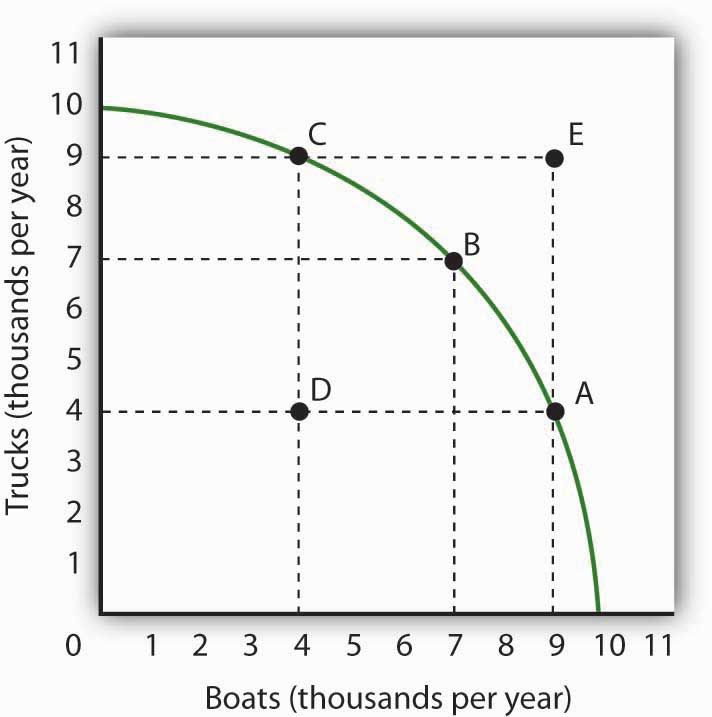
If a point lies on the curve this means the company is being efficient. If a point lies inside the curve, this tells the company what?
a)
They are being over efficient
b)
They are not efficient
c)
It is impossible
d)
None of the above
17.
What does point B represent?
a)
Production at greater than the country's minimum potential
b)
Production is less than the country's minimum potential
c)
Production is greater than the country's maximum potential
d)
Production at the country's maximum potential
18.
What does point Y represent on the PPC?
a)
Efficiency
b)
Unattainable / impossible
c)
Inefficency
d)
Nothing
19.
Antonio has an Economic test tomorrow and knows that if he stays up and studies until 11 p.m. he has a good chance of making an A on the test.  However he is really tired and knows that if he goes to bed at 10:00 p.m. he can easily make a B on the exam.  What is Antonio's opportunity cost if he goes to bed at 11:00 p.m.
a)
An A on the exam 
b)
making a B on the exam 
c)
Losing one hour of sleep
d)
gaining one hour of sleep
20.
The opportunity cost of increasing production from point B to point C is...
a)
Scarcity
b)
2 boats
c)
2 trucks
d)
3 boats
21.
The opportunity cost of increasing production from point C to point A is...
a)
1 boat
b)
2 boats
c)
5 trucks
d)
3 trucks
22.
The U.S. can produce 50 cars and 25 tools.  Peru can produce 20 cars and 15 tools.  What is the opportunity cost of producing a car in the U.S.?
a)
.5 tools
b)
.5 cars
c)
.75 cars
d)
1.3 tools
23.
The U.S. can produce 10 ipads or 20 phones.  China can produce 20 ipads or 30 phones. Who should produce what?
a)
U.S.-ipads
China- phones
b)
U.S. phones
China- ipads
c)
both should produce ipads
d)
they should not specialize
24.

In 8 hours, Lana can bake 10 cakes while Lenny can bake 4 cakes. Lenny has an Absolute Advantage in making cakes.

a)

True

b)

False

25.
The US can produce 200 airplanes or 400 trucks. Japan can produce 300 trucks or 100 airplanes. 
Which country has the comparative advantage in producing trucks and what is their opportunity cost? 
a)
Japan, 1/3 airplane per truck
b)
US, 1/2 airplane per truck
c)
US, 2 airplanes per truck
d)
Japan, 3 airplanes per truck
26.

Why are crayons made using an assembly line?

a)

It makes the crayons more colorful.

b)

More crayons can be made faster.

c)

They make better crayons

27.
What increases productivity?
a)
specialization
b)
capital resources
c)
education/training
d)
all of the above
28.
Becky, Betty and Bob run a cupcake shop.  Becky makes the cupcakes, Betty decorates them and Bob sells them.  The different jobs they have is an example of:
a)
advertising
b)
specialization
c)
capital resources
d)
economic exchange
29.

What is the definition of Division of labor?

a)

the amount of goods and service workers can produce in a given time

b)

when a person, country, or region works on making one part of an item

c)

the use of science to create new products or make old ones better

d)

dividing up workers so that each worker completes one job, which is part of a larger job

30.
How does division of labor increase productivity?
a)
Workers require minimal training.
b)
Workers require minimal training.
c)
Workers become expert at one task.
d)
Workers move often from job to job.
31.

Which is true of a voluntary exchange?

a)

The buyer benefits.

b)

The seller benefits.

c)

Both sides benefit or they wouldn't make the trade.

d)

Neither side benefits.

32.
Which BEST describes productivity?
SSEF6a
a)
the interaction of buyers and sellers
b)
the relationship of inputs and outputs
c)
producing at high opportunity costs
d)
trading based on absolute advantage