
 Worksheets
BIOCATALYSIS
Total questions: 20
Worksheet time: 17mins
Which of the following statements regarding enzyme is TRUE
Enzyme decreases the free energy change of a reaction
Enzyme changes the direction of chemical reaction
Enzyme increase rate of reaction
Enzyme prevents changes in substrate concentration
An enzyme catalyses a reaction by …
lowering the energy of activation of a reaction
supplying the energy to speed up a reaction.
lowering the free energy of a reaction.
changing the equilibrium of a spontaneous reaction.
What is the active site of an enzyme?
A region that binds allosteric regulators of the enzyme
A region that binds the products of the catalytic reaction
A region that is inhibited by the presence of a coenzyme or a cofactor
A region that is involved in the catalytic reaction of the enzyme
Zinc, an essential trace element for most organisms, is present in the active site of enzyme carboxypeptidase. The zinc most likely functions as
a cofactor necessary for enzyme activity
a competitive inhibitor of the enzyme
a non-competitive inhibitor of the enzyme
a coenzyme derived from a vitamin

Watch the animation and identify the hypothesis involved
Lock and Key hypothesis
Induced Fit hypothesis
Enzyme-Substrate hypothesis
NAD+ is the example of
metal ion activator
coenzyme
prosthetic group
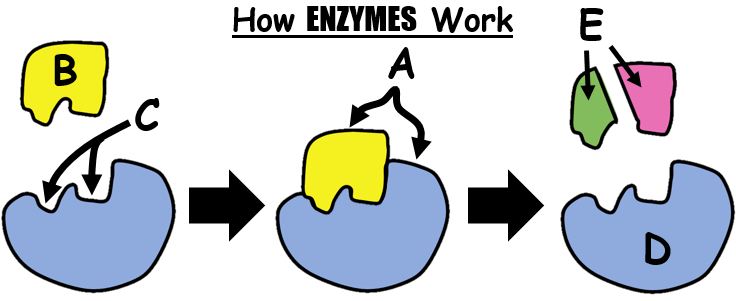
In the diagram, what is letter A?
product
substrate
enzyme-substrate complex
active site
What reduces the productivity of enzymes by preventing substrates from entering active sites?
non competitive inhibitors
competitive inhibitors
coenzymes
cofactors
Increasing the substrate concentration in an enzymatic reaction could overcome which of the following?
Denaturation of the enzyme
Non- competitive inhibition
Competitive inhibition
Saturation of enzyme activity
According to the induced fit hypothesis of enzyme catalysis, which of the following is CORRECT?
The binding of the substrate slightly changes the shape of the enzyme’s active site
The binding of the substrate depends on the shape of the active site
Some enzymes change their structure when activators bind to the enzyme
A competitive inhibitor can outcompete the substrate for the active site
A series of enzymes catalyze the reaction A --> B --> C --> D. Product D binds to the enzyme that converts A to B at a position other than its active site. This binding decreases the activity of the enzyme. What is substance A?
A substrate
A coenzyme
The product
An allosteric inhibitor
A series of enzymes catalyze the reaction A --> B --> C --> D. Product D binds to the enzyme that converts A to B at a position other than its active site. This binding decreases the activity of the enzyme. What is the function of substance D?
As a coenzyme
As a non-competitive inhibitor
As a competitive inhibitor
As a substrate
Enzymes are
nucleic acid
protein
carbohydrates
lipids
Which of these are characteristics of an enzyme.?
Enzymes are highly specific
Can be denatured at high pH
Reusable
Can be denatured at extreme pH
Which of the following descriptions best describes an induced fit?
The active site alters shape such that it is ready to accept a substrate.
A substrate binds to an active site and alters the shape of the active site.
An active site alters the shape of the substrate such that it can adopt the necessary active conformation for binding.
The lower the temperature, the faster the reaction at the enzyme will occur.
TRUE
FALSE

Based on the graph, which of the following could be used to increase the reaction rate beyond point C?
Increase the amount of substrate
Add more water
Increase the temperature
Increase enzyme concentration
When a piece of liver is dropped into hydrogen peroxide, the hydrogen peroxide bubbles vigorously as a result of what reaction?
Hydogen peroxide being broken into water and oxygen
Hydogen peroxide is destroying germs in the liver
More hydogen peroxide is being created by the liver
Liver and hydogen peroxide are joining together to make a new protein
Hydrolases is one important class of enzyme that function to catalyze
conversion between isomers.
splitting of a molecule using water.
reaction in which double bonds are formed.
oxidation-reduction reactions.

Which of the following conclusions can be drawn from this graph?
The optimum pH of the enzyme is 6.6.
The optimum pH of the enzyme is 5.8
The enzyme’s activity increases as pH increases 5.0 to 9.0
The enzyme’s activity is greater around pH of 8.0 .

