
 Worksheets
Selective Incorporation
Total questions: 12
Worksheet time: 24mins
In 1961, the Supreme Court heard a case in which the police entered into a residence without a warrant looking for a suspect thought to be hiding in the house. While searching for the suspect, the police found illegal pornographic material. The police arrested the homeowner and she was convicted in state court of possessing pornography. The Court decided to throw out the conviction because the police did not produce a search warrant, violating the right of the accused to be protected against an unreasonable search and seizure.
Which of the following constitutional provisions does the case described in the scenario have in common with McDonald v. Chicago (2010)?
The establishment clause
The due process clause
The equal protection clause
The free exercise clause
a
b
c
d
Selective incorporation is best defined as which of the following?
the legal requirement that an individual’s rights must be respected by a state or government; protected at the federal level by the Fifth Amendment, and at the state level by the Fourteenth
The constitutional doctrine that applies some, but not all, protections of the Bill of Rights to the states and to all levels of government
The rights and immunities protected by the Bill of Rights and interpreted by the Supreme Court as “implicit in the concept of ordered liberty”
The belief that the entirety of the Bill of Rights applies to the states and to all levels of government, not just to the federal government
“The District’s total ban on handgun possession in the home amounts to a prohibition on an entire class of “arms” that Americans overwhelmingly choose for the lawful purpose of self-defense.”
Associate Justice Scalia, majority opinion in D.C. vs Heller
In its D.C. vs Heller ruling, the Court struck down a handgun ban in Washington, D.C.
In which Supreme Court ruling was the Second Amendment right to bear arms first incorporated to the states?
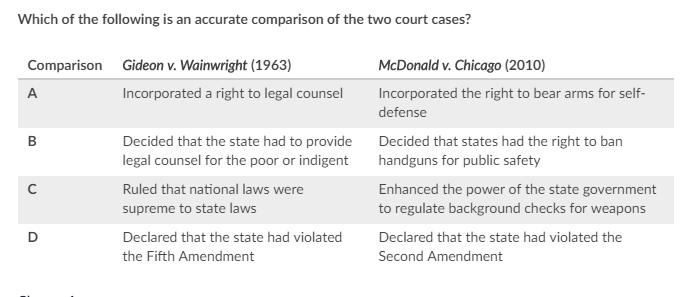
McDonald v. Chicago
Gideon v. Wainwright
Tinker v. Des Moines
Roe v. Wade
In 1961, Clarence Earl Gideon stood trial in Florida, accused of robbing a pool hall. Gideon was poor and could not afford a lawyer. He requested that the court provide one for him, but Florida only provided lawyers for defendants accused of capital offenses. The Supreme Court decided to throw out the conviction because lawyers were necessary to ensure a fair trial. The Court ruled that states must provide counsel to defendants too poor to afford lawyers or they are violating the constitutional right to legal counsel.
Which of the following statements best explains the impact of this decision?
It enhanced the state’s power to refuse to provide legal counsel in some felony cases
It applied the Sixth Amendment to the federal government through total incorporation
It limited the state’s power to convict someone who was poor or mentally ill
It applied the Sixth Amendment to the states through the incorporation doctrine
Which of the following constitutional provisions does the Gideon have in common with McDonald v. Chicago (2010)?
The due process clause
The establishment clause
The free exercise clause
The equal protection clause
In 1961, the Supreme Court heard a case in which the police entered into a residence without a warrant looking for a suspect thought to be hiding in the house. While searching for the suspect, the police found illegal pornographic material. The police arrested the homeowner and she was convicted in state court of possessing pornography. The Court decided to throw out the conviction because the police did not produce a search warrant, violating the right of the accused to be protected against an unreasonable search and seizure.
Which of the following statements best explains the impact of this decision?
It enhanced the state’s power to conduct searches and seizures without a warrant
It applied the Fourth Amendment to the federal government through total incorporation
It limited state power to conduct legal searches and seizures in all cases involving free speech or press
It applied the Fourth Amendment to the states through the incorporation doctrine
Justice Cardozo argues that certain rights protected at the federal level also apply at the state level through the Fourteenth Amendment.
Which clause is used to support Cardozo's argument?
The equal protection clause
The establishment clause
The privileges or immunities clause
The due process clause
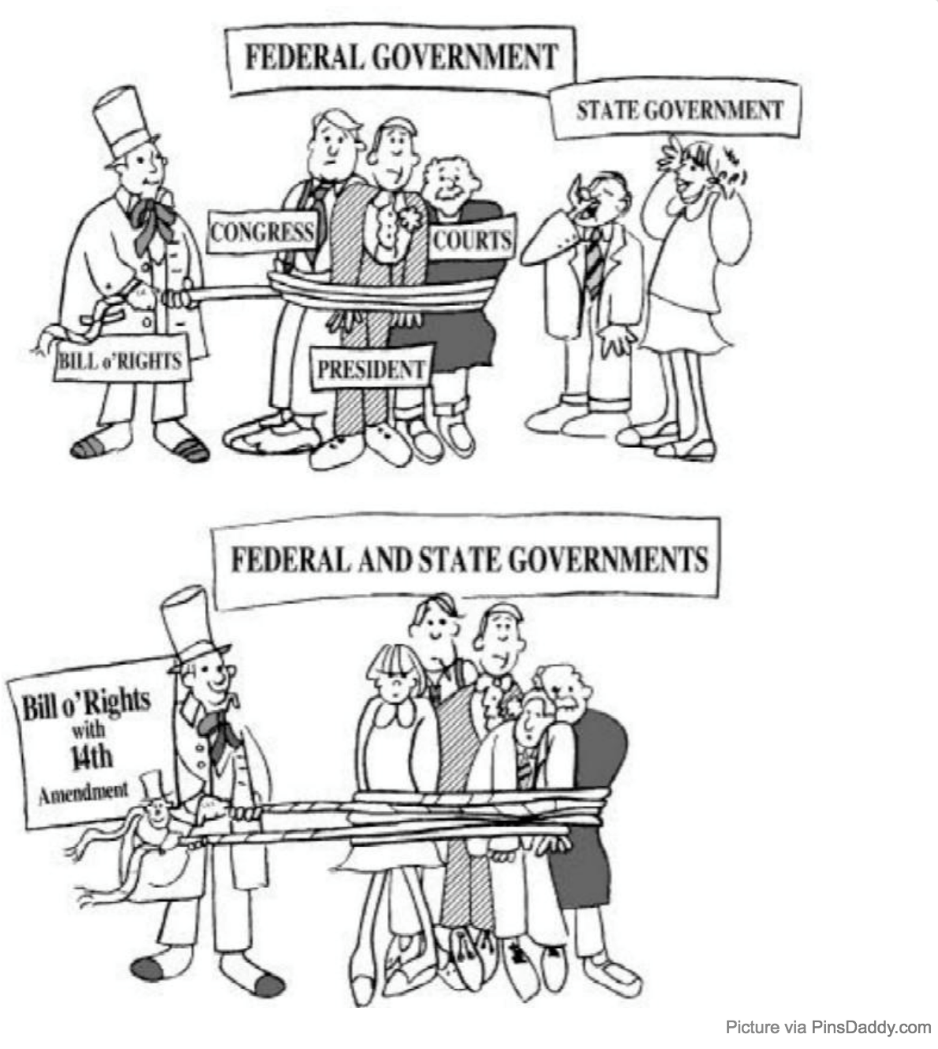
Which of the following Supreme Court cases is most relevant to the topic of the cartoon?
United States v. Lopez (1995)
New York Times Co. v. United States (1971)
McDonald v. Chicago (2010)
Marbury v. Madison (1803)
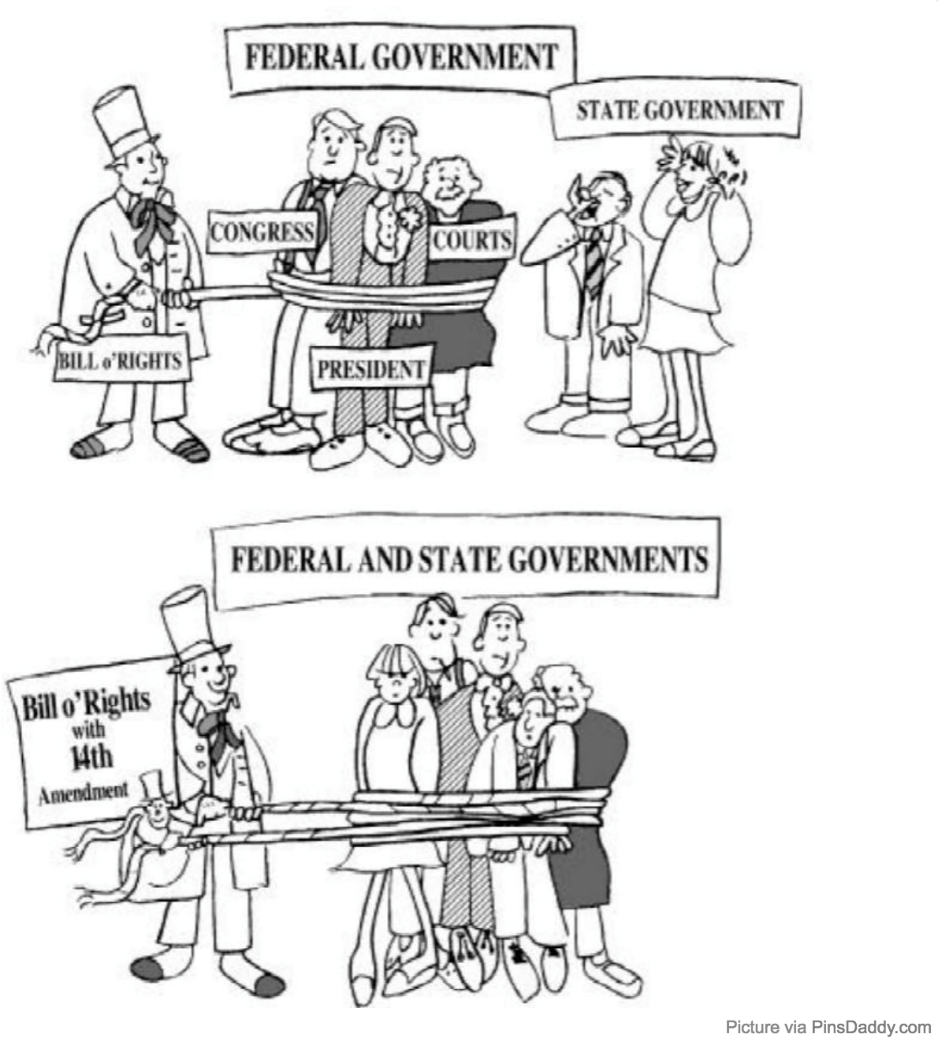
Which of the following best describes the message in the political cartoon?
The Supreme Court has been able to prevent state government infringement of basic liberties protected under the Bill of Rights by applying the Fourteenth Amendment
The Supreme Court has historically used the Bill of Rights to protect citizens from state infringement of basic liberties
The Supreme Court has ruled that state governments must add the Bill of Rights to each of their state constitutions
The Supreme Court has maintained that the Bill of Rights only applies to the federal government and not state governments
Which statement accurately summarizes the impact of the McDonald v. Chicago (2010) decision?
It required that each state institute stricter background checks and inform the federal government of all handgun purchases
It restricted the state from denying any person a gun if they wanted it for self-defense
It increased the state’s power to ban handguns to protect the public from gun violence
It incorporated an individual’s right to bear arms for self-defense and made it apply to state and local governments
“In … [certain] cases, immunities that are valid as against the federal government by force of the specific pledges of particular amendments have been found to be implicit in the concept of ordered liberty, and thus, through the Fourteenth Amendment, become valid as against the states."
Associate Justice Cardozo, majority opinion in Palko v. Connecticut (1937). Source: Justia
Based on the text, which of the following statements would the author most likely agree with?
The entirety of the Bill of Rights should apply to the states, because all of its protections are “implicit in the concept of ordered liberty”
Rights that are “implicit in the concept of ordered liberty” apply to the federal government but are not valid against the states
The Supreme Court is a branch of the federal government and should not intervene in disputes at the state level
The question of whether or not a right applies to the states as well as the federal government can be answered by considering if the right is “implicit in the concept of ordered liberty"

