

Wayground logo

Free Printable Worksheets

Font size

S
M
L
XL
Worksheets

9th grade Midterm Review 2019

Total questions: 103

Worksheet time: 1hrs 3mins
Name
Class
Date
1.
1.  What were the primary occupations of people during the Paleolithic Era?
a)
a.  Hunters & Gathers
b)
a.  Toolmakers
c)
a.  Farmers
2.
During the Neolithic Revolution
a)
People learned to grow food
b)
People migrated to find food
c)
People were nomadic
3.
Nomadic means to
a)
Sleep in tents
b)
Move around frequently
c)
Stay in one place
4.
What change marked the beginning of the Neolithic Revolution? 
a)
beginning of hunting and gathering
b)
man learned to write
c)
man began farming
d)
man built towns and cities
5.
How did the start of farming change early human tribes? 
a)
It forced them to stay in one place and build villages and cities.
b)
It caused them to continue to hunt animals and gather plants. 
c)
It ended fighting between the tribes for land.
d)
It stopped them from building temples for their gods.
6.
What were the effects of the Neolithic Revolution?
a)
Surplus Food Supply
b)
Specialization of Jobs
c)
Permanent Settlements
d)
All of the above
7.
Why do historians call the Neolithic Revolution a revolution?
a)
It was during this time that people first started using weapons against each other.
b)
During the time, huge changes occurred in how people lived
c)
Paleolithic people fought against Neolithic people
d)
People first started using tools.
8.
Successful civilizations have many of these including a capital with common features.
a)
Religion
b)
Cities
c)
Government
d)
language
9.
The Ancient Greeks worshipped in temples and had many polytheistic gods.  This is an example of what cultural universal?
a)
Religion
b)
Cities
c)
Art and Architecture
d)
Government
10.
Greeks built three different types of columns.  This is an example of what cultural universal?
a)
Religon
b)
Government
c)
Cities
d)
Art and/or Architecture
11.
The Greeks practiced a direct democracy where all citizens met in the agora to discuss laws and vote on them.  This is an example of which cultural universal?
a)
Writing and Literature
b)
Religion
c)
Public Works
d)
Government
12.
What word means to tame wild plants and animals for human use?
a)
agriculture
b)
domesticate
c)
dominating
d)
irrigation
13.
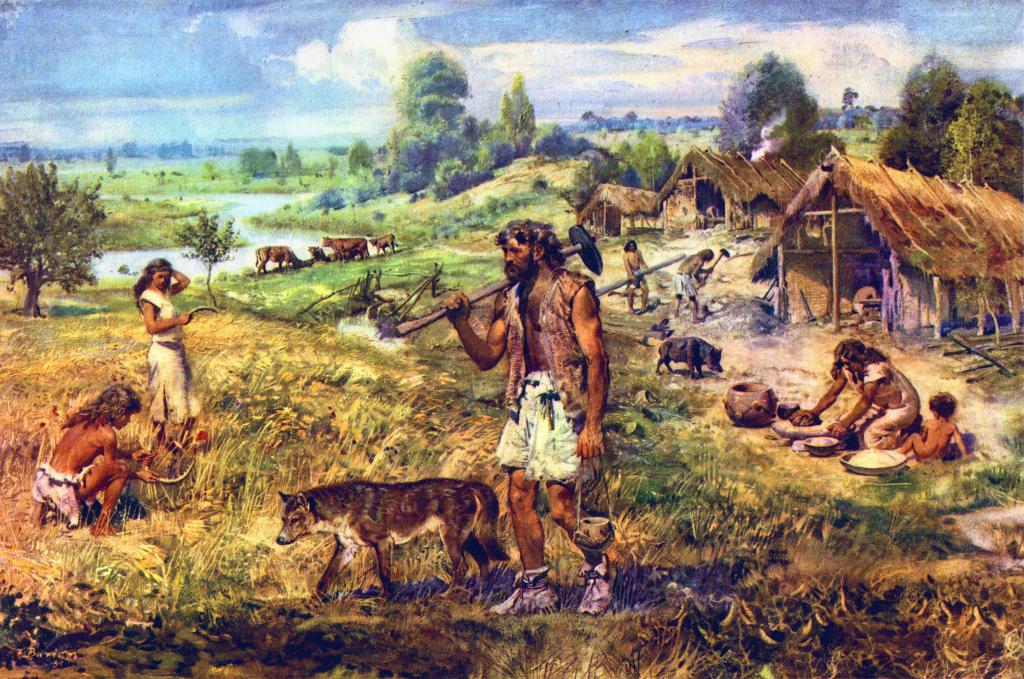
Which feature of a civilization is shown here?
a)
government
b)
job specialization
c)
art & architecture
d)
social classes
14.
What feature was developed as people began to work at different jobs and began to find different levels of respect or different status to different jobs?
a)
Writing systems
b)
Social classes
c)
Job specialization
15.
One of the eight features that help make a civilization organized is a complex ___________.
a)
religion
b)
government
c)
city
16.
What is a group of people living and working together for the purpose of creating an organized society?
a)
society
b)
civilization
c)
country
17.
Where were cities first developed around?
a)
highways
b)
rivers/water
c)
farms
18.
Name the River Valley Civilization shaded in purple on the map
a)
Egypt
b)
Mesopotamia/
Sumer
c)
India
d)
China
19.
Name the River Valley Civilization shaded in orange on the map
a)
Egypt
b)
Mesopotamia/
Sumer
c)
India
d)
China
20.
Name the River Valley Civilization shaded in pink on the map
a)
Egypt
b)
Mesopotamia/
Sumer
c)
India
d)
China
21.
Name the River Valley Civilization shaded in yellow on the map
a)
Egypt
b)
Mesopotamia/
Sumer
c)
India
d)
China
22.
Name the civilization: 
- Nile River
- Hieroglyphics
- Pyramids
a)
Egypt
b)
Mesopotamia/
Sumer
c)
India
d)
China
23.
Name the civilization: 
- Tigris and Euphrates
- Cuneiform
- City-States
a)
Egypt
b)
Mesopotamia/
Sumer
c)
India
d)
China
24.
Name the civilization: 
- Indus River
- Harappa
- Mohenjo Daro
a)
Egypt
b)
Mesopotamia/
Sumer
c)
India
d)
China
25.
Name the civilization: 
- Huang He (Yellow) River
- Calligraphy writing
- Paper and Silk
a)
Egypt
b)
Mesopotamia/
Sumer
c)
India
d)
China
26.
River Valleys provided all the following benefits EXCEPT -
a)
Protection from invaders
b)
Potential severe floods
c)
Water for agriculture
d)
Water for sanitation
27.
Most early religious traditions can be categorized as -
a)
Monotheistic
b)
Polytheistic
c)
Atheistic
d)
Agnostic
28.
Which civilization developed a direct democracy?
a)
China
b)
Greece
c)
India
d)
Rome
29.
Founder of Buddhism
a)
Asoka
b)
Chadragupta
c)
Siddartha
d)
Srigupta
30.
Silk making and eaves are characteristic of this region.
a)
China
b)
Greece
c)
India
d)
Rome
31.
The Qin Dynasty followed the _____________ philosophy.  The Han Dynasty followed the _____________ philosophy.
a)
Confucianism; Daoism
b)
Confucianism; Legalism
c)
Legalism; Daoism
d)
Legalism; Confucianism
32.
Hammurabi’s Code : Ancient Mesopotamia : : ___ : Roman Republic 
a)
Asoka's Edicts
b)
Draco's Laws
c)
Laws of the Twelve Tables
d)
Legalist Code
33.
Persia, India, Greece, and Egypt were united under which empire?
a)
Han
b)
Hellenistic
c)
Qin
d)
Roman
34.
Chandragupta founded which empire?
a)
Gupta
b)
Han
c)
Mauryan
d)
Qin
35.
Greec'e geography led to
a)
Unification between cultures
b)
formation of poleis
c)
different languages in Greece
d)
different religions in Greece
36.
Greece made advancements in ___________ and Rome made advancements in _____________.
a)
Art; Literature
b)
Art; Law
c)
Law; Drama
d)
Law; Sculpture
37.
Who most likely said the following?  "Our form of government favors the many instead of the few; that is why it is called a democracy...  A man may serve his country no matter whet his position on the social scale."
a)
Caesar Augustus
b)
Julius Caesar
c)
Pericles
d)
Plato
38.
Hammurabi's Code, the Ten Commandments, and the Twelve Tables were all significant to their societies because they established
a)
democratic governments
b)
official religions
c)
rules of behavior
d)
economic systems
39.
Once contribution of Classical Roman culture was the development of
a)
the concept of zero
b)
the process of making silk
c)
a republic form of government
d)
the printing press
40.
Which body of water was the center of Roman trade
a)
Red Sea
b)
Mediterranean Sea
c)
Atlantic Ocean
d)
Black Sea
41.
What is the Roman set of Laws similar to Hammurabi's Code and The Ten Commandments?
a)
Justinian's Code
b)
Koran
c)
Roman Twelve Tables
d)
Analects of Confucius
42.
Which technological advancement helped unify the Roman Empire?
a)
astrolabe
b)
road system
c)
gunpowder
d)
wheeled cart
43.
What was the name of the 200 year Golden Age of Classical Rome?
a)
Peace of Italy
b)
Piece of Italy
c)
Pax Romana
d)
Pax Italy
44.

Why were the Chinese able to control the silk trade for centuries?

a)

They bought up all the silk in Asia.

b)

They kept the method to make silk a secret.

c)

The Chinese did not make money on silk.

d)

They told everyone else how to make silk.

45.

Way was the Silk Road important?

a)

It connected the many rivers in China.

b)

It was an important pathway that linked people using trade routes across China to Europe.

c)

It provided a safe route to Japan and Korea.

d)

It was for royalty only.

46.
Which civilization had a direct democracy? 
a)
Athens
b)
Sparta
c)
Rome
d)
Byzantine
47.
Which civilization invented the republic?
a)
Athens
b)
Sparta
c)
Rome
d)
Byzantine
48.
Who was able to vote in Athens?
a)
Male citizens only
b)
All men
c)
Male and female citizens
d)
Everybody
49.
The Twelve Tables were the written laws of
a)
Athens
b)
Sparta
c)
Rome
d)
Byzantine
50.

Why did Diocletian divide the leadership of the Roman Empire?

a)

To increase farming in the empire

b)

to increase the standing army

c)

to make Constantinople Istanbul

d)

to bring order to the empire

51.

In what year did the Roman Empire officially fall?

a)

476 BC

b)

1492

c)

476 AD

d)

1000 AD

52.

What do you call a territory with many groups of people, but only one ruler or form of government?

a)

Dictatorship

b)

Empire

c)

Nation

d)

Kingdom

53.

Who was the emperor that brought stability back to the Empire after the 3rd century crisis, but he divided the Roman Empire into the West and the East?

a)

Constantine

b)

Marcus Aurelius

c)

Titus

d)

Diocletian

54.

What was the name of the Mongol nomadic warriors-- barbarians-- who posed a major threat to Rome after 370 A.D.?

a)

Huns

b)

Celts

c)

Saxons

d)

Jukes

55.
What year did the Roman empire collapse?
a)
350 A.D.
b)
476 A.D. 
c)
200 A.D.
d)
632 A.D. 
56.
When Rome divided it split into?
a)
North and South
b)
Rome and Ancient Rome 
c)
East Rome and West Rome 
d)
Old and New
57.
Rome had enemies attacking their borders in too many places because the empire was too large?
a)
True
b)
False
58.

What was the social structure of the Han Dynasty?

a)

1.Emperor

2.Nobles/ Government officials

3.Farmers, Peasants, ironworkers

4.Merchants, artisans, craftsmen, slaves

b)

1.Emperor

2.Merchants, artisans, craftsmen, slaves

3.Nobels, Government officials

4.Farmers, peasants, iron workers

c)

1.Emperor

2.Nobels/ Government officials

3.Merchants, artisans, craftsmen, slaves

4.Farmers, peasants, iron workers

59.

True or False: The Great Wall existed during the Han Dynasty.

a)

True... the map shows it was partially built.

b)

False... it is not on the map.

60.

TRUE or FALSE: During the Han Dynasty, the teachings of Confucius were nationally honored.

a)

True

b)

False

61.

How did Buddhism get to China?

a)

Wu Di created a new way of thinking and made it a religion.

b)

People traveling on the Silk Road brought the ideas and teachings back to the capital.

c)

The Buddhists invaded and forced the people to believe.

62.

What is this a map of?

a)

Marauder's Map

b)

Silk Road

c)

North America and South America

d)

Christopher Columbus's route

63.

TRUE or FALSE: Traders frequently traveled the entire length of the Silk Road.

a)

True

b)

False

64.

The Han Dynasty is also called the ___________ Age.

a)

Copper

b)

New

c)

Golden

d)

Rotten

65.
Under the first Han emperor, China
a)
had a legalist government
b)
had a government based upon Confucian teachings.
c)
stopped Shi Huangdi's efforts to standardize Chinese life.
d)
began exporting Hatchimals.
66.
The Han civil service helped govern China. To find the best people Emperor Wudi
a)
had them build a pyramid to test their intelligence.
b)
asked them to explore regions to see if they were intelligent enough to create good maps.
c)
gave them money and nice clothes as a reward.
d)
had them take an exam based on the teachings of Confucius.
67.
Who was the First Emperor of China?
a)
Confucius 
b)
Wu Di
c)
Lui Bang
d)
Shi Huangdi
68.
What is Legalism? 
a)
A simple and natural way of life
b)
Leaders must be good and wise for their subjects to be good and wise 
c)
Strong ruler and harsh laws are needed for social order
d)
The Mandate of heaven will provide the answers for the emperor 
69.
Which of the following is an example of censorship under the Qin Dynasty. 
a)
Forcing the Chinese people to follow the same religion 
b)
Dividing the country into 36 provinces 
c)
Debating the government was banned 
d)
Using the same currency across the country 
70.
What did Emperor Shi Huangdi begin to build shortly after taking control? 
a)
The Pyramids 
b)
The Great Wall 
c)
A large standing army 
71.
Why did Shi Huangdi enforce harsh laws 
a)
To keep social order in the Qin Dynasty 
b)
Because it followed Confucian values 
c)
Because it followed Daoist beliefs 
72.
Which Dynasty came directly before the Qin Dynasty?
a)
Shang
b)
Xia
c)
Zhou
d)
Han
73.
The main strength of Han government was
a)
a well organized civil service.
b)
a strong army of good horsemen.
c)
riches from the Silk Road.
d)
the Great Wall of China.
74.

Which action is most closely associated with polytheism?

a)

praying in a synagogue

b)

accepting the Eightfold Path

c)

worshipping many gods

d)

reading the Koran

75.

Believers of Hinduism are expected to

a)

fulfill their dharma for a favorable reincarnation

b)

complete a pilgrimage to Mecca

c)

obey the Ten Commandments

d)

follow the Eightfold Path to achieve enlightenment

76.

Which belief is shared by Hindus and Buddhists?

a)

Everyone should have the same social status.

b)

People should pray five times a day.

c)

The soul can be reincarnated.

d)

Material wealth is a sign of the blessing of the gods.

77.

In the practice of religion, the Ten Commandments are to Christianity as the Eightfold Path is to

a)

Buddhism

b)

Daoism

c)

Islam

d)

Shinto

78.

Which belief system is most closely associated with the terms Eightfold Path, Four Noble Truths, and nirvana?

a)

Buddhism

b)

Christianity

c)

Judaism

d)

Shinto

79.

Which individual developed an Asian philosophy associated with the five relationships, filial piety, and the Analects?

a)

Laozi (Lao Tzu)

b)

Confucius

c)

Han Wudi

d)

Siddhartha Gautama

80.

Which belief system is considered monotheistic?

a)

Judaism

b)

Shinto

c)

Confucianism

d)

Animism

81.

Jewish religious and cultural identity has been greatly influenced by

a)

Ramadan and the concept of reincarnation

b)

The Torah and the Diaspora

c)

The New Testament and the Four Noble Truths

d)

The Koran and the code of bushido

82.

Which statement was true of the caste system in traditional India?

a)

Members of different castes often intermarried.

b)

Caste membership determined a person's occupation.

c)

The highest caste was composed of untouchables.

d)

The caste system had little effect on daily village life.

83.

One way in which the Five Relationships, the Ten Commandments, and the Eightfold Path are similar is that they

a)

promote polytheism

b)

establish gender equality

c)

provide codes of behavior

d)

describe secularism

84.

• Showing respect for parents

• Maintaining family honor

• Honoring all elders

Which term is most closely related to these three actions?

a)

nirvana

b)

animism

c)

filial piety

d)

hadj (hajj)

85.
What word best describes the land of the Greek peninsula?
a)
rocky and mountainous
b)
flat
c)
desert
d)
rolling plains
86.
The ancient Greeks were  
a)
Monotheistic  
b)
Polytheistic
c)
Atheist
d)
Scientologist
87.
During which Age did the Greeks make great advances in art, architecture, medicine, and philosophy?
a)
The Hellenistic Age
b)
The Golden Age
c)
The Peloponnesian Age
d)
The Bronze Age
88.
Which term describes the blending of Greek culture with Persian, Indian, & Egyptian influences?
a)
Classical
b)
Arabesque
c)
Hellenism
d)
Gothic
89.
One of the most famous ancient Greek poets who wrote the Iliad was...
a)
Homer.
b)
Athena.
c)
Sandburg. 
d)
Pericles
90.
Greek has many _________that are like mini countries.
a)
counties
b)
city-states
c)
provinces
d)
parishes
91.
A militaristic city-state where boys were trained from an early age to fight.
a)
Athens
b)
Delphi
c)
Corinth
d)
Sparta
92.
Who was the leader of Athens after the defeat of the Persians and took Athens into a "Golden Age" of prosperity and achievement?
a)
Pericles
b)
Leonidas
c)
Themistocles
d)
Socrates
93.
A city-state which favored democracy and a well-rounded education. 
(Also, the largest city-state by a wide margin)
a)
Sparta
b)
Athens
c)
Delphi
d)
Corinth
94.
What religion did Ashoka turn to that changed the way he ruled the Maurya Empire?
a)
Christianity
b)
Islam
c)
Buddhism
d)
Hindusim
95.
The first emperor of the Mauryan Dynasty was...
a)
Chandragupta
b)
Ashoka
c)
Siddhartha Gautama
d)
Aryan
96.
Ashoka released a series of edicts carved into...
a)
Stone pillars
b)
Wooden pillars
c)
Marble wall
d)
Stone Steps
97.
The Mauryan Empire reached its height under his rule.
a)
pilgrim
b)
Bhagavad Gita
c)
Ashoka
d)
Chandra Gupta
98.
India was the home of which empires?
a)
Tang and Song
b)
Mauryan and Gupta
c)
Roman and Byzantine
d)
Mongol and Russian
99.

A period of great happiness, prosperity, and achievement is known as:

a)

Silver age

b)

Golden age

c)

Bronze age

d)

Good age

100.

What is the Gupta Period known as

a)

the golden age.

b)

the silver age.

c)

the dark age.

d)

the bronze age.

101.
What are the two major rivers of Ancient India?
a)
Tigris & Euphrates
b)
Nile & Blue Nile
c)
Indus & Ganges
d)
Huang He & Yangtze
102.
Which religion was most popular in the Gupta Empire?
a)
Hinduism
b)
Buddhism
c)
Christianity
d)
Jainism
103.

King Ashoka realized the brutality of war and adopted what principles?

a)

Buddhist principles

b)

Hindu principles

c)

Christian principles

d)

Jewish principles
