
 Worksheets
S2 EXAM - 9A World History 2
Total questions: 100
Worksheet time: 51mins
Which country did the Renaissance start in?
England
France
Italy
Germany
Renaissance means
Rebirth
Restart
Reform
Relation
A philosophical way of thinking that celebrates the individual
Humanism
Dogism
Sonnets
Protestant
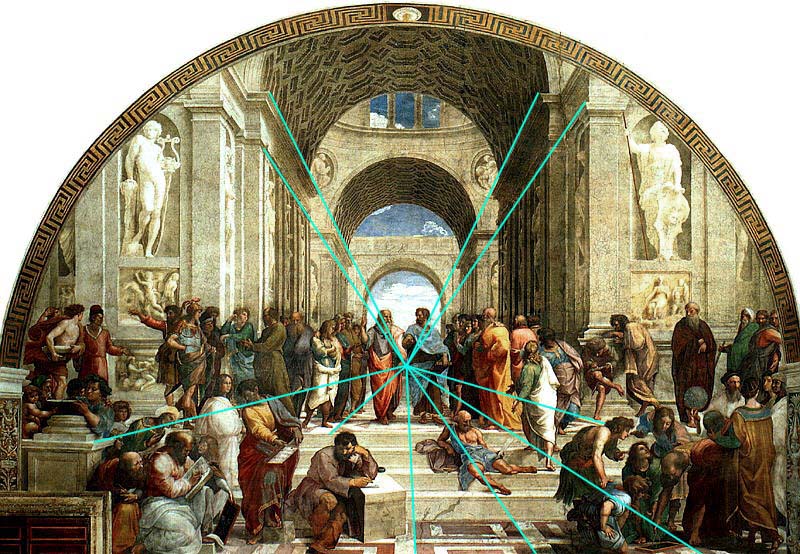
Who was Johann Gutenberg?
the inventor of the telescope
the inventor of the printing press
the founder of the laws of planetary motion
a religious reformer
The movement to change the church during the Renaissance was called?
Counter-Reformation
Counter- Revolution
Revolution
Reformation
If a person was accused of heresy, he/she could be kicked out of the church or ______________________.
ordained
crowned
excommunicated
reformed
Who is Martin Luther?
A baptist minister and social activist
A monk, theologian, and religious reformer
A singer in the catholic church
A racecar driver
What mainly helped Martin Luther spread his teachings?
Word of mouth
Printing press
Food
Paintings
Why did Luther disapprove of indulgences?
He felt the church was not charging enough.
He felt that faith alone was the only path to salvation.
He believed the Pope was corrupt.
all of the these
What was the church's response to Luther's ideas?
Luther was excommunicated.
Luther was sainted.
Luther was stripped of his ministerial vestments.
Luther was put to death.
What language did Martin Luther translate the New Testament to?
German
French
English
Chinese
Why were Copernicus’ proposals about the solar system so unique?
People believed that Earth was the center of the universe.
People believed that the Moon was the center of the universe.
People believed that the Sun was the center of the universe.
People believed that Earth was flat.

The Industrial Revolution is known as the ...
increase in purchases of land by wealthy landowners to cultivate larger fields.
increase in machine-made goods that began in England during the 18th-century.
a widespread use of kids as factory laborers working 14 hour days.
increase in populations of urban areas during the 1800s.
Factories
Hand
Women
Royalty
steel
textiles; cloth products
locomotives
flying shuttles
They moved goods more quickly and less expensively over greater distances.
They were fun to ride on to go visit family in other states.
People could ride on railroads to get to their jobs in another city.
What is the definition of capitalism?
An economic and political system in which a country's trade and industry are controlled by government owners for profit
An economic and political system in which a country's trade and industry are controlled by private owners for profit, rather than by the government
What power source did the first factories run on?
wind power
nuclear power
electricity
water or steam
What 3 factors are needed for production to drive the Industrial Revolution?
Land
Labor
Capital
All of these.
What was the NEGATIVE effect of urbanization of Britain’s population?
Housing was poorly constructed and crime was a persistent problem
The rural population increased and the urban population decreased
Power shortages
Why did children not attend school?
Schools didn't exist.
Schools could not be built in the urban areas.
Kids were forced to beg and work.
Government didn't think school was necessary.
What decreased in the urban areas during the Industrial Revolution?
jobs for workers
England's wealth
living conditions in cities
the production of goods
How did the Industrial Revolution affect cities?
it created technology to clean them
it made them lose valuable sources of food
it made the population grow faster in the cities
it made the crime rate drop
What were the effects of the Railroad?
It caused more factories to go out of business.
It cause farmers to rebel.
It expanded rapidly through Russia.
It fueled other industries like coal, steam engines, iron and steel
What is the name of the voluntary association created to protect workers' rights?
Labor Unions
Labor Strikes
Collective Bargaining
Communism
What system was impacted by the invention and use of the Cotton Gin and Spinning Jenny?
Factory System
Agricultural System
What did England have that led them to be the leader in the Industrial Revolution?
Coal
Iron ore
Abundant water sources
All of the above
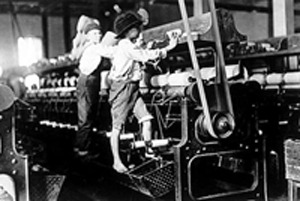
This image represents ...
how machines replaced workers.
how labor unions rose in factories.
how children replaced adults in factories.
how unions pushed for more workers to be hired.
Who invented the light bulb?
Thomas Edison
Henry Ford
Samuel Morse
Alexander Graham Bell
A form of housing for factory workers that was unsanitary with no indoor plumbing.
Boat houses
Mobile home
Tenement
Barns
The Big War
The Bad War
The Great War
The World War
Whose assassination triggered the beginning of WWI?
Ferdinand
Stalin
Hitler
Mussolini
The Zimmerman Telegraph (where Germany promised to help Mexico gain back land from the United States) was the "last straw" and caused the United States to declare war on Germany and enter WW1.
True
False
The Group of nations-originally consisting of Great Britain, France, and Russia, and later joined by the United States, Italy, and others- that opposed the central powers
Axis
Allied powers
Central Powers
League of Nations
Pride in one's nation, promoting it's causes, cultures and interests is called
militarism
nationalism
imperialism
alliances
The belief that a country needs a strong army is called
Imperialism
Militarism
Nationalism
Socialism
What Germans called their submarines
U-Boats
Convoy System
Red Scare
Reparations
The area of ground between two opposing trench forces is called
No Man's Land
Going Over The Top
Total War
Which country had to take full responsibility for WWI, pay war reparations, and lose most of its military?
France
Germany
Austria-Hungary
Serbia
The provision in the Treaty of Versailles in which Germany acknowledged that it alone was responsible for WWI
Reparations
German Responsibility Clause
Nationalism
War Guilt Clause
Which of the following was not a main provision (requirement) of the Treaty of Versailles on Germany?
loss of territory
reparation payments to the Allies
Germany had to apologize in writing to each country
limits on Germany army
1914, 1918
1999, 2003
1900, 1918
How did the military technology of machine guns impact World War 1
It increased casualty rates
More firepower led to a shorter war
More soldiers were required to protect an area of land
Weapons made less noise than in previous wars
How long was the United States in actual combat in WWI?
7 months
2 years
7 years
1 day
Who was the president of the United States during WWI?
Teddy Roosevelt
Franklin Roosevelt
Woodrow Wilson
The German invasion of which nation caused Britain and France to declare war on Germany?
Austria
Belgium
Czechoslovakia
Poland

How are dictators able to rise to power after countries suffer hardships?
People want strong leaders to solve their problems.
Dictators promise freedom.
Dictators allow everyone to vote.
Dictators promise to end fascism.
Which WWII leader became President after FDR passed, wanted to save American lives in the Pacific, and decided to drop the atomic bombs?
Franklin D. Roosevelt
Winston Churchill
Harry S. Truman
Joseph Stalin
The first woman to work in a factory during WWII
A representation of American women that went to work during WWII
An actress used for make-up advertisements
A famous pilot
In which French city did hundreds of civilian boats choose to rescue British and some French soldiers from being pinned by Germany on the beaches?
Paris
Dunkirk
London
Madrid
Where did the attack on Pearl Harbor take place?
Japan
Hawaii
Germay
France
What year did the attack on Pearl Harbor take place?
1942
1941
1949
1939

Who is this?
Hitler
Winston Churchill
King George
Benito Mussolinni
Treaty of Paris
Treaty of Versailles
Giving Germany funds
Democracy
What were the two cities on which atomic bombs were dropped?
Kobe & Osaka
Tokyo & Yokohama
Roswell & Albuquerque
Hiroshima & Nagasaki
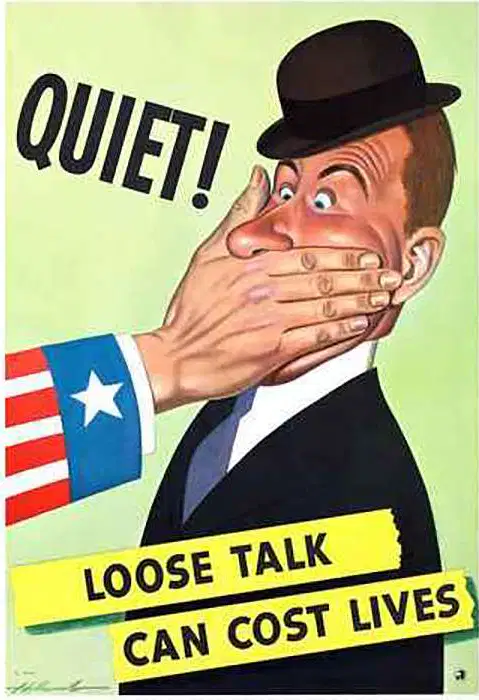
Ideas or information that is designed to spread and influence opinion
propaganda
isolationism
appeasement
super bowl commercials
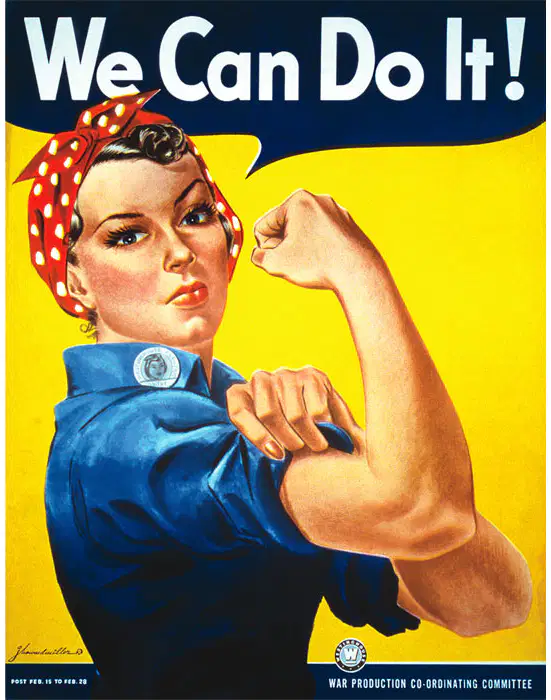
How did the role of women change during World War II?
Women were expected to enlist in the military as soldiers.
Women were needed to start working in jobs that used to belong to men.
Women were expected to run for political office to start negotiating for peace.
Women were expected to leave jobs and start staying home with their children.
Fascism
Communism
Socialism
Democracy
A government where the state has complete control over every part of public and private life
Totalitarianism
Gulag
Communism
Reparations

What was the German war tactic known as "lighting war?"
Panzerkrieg
Silverbulletkrieg
Blitzkreig
None of the above
What was the name of Hitler's secret police, who rooted out all oppositions to his policies?
SA
SS
Einstagruppen
Gestapo
What was the enigma?
The name of the Riddler
Batman's foe
The German code machine
A bomb
To decode, figure out, or solve
propoganda
decipher
incite
trepidation
A secret or disguised way of writing a message; a code.
cipher
decrypt
Vigenere
A method used in WWII telecommunication to encode text characters as standardized sequences of two different signal durations, called "dots" and "dashes"
Morse Code
enigma machine
cryptography
caesar

