wayground logo

Free Printable Worksheets

Font size

S
M
L
XL
Worksheets

Currents, Waves, Tides, and Ocean Zones

Total questions: 90

Worksheet time: 1hrs 6mins

Name
Class
Date
1.
A[n] ______________ tide occurs when the sun is at right angles to the line between Earth and the moon. 
a)
high
b)
neap
c)
low
d)
spring
2.
Differences in the moon's and sun's pull on different sides of the Earth cause _________.
a)
gravity
b)
lunar phases
c)
tides
d)
dabbing
3.
The bulge of water on the side of the Earth closest to the moon produces ___________.
a)
high tide
b)
low tide
c)
neap tide
d)
spring tide
4.
Tides are caused mainly by the differences in how much gravity from the moon and the sun pulls on different parts of the Earth. 
a)
True
b)
False
5.
Changes in the positions of Earth, the moon, and the sun affect the height of high tides during a month. 
a)
True
b)
False
6.
Which body has the greater effect on Earth's tides?
a)
Sun
b)
Saturn
c)
Moon 
d)
Venus
7.

What type of tide would this arrangement of earth-moon-sun create?

a)

full moon tide

b)

new moon tide

c)

neap tide

d)

spring tide

8.
What type of tides would this arrangement of earth-moon-sun create?
a)
neap tide
b)
spring tide
c)
new moon tide
d)
full moon tide
9.
What causes tides?
a)
gravity
b)
wind
c)
spring
d)
neap
10.
How many low tides and high tides happen in a day?
a)
1 low tide, 1 high tide
b)
4 low tides, 4 high tides
c)
3 low tides, 3 high tides
d)
2 low tides, 2 high tides
11.
The Moon has a greater influence on Earth tides than the Sun because...
a)
it is smaller than the Sun
b)
it revolves around the Earth
c)
it is closer to the Earth
12.
Surface currents are a result of
a)
Global Wind Patterns
b)
Earth's Rotation
c)
Density
d)
All of the above
13.

Deep Ocean currents are a result of

a)

Global Wind Patterns

b)

Earth's Rotation

c)

Changes is salinity and temperature (density)

d)

All of the above

14.
The Coriolis Effect is caused by
a)
Earth rotating around the sun
b)
Earth rotating on its axis
c)
The tides
d)
Gravity
15.
The Gulf stream carries _____________ water from the east coast of The United States to the West coast of Europe.
a)
Cold
b)
Warm 
c)
Freezing
d)
Fresh
16.
What happens to a current when it comes in contact with a continent or landmass?
a)
It continues over the continent
b)
It stops
c)
It changes direction
d)
It is absorbed by the land
17.
As you go deeper in the ocean, the water is colder and less salty.
a)
True
b)
False
18.
Due to the Coriolis Effect, water in the northern hemisphere moves
a)
clockwise
b)
counter clockwise
c)
both
d)
neither
19.
Due to the Coriolis Effect, water in the southern hemisphere moves
a)
clockwise
b)
counter-clockwise
c)
both
d)
neither
20.
Warm ocean currents generally come from
a)
The North Pole
b)
The South Pole
c)
The Equator
d)
Both A and B
21.
Cold ocean currents generally come from
a)
The North Pole 
b)
The South Pole
c)
The Equator
d)
Both A and B
22.

The California Current (west coast) carries _________ water south from Canada.

a)

Cold

b)

Warm

c)

Freezing

d)

Fresh

23.

Two types of water currents are

a)

local and global

b)

sea and land

c)

surface and deep

d)

warm and cold

24.
Ocean currents have an affect on which two things
a)
climate and weather
b)
temperature and density
c)
land and sea
d)
equator and poles
25.
A strong surface current that runs along the east coast of the United States and carries warm water to Europe.
a)
California Current
b)
Global Conveyor Belt
c)
Gulf Stream
d)
Surface Current
26.
A cool current in the Pacific Ocean near North America that brings cold water down from Canada.
a)
California Current
b)
Global Conveyor Belt
c)
Gulf Stream
d)
Surface Current
27.
Constantly moving system of deep-ocean circulation driven by temperature and salinity. It moves water around the globe.
a)
California Current
b)
Global Conveyor Belt
c)
Surface Currents
d)
Gulf Stream
28.
A horizontal movement of ocean water that is caused by wind and that occurs at or near the ocean's surface.
a)
Gulf Stream
b)
Global Conveyor Belt
c)
Surface Current
d)
Gyre
29.

What process brings the deep cold ocean currents up to the surface (at the equator) and warm water to the bottom (at the poles)?

a)

Conduction

b)

Global Wind Patterns

c)

Deep water currents (convection)

d)

Temperature and salinity

30.
What name is given to large, destructive waves caused by underwater earthquakes and volcanoes?
a)
Spring tide
b)
Longshore current
c)
Tsunami
d)
Swell
31.

Surface Currents affect the climate of the land near which they flow.

a)

True

b)

False

32.

Surface currents greatly affect the climate in many parts of the world.

a)

True

b)

False

33.
A horizontal movement of ocean water that is caused by wind and that occurs at or near the ocean's surface.
a)
Gulf Stream
b)
Global Conveyor Belt
c)
Surface Current
d)
Gyre
34.
Deep-ocean currents are driven by 
a)
differences in soil
b)
differences in the water’s density,
c)
differences in nutrients 
d)
None of the Above
35.
The Gulf Stream is a ______ current that carries water from the ______ to the North Atlantic Ocean.
a)
cold, Tropics
b)
warm, Tropics
c)
cold, Mexico
d)
warm, South America
36.
The Earth's greatest source of energy comes from the _________.
a)
precipitation
b)
rotation of its axis
c)
Sun
d)
oceans currents
37.
What causes surface waves?
a)
underwater volcanoes
b)
earthquakes
c)
wind
d)
landslides
38.
Many people believe that ocean waves move water.  However, ocean waves really transfer ______.
a)
wind
b)
sand
c)
energy
d)
pressure
39.

Which direction do ocean waves move?

a)

back and forth

b)

up and down

c)

in a side-to-side motion

d)

in a circular motion

40.
What is a trough?
a)
highest point on a wave
b)
lowest point on a wave
c)
longest point on a wave
d)
shortest point on a wave
41.
Which of the following is not a cause of a tsunami? 
a)
Volcanic eruption
b)
Tornado
c)
Underwater earthquakes
d)
Landslide
42.
Stronger winds create __________ waves.
a)
larger
b)
smaller
43.
A wave can make a leaf bob up and down on the water, but it cannot move the leaf toward the shore. This is because waves only transfer ________
a)
A. matter  
b)
B. energy  
c)
C. media 
d)
D. crests
44.
What is the periodic rise and fall of the water level in the oceans?
a)
Tide
b)
Tidal range
c)
Spring Tide
d)
Neap Tide
45.
What is the increased tide that occurs two times in a month at the new and full moons?
a)
Tidal range
b)
Spring Tide
c)
Neap Tide
d)
Tide
46.
What is a tide of minimum range that occurs during the 1st and 3rd quarters of the moon?
a)
Tide
b)
Tidal range
c)
Spring tide
d)
Neap tide
47.

Is the ocean ever still?

a)

Yes

b)

No

48.
How do most surface waves form?
a)
Winds blow acorss the surface of the water and give their energy to the water.
b)
Lightning hits the water and makes the water move.
49.
Which is more dense?
a)
Cold Water
b)
Hot Water
50.
In what zone does approximately 90% of all ocean life live?
a)
sunlight
b)
twilight
c)
midnight
51.
As oceans become deeper, the water pressure ___________________.
a)
increases
b)
decreases
c)
stays the same
52.

Which layer of the ocean starts at 200 meters and extends to 1000 meters?

a)

sunlight

b)

twilight

c)

midnight

53.
90% of the ocean belongs in this ocean layer.  What is it?
a)
sunlight
b)
twilight
c)
midnight
54.

Humans can only explore the midnight zone with the help of ________________.

a)

scuba gear

b)

the federal government

c)

submersible vehicles

d)

Michael Jordan

55.
Which zone has the warmest water temperature?
a)
sunlight
b)
twilight
c)
midnight
56.
Which zone is completely dark and near freezing in temperature?
a)
sunlight
b)
twilight
c)
midnight
57.
The ocean layers are divided by the amount of __________________ in each layer.
a)
animals
b)
salt
c)
light
d)
people
58.
There’s very little life, immense pressure and absolutely no sunlight in this zone.  Name it.
a)
sunlight
b)
twilight
c)
midnight
59.
As you move deeper into the water temperature, pressure and salt content change.
a)
true
b)
false
60.
Sunlight allows ________________ to occur in the sunlight zone.
a)
bioluminesence
b)
transpiration
c)
photosynthesis
d)
voting
61.
Coral reefs are found on...
a)
continental slopes
b)
continental shelves
c)
abyssal plains
d)
trenches
62.

This sea turtle mainly eats sea grass and other ocean plants. Which ocean zone would most likely be its habitat?

a)

Midnight Zone

b)

Twilight Zone

c)

Sunlight Zone

63.

Which ocean zone has organisms well adapted for very low temperatures and little light?

a)

Sunlight Zone

b)

Twilight Zone

c)

Midnight Zone

64.

An animal that has adapted to medium pressure, less light, medium salinity, and colder temperatures would be found in which zone?

a)

Sunlight

b)

Twilight

c)

Midnight

65.

An animal that has adapted to survive in the most pressure, no light, the highest salinity, and the coldest temperatures would be found in which zone?

a)

Sunlight

b)

Twilight

c)

Midnight

66.

An animal that has adapted to survive in the most sunlight, the least pressure, the lowest salinity, and the warmest temperatures is found in which zone?

a)

Sunlight

b)

Twilight

c)

Midnight

67.

Which of the following statements are true? (Select ALL that apply)

a)

Saltwater is more dense that freshwater

b)

Freshwater is more dense than saltwater

c)

Freshwater layers below freshwater because water (H20) has more mass than salt (NaCl)

d)

Saltwater layers below freshwater because the salt molecule (NaCl) has more mass than the water molecule (H20)

68.
The salt that is in your salt shaker is the same salt that is in our oceans?
a)
true
b)
false
69.
What happens to pressure as you go deeper into the ocean? 
a)
increases
b)
decreases
c)
stays the same
d)
doubles
70.
In addition to salinity, what factor affects the density of seawater?
a)
depth
b)
latitude
c)
temperature
d)
salt content
71.
What is the scientific name for salt? 
a)
Sodium Acetate 
b)
Sodium Chloride 
c)
Chloride sodium 
d)
Hydroxide sulfate 
72.
As we go deeper into the ocean, salinity ___________. 
a)
Doubles
b)
Decreases 
c)
Increases
d)
Remains the same 
73.
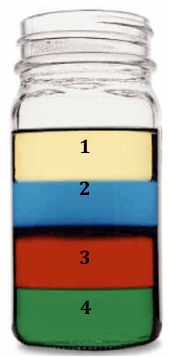
Put the liquids in order from most dense to least dense?
a)
4, 3, 2, 1
b)
1, 2, 3, 4
c)
3, 4, 2, 1, 
d)
4, 3, 1, 2
74.
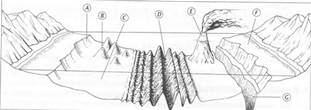
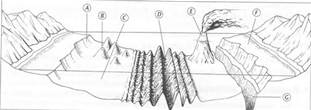
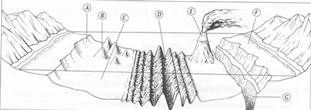
What is letter D?
a)
Cont. Shelf
b)
Mid-Ocean Ridge
c)
Volcanic Island
d)
Seamount
75.
What is letter G?
a)
Mid-Ocean Ridge
b)
Rift
c)
Trench
d)
Cont. Shelf
76.
The shallowest(least deep) part of the ocean is the ____________________
a)
trench
b)
abyssal plain
c)
continental shelf
d)
continental slope
77.
What is letter C?
a)
Mid-Ocean Ridge
b)
Cont. Shelf
c)
Cont. Slope
d)
Abyssal Plain
78.
As you go deeper in the ocean, the water is warmer and less salty.
a)
True
b)
False
79.

Increased evaporation of ocean water will result in...

a)

decreased salinity

b)

Increased temperature

c)

Increased salinity

d)

snow days

80.
Which process does NOT lead to a decrease in the salinity of water?
a)
runoff from land
b)
precipitation
c)
sea ice melting
d)
evaporation
81.
In addition to salinity, what factor affects the density of seawater?
a)
depth
b)
latitude
c)
temperature
d)
salt content
82.
Which process increases the salinity of water?
a)
runoff from land
b)
formation of sea ice
c)
precipitation
d)
melting of sea ice
83.
The high salinity of the Mediterranean Sea is due primarily to —
a)
Precipitation
b)
Deposition
c)
Volcanoes
d)
Evaporation
84.
Seawater is typically denser than freshwater due to seawater’s —
a)
Greater depth
b)
Lower freezing point
c)
Smaller mass
d)
Higher salinity
85.
Why is the ice shelf floating?
a)
The ocean water is
filled with vegetation
that keeps
the ice from sinking. 
b)
The ice is melting faster than it can sink
c)
The ice is warmer than the ocean water
d)
The ice is less dense than the ocean water.
86.

The more scientific name of the Global Conveyor Belt is _____.

a)

halinethermal circulation

b)

thermohaline circulation

c)

thermodensity circulation

87.
What increases as you get deeper into the ocean?
a)
Temperature
b)
Pressure
c)
Sunlight
d)
Marine life 
88.
What 2 things decrease as you go deeper into the ocean?
a)
Temperature/ Sunlight 
b)
Pressure/ Marine life 
c)
Sunlight/ Pressure
d)
Temperature/ Pressure 
89.
What 3 things cause currents?
a)
wind patterns, temperature, and salinity
b)
temperature, sediment, sun
c)
waves, the moon, sediment
d)
shallow water, temperature, and salinity
90.

Where would you find the lowest levels of salinity?

a)

Where the gulf stream meets Europe

b)

Where a river meets the ocean

c)

Where the ocean trench forms

d)

In a brine pool