wayground logo

Free Printable Worksheets

NEW

Font size

S
M
L
XL
Worksheets

DNA/ RNA Test REview

Total questions: 41

Worksheet time: 1hrs 9mins

Name
Class
Date
1.
Are all mutations bad?
a)
Yes
b)
No
2.
In a molecule of double-stranded DNA, the amount of Adenine present is always equal to the amount of
a)
cytosine
b)
guanine
c)
thymine
d)
uracil
3.
Any change in the sequence of DNA is...
a)
transgenic shift
b)
Single Genotype
c)
Monohybrid Trait
d)
Mutation
4.
Which organelle is DNA usually found in?
a)
cell membrane
b)
vacuole
c)
chloroplast
d)
nucleus
5.
What is a codon?
a)
It is a three letter section of bases that are read by ribosomes to stamp amino acids into a protein
b)
They are the codes on the DNA (hence "code-on"
c)
It is a type of mutation that occurs when there has been a substitution, deletion or insertion.
d)
It is a made up word for this quiz. Nice try, Wampler.
6.
What are the building blocks of proteins called?
a)
DNA
b)
RNA
c)
Ribosomes
d)
Amino Acids
7.
In DNA, Adenine bonds with ______________.
a)
Guanine
b)
Thymine
c)
Cytosine
d)
Adenine
8.
What is the central dogma of biology?
a)
Proteins are made from RNA that assembles amino acids through DNA ribosomes.
b)
RNA copies all information for an organism onto DNA which assembles ribosomes, and creates amino acids from proteins
c)
DNA is the blueprint for an organism. RNA copies specific sections that need to be built and transfers that information to a ribosome which assembles proteins out of amino acids.
d)
RNA is the blueprint for an organism. It copies its information onto DNA, which takes amino acids (like lego building blocks) and assembles those acids into proteins.
9.

Which choice describes DNA after replication has taken place?

a)

one molecule with two original strands and one molecule with two new strands

b)

two molecules, each with one original and one new strand

c)

two molecules, each with two new strands

d)

two molecules, each with two old strands

10.

At what point in the cell cycle does DNA replication occur and why?

a)

before a cell divides, to provide each of the two resulting cells with a complete set of DNA instructions

b)

before a cell divides, to ensure that the DNA will fit into the resulting cells

c)

during cell division, to ensure that the DNA will fit into the resulting cells

d)

after a cell divides, to provide each of the two resulting cells with a complete set of DNA instructions

11.

Four different segments of a DNA molecule are represented above.


There is an error in the DNA in which molecule?

a)

segment 1 only

b)

segment 3 only

c)

segment 2 and 3

d)

segment 3 and 4

12.

The sequence of DNA below is part of a gene. How many amino acids are coded for by this segment?

5' ATCAGCGCTGGC 3'

a)

4

b)

8

c)

12

d)

20

13.

A scientist puts nucleotide chains of UUUUUU in a test tube under conditions allowing protein synthesis. Soon the test tube is full of polypeptide chains composed only one the amino acid phenylalanine. What does this experiment indicate?

a)

The amino acid phenylalanine is composed of uracil.

b)

UUU codes for the amino acid phenylalanine.

c)

Protein synthesis malfunctions in test tubes.

d)

Most proteins contain only one type of amino acid.

14.

Which of the following would most likely cause a mutation?

a)

the placement of ribosomes on the endoplasmic reticulum

b)

the insertion of a nucleotide into DNA

c)

the movement of transfer RNA out of the nucleus

d)

the release of messenger RNA from DNA

15.

A diagram of a cellular process is shown above.


Which of the following identifies the process shown at point Z?

a)

translation

b)

translocation

c)

replication

d)

transcription

16.

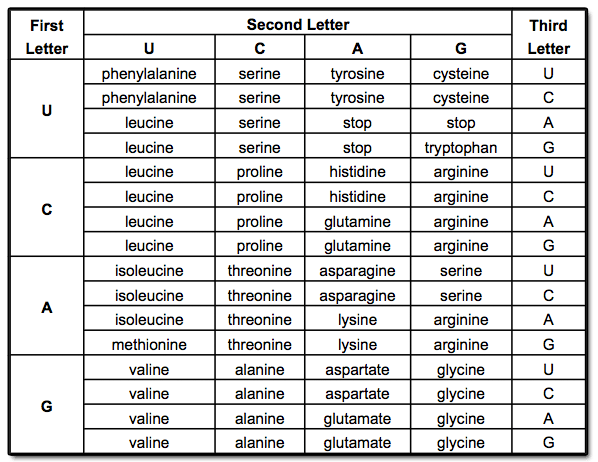
During transcription the DNA base sequence is transcribed into a complimentary mRNA sequence. A codon table like the one shown below lists the amino acids coded for by particular triads of mRNA bases. A segment of DNA has undergone a mutation in which one nucleotide has been changed. The original sequence was ACG and the new sequence is ACA. Use the codon table to determine whether or not this mutation will cause a change in the phenotype of the organism.

a)

yes, the phenotype of the organism would change because a new amino acid will be coded for.

b)

yes, the phenotype of the organism would change because any change in the DNA sequence will cause a change in phenotype.

c)

Even though the DNA sequence changed, the sequence still codes for the same amino acid, so no change in phenotype will occur.

d)

It is impossible to determine if a change in phenotype will occur using only the DNA sequence.

17.

Which of the following carries amino acids to the site of protein synthesis?

a)

mRNA

b)

rRNa

c)

tRNA

d)

nRNA

18.
Which of the following accurately describes the difference between transcription and translation?
a)
In transcription, the genetic code of a DNA molecule is first encoded. Translation is the process of converting the DNA code into code that RNA can use.
b)
In transcription, an amino acid chain is encoded in a DNA molecule. Translation is the process of turning the amino acids into nucleic acids in an RNA molecule.
c)
In transcription, the genetic code of a DNA molecule is transferred to a messenger RNA molecule. Translation is the process of creating an amino acid chain using the encoded messenger RNA.
d)
In transcription, a double helix DNA molecule is split into two separate single strands. Translation is the process of joining each single DNA strand with a single strand of matching RNA
19.
Which statement correctly describes the difference between DNA transcription and DNA replication?
a)
DNA replication results in a single-stranded RNA molecule, while DNA transcription results in two copies of a double helix of DNA.
b)
DNA replication results in two copies of a double helix of DNA, while DNA transcription results in a single-stranded RNA molecule.
c)
DNA replication results in a single copy of a double helix of DNA, while DNA transcription results in two copies of a single-stranded RNA molecule.
d)
DNA replication results in two copies of a single-stranded RNA molecule, while DNA transcription results in a single copy of a double helix of DNA.
20.
In DNA replication, complementary base pairing occurs between ___.
a)
Cytosine and uracil 
b)
Adenine and guanine
c)
Adenine and uracil
d)
Adenine and thymine
21.
 Which sequence depicts the correct order of protein synthesis within a cell? 
a)
DNA → mRNA → amino acids → proteins
b)
DNA → amino acids → mRNA → proteins
c)
 DNA → mRNA → proteins → amino acids
d)
DNA → proteins → amino acids → mRNA
22.
The intersection of the left, top, and right nitrogenous bases indicates which amino acid a mRNA codon represents.  This is true for all organisms.  This indicates that the ___.
a)
The genetic code is universal. 
b)
We, as organisms, differ only in our sequence of bases
c)
The genetic code determines the sequence of amino acids making up a protein 
d)
 All of the above
23.

What did Avery conclude at the end of his experiment?

a)

DNA is the macromolecule responsible for transferring genetic information.
b)

Avery did not conclude anything new.

c)

Mice are not reliable sources for experiment.

d)

Protein is the macromolecule responsible for transferring genetic information.
24.
Why is DNA important?
a)
it is very small and very complicated
b)
it's in everything
c)
it serves as the blueprint for traits of all living things
d)
because we eat it every day for energy
25.
What determines the code, or information, of a DNA molecule?
a)
the shape (structure) of the nitrogen bases
b)
the order (sequence) of the nitrogen bases
c)
the color of the nitrogen bases
d)
the frequency (number) of nitrogen bases
26.
In the early 1900s, most scientists thought it was _____________ that carried traits form parent to offspring. 
a)
Carbohydrates
b)
Lipids
c)
Proteins
d)
DNA
27.
Discovered that A=T and C=G
a)
Griffith
b)
Chargraff
c)
Hershey & Chase
d)
Watson & Crick
28.
What two molecules make up the 'backbone' of DNA?
a)
Adenine and thymine
b)
Phosphate and sugar
c)
Cytosine and guanine
d)
phosphate and guanine
29.
Watson and Crick were the first to suggest that DNA is _____
a)
a short molecule
b)
the shape of a double helix
c)
a protein molecule
d)
the genetic material
30.
Which of the following units are repeatedly joined together to form a strand of DNA? (This is the MONOMER of DNA.) 
a)
amino acids
b)
nucleotides
c)
fatty acids
d)
polysaccharides
31.

Which enzyme is responsible for adding nucleotides to DNA during replication?

a)

Topoisomerase

b)

DNA Polymerase

c)

Ligase

d)

Primase

32.
The enzyme that unzips the DNA to prepare for replication
a)
helicase
b)
replicase
c)
polymerase
d)
synthase
33.
Which of the following describes RNA?
a)
RNA is usually double-stranded and contains the base thymine
b)
RNA is usually single-stranded and contains the base uracil
c)
RNA is longer than DNA and uses five bases to encode information
d)
RNA is made in the nucleus of eukaryotic cells and stays there to carry out its functions
34.

I am a message that is translated to form a protein

a)

mRNA

b)

rRNA

c)

tRNA

d)

hRNA

35.

Brings amino acids to help make the growing protein

a)

mRNA

b)

rRNA

c)

tRNA

36.
What is the correct amino acid sequence for the mRNA code AUGCCAGUAUGA
a)
Met-Pro-Ala-Val
b)
Met-Pro-Val
c)
Tyr-Gly-His
d)
Tyr-Gly-Arg-His
37.
If a mutation occurs in a body cell, will the trait be passed onto the organism's offspring?
a)
No, the trait is in a somatic cell
b)
Yes, the trait is in a somatic cell
c)
No, the trait must be in a sex cell
d)
Yes, the trait is in a sex cell
38.
A type of substitution in which no  amino acids change is called 
a)
Missense
b)
Nonsense
c)
Silent
d)
Deletion
39.
What mutation has occurred here? 
T-G-A-C-C-A
T-G-A-G-C-A
a)
Substitution
b)
Deletion
c)
Insertion
d)
Frameshift 
40.
Why are insertion and deletion (frameshift) mutations so harmful?
a)
They change all of the codons from the mutation on down the line, which changes the amino acid sequence
b)
They insert things that an organism doesn't need.
c)
They often delete things that organisms need.
d)
Insertion and deletions are not any more harmful than substitution mutations.
41.
Using the codon chart here or at your table to identify the amino acid sequence:
AUG-CCA-GUA-GGG-UAA
a)
MET-HIS-ALA-GLY-STOP
b)
MET-PRO-GLY-VAL-STOP
c)
MET-PRO-VAL-GLY-STOP
d)
MET-THR-SER-ASP-STOP