Wayground logo

Free Printable Worksheets

Font size

S
M
L
XL
Worksheets

Unit 7: Evolution

Total questions: 26

Worksheet time: 58mins

Name
Class
Date
1.

What word describes an inherited trait that helps an organism survive in its environment?

a)

natural selection

b)

mutation

c)

camouflage

d)

adaptation

2.

Why do frogs and other organisms reproduce so many eggs or offspring?

a)

so that their babies can have friends to play with

b)

the more offspring the more likely it is that some of the offspring will survive

c)

the more offspring the less likely it is that some of the offspring will survive

d)

the more offspring the less competition

3.
Almost all adaptations started off as?
a)
selective breeding
b)
physiological
c)
structural
d)
mutation
4.
Which of the following means "genetic change over time"
a)
natural selection
b)
speciation
c)
evolution
d)
fitness
5.

What word describes the process that causes beneficial genetic mutations to survive in a species and become adaptations?

a)

natural selection

b)

adaptation

c)

mutation

d)

genetic engineering

6.
Two organisms that are closely related would have:
a)
completely different DNA sequences
b)
exactly the same DNA sequence
c)
no proteins in common
d)
very similar DNA sequences
7.
Scientists think that dolphins and whales may have evolved from a common ancestor.  What evidence supports this hypothesis?
a)
They swim the same way.
b)
They live in the same area of the ocean.
c)
They have similar anatomies.
d)
They eat the same food.
8.
A structure that seems to serve no purpose in an organism is called:
a)
dichotomous
b)
vestigal
c)
homologous
d)
fossilized
9.
A characteristic that can be passed on from parent to offspring through genes is called a:
a)
resistance.
b)
genetic change.
c)
trait.
d)
selective breeding.
10.
Structures with the same parts but have different functions and suggests that organisms share a common ancestry are:
a)
vestigial structures.
b)
homologous structures.
c)
fossils.
d)
adaptive radiation.
11.
This image shows the development of various organisms and how they share a common ancestor because of similarities in development.  It is called:
a)
natural selection.
b)
speciation.
c)
evolution.
d)
embryology.
12.
Which evidence of common ancestry is being studied in this visual?
a)
biogeography
b)
fossil record
c)
anatomical homology
d)
molecular homology
13.
Which evidence of common ancestry is being studied in this visual?
a)
biogeography
b)
fossil record
c)
anatomical homology
14.
The similarities among early stages of the embryos provide evidence that -
a)
these organisms evolved from a common ancestor
b)
the organisms all retained their gills and tails
c)
the organisms belong to the same species
15.
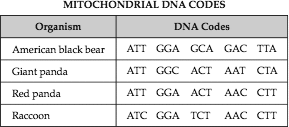
What conclusions can be made based on this table shown?
a)
the American black bear and the giant panda are most closely related
b)
the giant panda and the red panda are most closely related
c)
the red panda and the racoon are the most closely related
16.
The picture shows the members of the Camelidae family. The physical features and the geographical origin of these animals provide evidence that - 
a)
they live in the same type of environment.
b)
have slowly evolved to become herbivores.
c)
have a common ancestor.
d)
exchanged DNA in the past.
17.
In a population of ladybugs, black bugs are more successful in escaping predators. Overtime, this gene becomes more popular in the population and the ladybug population loses its red color.  
a)
Natural Selection
b)
Mutation
c)
Genetic Drift
d)
Gene Flow
18.
 A lion gets chased off from his pride, then joins another pride. He mates with a lioness and make 6 lion cubs.
a)
Natural Selection
b)
Mutation
c)
Genetic Drift
d)
Gene Flow
19.
 A hurricane wipes out half the population of blue jays in Cape Hatteras, North Carolina.
a)
Natural Selection
b)
Mutation
c)
Genetic Drift
d)
Gene Flow
20.
Ten years ago, in a small population of ducks, two sizes of eyes were observed, large and small. Three ducks have large eyes and 7 have small.  2 of the large-eyed ducks are randomly hit by cars and killed. Today, no large-eyed ducks are present in the population.
a)
Natural Selection
b)
Mutation
c)
Genetic Drift
d)
Gene Flow
21.
 A population of flowers on one side of a river transports pollen to the flowers on the other side of the river, producing offspring.
a)
Natural Selection
b)
Mutation
c)
Genetic Drift
d)
Gene Flow
22.

A few deer wander out of their native woods into a completely new park where no deer had ever been before. They go on to create an entirely new population.

a)

Founder Effect

b)

Natural Selection

c)

Non-random mating

d)

Mutation

23.

There was once a large population of cheetah, but about 12,000 years ago most of the cheetahs were killed off because of human activity and only a few survived. What is this an example of?

a)

Bottleneck Effect

b)

Gene Flow

c)

Founder Effect

d)

Natural Selection

24.
Which of the following is true of genetic drift?
a)
It can decrease genetic diversity in a population
b)
It is necessary in order for a population to be in equilibrium
c)
It can increase genetic diversity in a population 
d)
It plays a much larger role in determining the genetic makeup of populations than natural selection 
25.
This mechanism of evolution occurs when populations migrate.
a)
Extinction
b)
Gene flow
c)
Genetic drift
d)
Natural Selection
26.
When individuals move in or out of a population.
a)
Gene Flow
b)
Genetic Drift
c)
Mutation
d)
Natural Selection