wayground logo

Free Printable Worksheets

NEW

Font size

S
M
L
XL
Worksheets

Chapter Twenty

Total questions: 53

Worksheet time: 41mins

Name
Class
Date
1.
Day and night is caused by the _____________ of earth on its axis.
a)
revolution
b)
orbit
c)
rotation
2.
The spinning of an object on its axis is called______
a)
orbit
b)
rotation
c)
revolution
d)
tide
3.
What are the reasons for the seasons?
a)
Earth's tilt and rotation.
b)
Earth's rotation and revolution.
c)
Earth's tilt and revolution.
d)
Earth's tilt and resolution
4.
When the Northern Hemisphere of Earth is Leaning away from the Sun, What season is the Southern Hemisphere experiencing?
a)
Summer
b)
Winter
c)
Spring
d)
Fall
5.
How long does it take the Earth to make one REVOLUTION around the Sun?
a)
12 hours
b)
24 hours
c)
365 days
d)
29.5 days
6.
The motion of one object around another object
a)
rotation
b)
revolution
7.
Takes about 24 hours to complete one
a)
rotation
b)
revolution
8.
At position A, which hemisphere would have summer?
a)
Northern hemisphere
b)
Southern hemisphere
9.
The term equinox means....
a)
equal amount of day light and equal amount of night
b)
Equal amount of winter and summer
c)
Equal amounts of hot dogs for everyone
d)
The longest day of the year
10.
What is the longest day of the year?
a)
winter solstice
b)
summer solstice
c)
fall equinox
d)
spring equinox
11.
Why is the Equator warmest?
a)
Because it is closest to the sun.
b)
Because it receives the most direct sunlight
c)
Because no clouds form here.
d)
Because it is far from the sun
12.
Which season is taking place in the Northern Hemisphere in Position 4?
a)
Winter
b)
Spring
c)
Summer
d)
Fall
13.
Why do globes lean sideways?
a)
To allow them to spin easier.
b)
To demonstrate the tilt of Earth's axis.
c)
To demonstrate the effects of gravity.
d)
To demonstrate day and night.
14.
Objects in the sky appear to move from _______ to _______.
a)
East to West
b)
West to East
c)
North to South
d)
South to North
15.
Objects appear to move from east to west because Earth turns from _______ to ________.
a)
East to West.
b)
West to East.
c)
North to South.
d)
South to North.
16.
What is the darkest inner part of the shadow cone called, where a total eclipse can be viewed.
a)
Total
b)
Umbra
c)
Penumbra
17.
What is the larger outer lighter part of the shadow cone called, where a partial eclipse can be viewed?
a)
Partial
b)
Umbra
c)
Penumbra
18.
In order to have an eclipse, the Moon, Sun and Earth have to be?
a)
Below each other
b)
Above each other
c)
In alignment
19.
A lunar eclipse can occur only during the _________________.
a)
Full moon
b)
New moon
c)
Waxing moon
20.
A solar eclipse can occur only during the _________________.
a)
Full moon
b)
New moon
c)
Quarter moon
21.
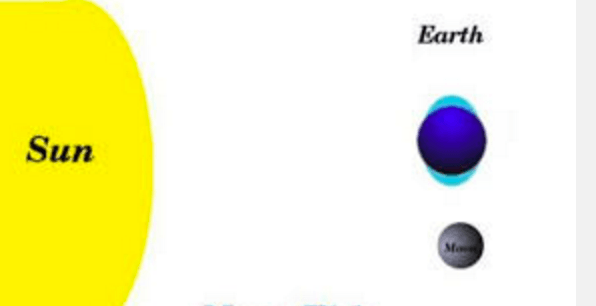
Which type of eclipse occurs when the Moon comes directly between Earth and the Sun?
a)
Lunar eclipse
b)
Solar eclipse
22.
Which type of eclipse occurs when the Earth comes directly between the Sun and Moon?
a)
Lunar eclipse
b)
Solar eclipse
23.
Most places on Earth experience about how many high and low tides in 24 hours?
a)
2 high and 2 low tides
b)
4 high and 4 low tides
c)
1 high and 1 low tides
24.
What type of tide occurs during a new and full moon?
a)
Neap tides
b)
Spring tides
c)
Normal tides
25.
What type of tide occurs during the first or third quarter moon?
a)
Neap tides
b)
Spring tides
c)
Normal tides
26.
If the Sun, Earth, and Moon create a 90 degree angle, the Earth would have __________.
a)
Spring tides
b)
Neap tides
c)
Normal tides
27.
How many moons does earth have
a)
2
b)
5
c)
9
d)
1
28.

It takes the earth 365 1/4 days to go around the sun. What do we do with the 1/4 day?

a)

we ignore it

b)

it gives us daylight savings time

c)

it gives us leap years

29.
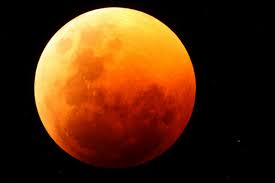
This image is an example of 
a)
Lunar Eclipse
b)
New Moon
c)
Solar Eclipse
d)
Full Moon
30.

Which image represents the sun's position during the June Solstice in the Northern Hemisphere?

a)

A

b)

B

c)

C

d)

D

31.

True/False The Big Bang Theory is the scientific explanation for the formation of Earth's Moon.

a)

True

b)

False

32.
What is the difference between a gibbous moon and a crescent moon?
a)
The gibbous shows more than half of the bright side of the moon.
b)
The crescent shows more than half of the bright side of the moon.
c)
The gibbous shows less than half of the bright side of the moon. 
33.
As the moon's shape appears to get smaller, we say that the moon is _.
a)
swelling
b)
waxing
c)
waning
d)
disappearing
34.
Phases of the moon in which the moon appears to be getting larger are referred to as _.
a)
waxing
b)
waning
c)
new
d)
eclipse
35.
Approximately how much time passes between the new moon and full moon?
a)
one month
b)
two weeks
c)
3 days
d)
24 hours
36.
The phase of the moon that occurs between the sun and Earth
a)
Full moon
b)
Waxing crescent
c)
Waning Crescent
d)
New Moon
37.
What is the correct order of the moon phases?
a)
new, full, 1st quarter, 3rd quarter
b)
new moon, 1st quarter, full moon, 3rd quarter
c)
1st quarter, 3rd quarter, new moon, full moon
d)
new, 1st quarter, 3rd quarter, full
38.
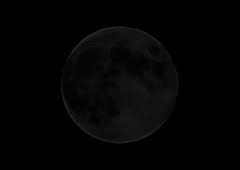
Name the moon phase
a)
First Quarter
b)
Last Quarter
c)
New Moon
d)
Full Moon
39.
Which moon phase is shown in this diagram?
a)
new moon
b)
1st quarter
c)
full moon
d)
last quarter/3rd quarter
40.
What phase is this?
a)
Full Moon
b)
First Quarter Moon
c)
Last Quarter Moon
d)
New Moon
41.
What is illuminating the Moon?
a)
Nuclear Fusion
b)
Sunlight
c)
Mirrors
d)
Flood Lights
42.

What process provides the energy that lights the Sun

a)

Nuclear Fission

b)

Nuclear Fusion

c)

Hamsters

43.

What moon feature is this?

a)

highlands (mountains)

b)

crater

c)

maria

44.

What moon feature is this?

a)

highlands (mountains)

b)

crater

c)

maria

45.

The moon has its own light.

a)

True

b)

False

46.
Why do we always see the same side of the moon from Earth?
a)
because the phases change
b)
because it rotates and revolves at the same rate
c)
because half of the moon always receives sunlight
d)
The moon changes positions
47.

A large flat, dark area on the moon's surface.

a)

rille

b)

crater

c)

maria

d)

mountain

48.

The moon's mountain range is called _________.

a)

mountains

b)

highlands

c)

avalanche

49.

The time for one rotation of the Moon is 27.3 days. What is the time revolution?

a)

29.7 days

b)

365.24 days

c)

27.3 days

d)

24 hours

50.

If I were standing in the penumbra of a solar eclipse what would I see?

a)

A total solar eclipse

b)

A partial lunar eclipse

c)

A total eclipse of the heart

d)

A partial solar eclipse

51.

Why do we not have a solar or lunar eclipse every month?

a)

Because the orbits of the Earth and Moon are tilted

b)

Because the Moon rotates slower than the Earth

c)

Because the Moon does not cast a shadow

52.

True/False the words Orbit and Revolve mean the same thing.

a)

True

b)

False

53.

Which object has the greatest effect of Earth's tides?

a)

The Sun

b)

Mars

c)

The Moon