
 Worksheets
chapter 7 review
Total questions: 26
Worksheet time: 21mins
Name
Class
Date
1.
What kind of reaction is this:
2H2 + O2 --> 2H2O
2H2 + O2 --> 2H2O
a)
Synthesis
b)
Decomposition
c)
Single Replacement
d)
Double Replacement
2.
What kind of reaction is this:
2H2O2 →2 H2O + O2
2H2O2 →2 H2O + O2
a)
Synthesis
b)
Decomposition
c)
Single Replacement
d)
Combustion
3.
What is the main difference between synthesis and decomposition?
a)
One is negative and one is positive
b)
One is being combined into something and one is being broken down into something
c)
One deals with two or more substances and one deals with just one
d)
The both deal with two or more substances
4.
What type of reaction occurs in a hand warmer
a)
exothermic
b)
endothermic
5.

In an exothermic reaction, heat is ...
a)
taken in or absorbed
b)
given out or released
6.
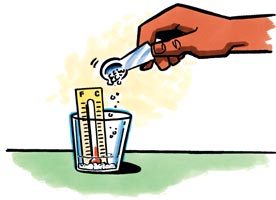
In an endothermic reaction, heat is ...
a)
taken in or absorbed
b)
given out or released
7.
Which of the following is a sign that a chemical reaction has occurred?
a)
change in shape
b)
melting
c)
formation of a gas
d)
dissolving
8.
A change where one or more new substances are created.
a)
Physical Change
b)
Chemical Change
9.
Fizzing, foaming, and burning are all examples of
a)
Chemical change
b)
Physical change
10.

What are the products of the chemical reaction pictured?
a)
CH4 and CO2
b)
CH4 and O2
c)
CO2 and H2O
d)
O2 and H2O
11.
The reactants are on the left side of the chemical equation.
a)
True
b)
False
12.
Which of the following is an example of synthesis?
a)
Na + Br2 --> NaBr
b)
KClO3 --> KCl + O2
c)
HgO + Cl2-->HgCl + O2
d)
Cl2 + NaBr --> NaCl + Br2
13.
Which reaction type is the following: AgF + CaCl2 --> AgCl + CaF2
a)
Decomposition
b)
Single Replacement
c)
Synthesis
d)
Double Replacement
14.
Which reaction type is the following: Na + CaF2 --> Ca + NaF
a)
Decomposition
b)
Single Replacement
c)
Synthesis
d)
Double Replacement
15.
Is the equation balanced?: 2H2O + O2 --> 4MgO + 3Fe
a)
Yes
b)
No
16.
Balance this equation
_N2 + _H2 --> _NH3
_N2 + _H2 --> _NH3
a)
1,2,3
b)
1,3,2
c)
1,1,2
d)
2,1,1
17.
What is the little number after an element in a chemical equation called.
Example: H2
Example: H2
a)
Coefficient
b)
Subscript
c)
Atom
d)
Equation
18.
What is a coefficient?
a)
The small number on the right of the chemical symbol.
b)
The large number to the left of a formula.
19.
How many atoms of aluminum are on each side of the following equation: 4Al + 3O2 --> 2Al2 O3
a)
2
b)
6
c)
1
d)
4
20.
Increase in temperature of the reactants can do one of the following
a)
Slow collision frequency
b)
Allow less effective collision between the particles
c)
Cause particles to lose speed
d)
Increase collision between the particles thus increasing the rate.
21.
Which factors increase the rate of a reaction.
a)
increasing temperature
b)
increasing concentration
c)
increasing surface area
d)
all of these
22.
A ______________ is a substance that increases the rate of a reaction without being used up during the reaction.
a)
catalyst
b)
product
c)
reactant
d)
solute
23.
Why does a higher concentration increase the rate of reaction?
a)
it increases the amount of reactants
b)
it lowers the activation energy
c)
it increases the energy of particle collisions
d)
it increases the frequency of particle collisions because there are more collision sites
24.
This slows down or even stops a chemical reaction.
a)
de-activator
b)
catalyst
c)
enzyme
d)
inhibitor
25.
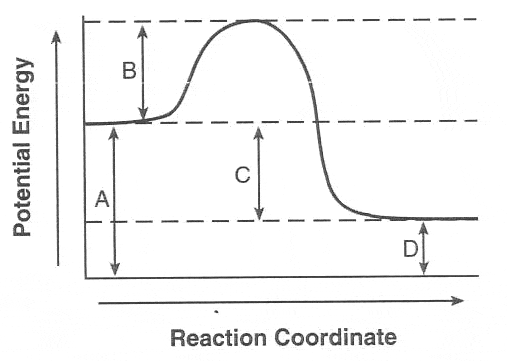
What type of reaction is this?
a)
Endothermic
b)
Exothermic
26.
Grinding a seltzer tablet into powder increases the rate of reaction due to increased
a)
concentration
b)
surface area
c)
temperature
d)
reactants
100 %

