wayground logo

Free Printable Worksheets

Font size

S
M
L
XL
Worksheets

Econ Review pt2

Total questions: 133

Worksheet time: 3hrs 31mins
Name
Class
Date
1.
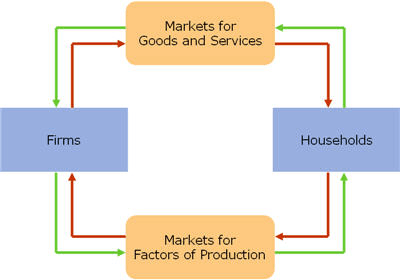
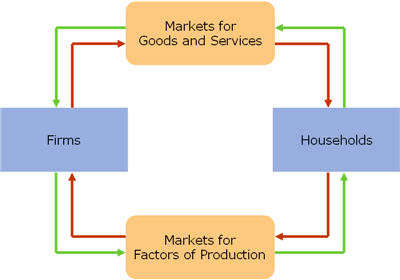
What is being represented by the "green flow lines"
a)
Flow of Money
b)
Flow of Goods and Services
c)
law
2.
What is being represented by the "red flow line"
a)
The flow of money
b)
The flow of goods and services
3.
In the circular flow model, what do individuals SELL to businesses
a)
Services
b)
Money
c)
Resources
d)
D Goods
4.
In the United States economy, what do businesses buy from consumers?
a)
Resources
b)
Interest
c)
goods
d)
services
5.
What do the households provide businesses?
a)
Labour
b)
Wages
c)
Resources
d)
Goods and services
6.
The circular flow model of a market economy shows
a)
how profits are made
b)
what inputs are required for what outputs
c)
how many firms can support the needs of how many households
d)
the interactions between households and  firms in the free market
7.
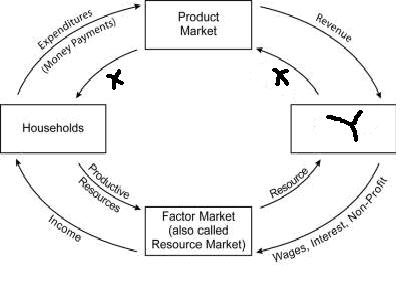
Look at the picture.  What should replace Y?
a)
Consumers
b)
Firms
c)
Factors
d)
Revenue
8.
In which market do consumers purchase goods and services?
a)
Factor 
b)
Product
c)
Households
d)
none of the above
9.
"Consumers purchase products in the Product Market".  What represents "consumers"?
a)
Households
b)
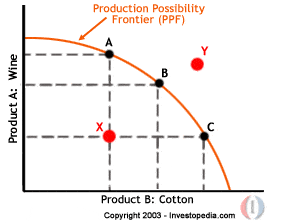
Businesses/Firms
c)
Income
d)
REsource
10.
Why do firms need to purchase the productive resources in the factor market?
a)
To produce labor
b)
To produce goods and services
c)
To increase demand
d)
None of the above
11.

In the circular flow, we can actually talk about two markets. What are they?

a)

Natural market and stable market

b)

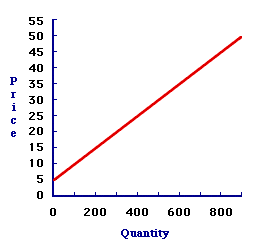
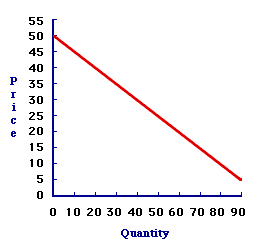
Command market and free market

c)

Resource market and product market

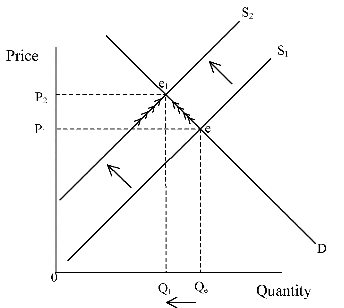
12.

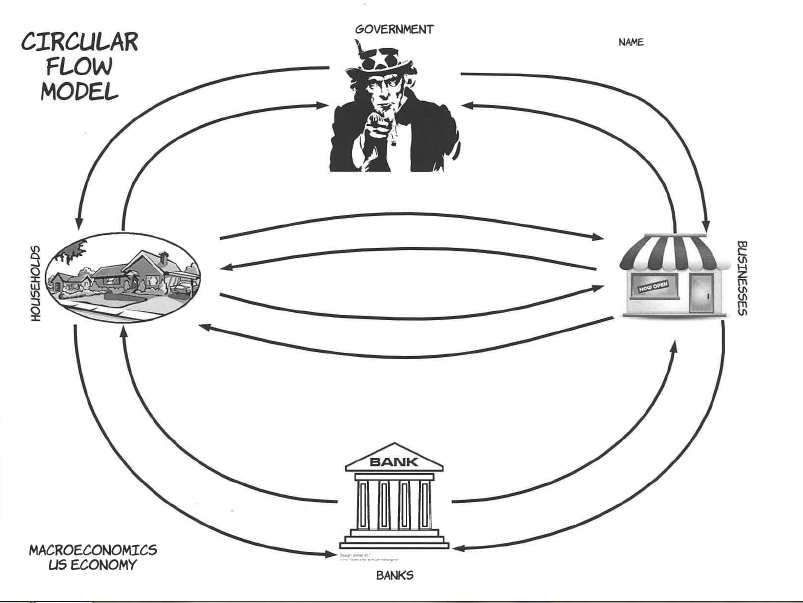
All of the following flow among households, businesses, and the government in American economy EXCEPT:

a)

Resources

b)

Laws

c)

Goods and services

d)

Money

13.

Which of the following is true of traditional economies?

a)

economic decisions are determined by the government.

b)

People have access to private property.

c)

the production of goods is based on custom.

d)

they resemble a communist economic system.
14.

There are four types of economic systems. Most economies are _____.

a)

Traditional

b)

Command

c)

Market

d)

Mixed

15.
The government has little to no role in the production of goods in this type of economy. 
a)
Traditional 
b)
Mixed
c)
Command 
d)
Market
16.
 All Americans enjoy the following economic freedoms EXCEPT the freedom to:
a)
buy and sell various goods
b)
fix prices
c)
own property
d)
earn profit
17.
In terms of resources, what do households provide for businesses?
a)
loans
b)
savings
c)
labor
d)
private goods
18.
1. People focus on producing a few things instead of making everything they want by themselves.
a)
interdependence
b)
specialization
c)
scarcity
d)
market
19.
In what way does specialization increase productivity?
a)
Specialization reduces scarcity
b)
Specialization reduces the cost of production
c)
Specialization increases the demand for a product
d)
Specialized workers are generally more highly educated
20.

Which economic system prohibits the private ownership and management of resources and emphasizes income and wealth equality?

a)

Free enterprise

b)

Capitalism

c)

Communism

d)

Socialism

21.
In the products market
a)
firms buy goods and services from households
b)
firms sell goods and services to households
c)
firms sell resources to households
d)
firms buy resources from households
22.
Why do markets exist?
a)
to allow people to exchange goods and services
b)
to allow people to earn money
c)
to increase profits for business owners
d)
to concentrate the productive efforts of individuals
23.
 In a command economy, most of the capital, tools, and production equipment are
a)
outdated
b)
privately owned
c)
owned by government
d)
unregulated
24.
 The free-enterprise system means that Americans
a)
are able to run their businesses in the way they think is best
b)
are entitled to receive free products from stores
c)
do not have to pay taxes during their first year in business
d)
depend on the government to tell them how to operate.
25.
In the circular flow model, the product market describes _____.
a)
stores that sell goods and services to households
b)
the government paying for public goods
c)
households selling their labor to businesses
d)
households receive income from businesses
26.
SSEMI1 In which market do Firms purchase the scarce resources from households?
a)
Factor 
b)
Product
c)
Households
d)
none of the above
27.
How do individuals contribute to the circular flow of economic activity? 
a)
Businesses buy goods and services from individuals 
b)
Businesses purchase productive resources in product markets 
c)
Individuals provide labor for factor markets and buy goods in product markets 
d)
Individuals buy productive resources from factor markets and provide labor for product markets 
28.

Which statement is true about the circular flow diagram?

a)

Businesses and households are not components of the circular flow diagram.

b)

Households are demanders in the factor market and suppliers in the product market.

c)

Households are demanders in the product market and suppliers in the factor market.

d)

Businesses are demanders i the product market ad suppliers int he factor market.

29.
What is the correct label for line 6 above? 
a)
Resource
b)
Product
c)
Stock
d)
Free
30.
SSEMI1 Which of the following would NOT be included in (8)?
a)
Consumer Expeditures
b)
Rent
c)
Wages
d)
Net Profits
31.
Households = 
a)
sellers in the factor market
b)
buyers in the product market
c)
consumers in the product market
d)
all of the above.
32.
Firms = 
a)
Businesses
b)
Sellers in the resources market
c)
Sellers in the product market
d)
Both Businesses and Sellers in the Output market
33.
Money made from the sale of goods and services; paid to firms and used to acquire new resources.
a)
profit
b)
salary and wages
c)
revenue
d)
interest
34.

A product that can be used to satisfy a want or need.

a)

Scarcity

b)

Dividends

c)

Goods

d)

Liability

35.

Section of the economy made up of individuals or families

a)

Firms

b)

Households

c)

Businesses

d)

Factor

36.

Where buyers and sellers learn information from one another and voluntarily exchange goods, services, & money

a)

Market

b)

Partnership

c)

Specialization

d)

Command Economy

37.

Function of money in which any commodity can be saved for later use

a)

Opportunity Cost

b)

Sole Proprietorship

c)

Store of Value

d)

Medium of Exchange

38.

Factors of production used in the making of goods & services

a)

Resources

b)

Services

c)

Stocks

d)

Complimentaries

39.

The act of buyers and sellers freely & willingly engaging in market transactions

a)

Opportunity Cost

b)

Scarcity

c)

Specialization

d)

Voluntary Exchange

40.

The value lost when one alternative is chosen over another

a)

Opportunity Cost

b)

Voluntary Exchange

c)

Specialization

d)

Scarcity

41.

When resources are limited and the need for goods & services are unlimited

a)

Specialization

b)

Voluntary Exchange

c)

Scarcity

d)

Opportunity Cost

42.

The _______ considers the weighted averages of a group of consumer goods and services.

a)

Consumer price index

b)

Aggregate supply

c)

Producer price index

d)

Aggregate demand

43.

Which of the following terms is also known as total output?

a)

Price index

b)

Price level

c)

Aggregate demand

d)

Aggregate supply

44.

__________ refers to a decrease in price level.

a)

Hyperinflation

b)

Disinflaation

c)

Deflation

d)

Stagflation

45.

__________ occurs in the economy when unemployment and inflation are both high.

a)

Hyperinflation

b)

Disinflation

c)

Deflation

d)

Stagflation

46.

Which of the following explains the relations between the average price of aggregate supply and the quantity demanded?

a)

Aggregate demand

b)

Price level

c)

Producer price index

d)

Consumer price index

47.

Which of the following is NOT one of the components of Gross Domestic Product (GDP)?

a)

Consumption

b)

Producer Price Index

c)

Government spending

d)

Investment

48.

Which of the following types of inflation occurs when sales drop and retailers cannot place higher prices on customers?

a)

Deflation

b)

Disinflation

c)

Hyperinflation

d)

Pre-inflation

49.

Which of the following interest rates is expressed in terms of current dollars as the percentage of the amount loaned?

a)

Simple interest rate

b)

Nominal interest rate

c)

Real interest rate

d)

Compound interest rate

50.

Which of the following is NOT one of the constants the aggregate supply curve assumes?

a)

State of technology

b)

Resource prices

c)

Rules providing production incentives

d)

Rate of production

51.
When inflation is high the _______________of the dollar decreases
a)
cost value
b)
purchasing power
c)
importance
d)
validity
52.
What is inflation?
a)
rise in all prices
b)
rise in most prices
c)
rise in some prices
d)
rise in general prices
53.
Who is most likely to be hurt by inflation?
a)
someone who borrowed money
b)
a retiree on a fixed income
c)
a business owner
d)
the U.S. government
54.
GDP that is adjusted for inflation
a)
real GDP
b)
nominal GDP
c)
price level
d)
net national product
55.
Fiscal policy is
a)
decisions the government makes to fight inflation
b)
actions the the Federal Reservice takes to control money supply
c)
does not help with inflation
56.

A tax on imports is called?

a)

tariff

b)

excise tax

c)

import tax

d)

quota

57.
How many districts are there in the Federal Reserve System
a)
10
b)
12
c)
24
d)
15
58.
The use of government spending and revenue collection to influence the economy
a)
Monetary Policy
b)
Fiscal Policy
59.
Decisions about how much to spend and how much to tax are part of...
a)
Monetary Policy
b)
Fiscal Policy
60.
The actions the Fed takes to influence the level of real GDP and the rate of inflation in a country
a)
Monetary Policy
b)
Fiscal Policy
61.
If the Fed purchases government securities, what will happen to the economy?
a)
Increase money supply
b)
Decrease money supply
62.
If the Fed lowers the discount rate, what will be the economic effect?
a)
Expands the money supply
b)
Decrease the money supply
63.
Which monetary policy decision is meant to increase the money supply?
a)
Congress passes a rule to reduce personal income taxes.
b)
The Federal Reserve buys treasury bonds on the open market.
c)
Congress passes a bill to reduce regulations on monopolies.
d)
The Federal government borrows money from a foreign bank to cover a budget deficit.
64.
The federal government's overall approach to spending and taxes is called
a)
Physical Policy
b)
Fiscal Policy
c)
Money
d)
Monetary Policy
65.
What would be the result of lowering interest rates on bank reserves held at the Federal Reserve?
a)
Money Supply increases
Aggregate Demand increases
b)
Money supply increases
Aggregate demand decreases
c)
Money supply decreases;
Aggregate demand increases
d)
Money supply decreases; Aggregate demand decreases
66.
The Federal Reserve does all of the following EXCEPT
a)
raise taxes and determine government spending
b)
act as the government's bank
c)
regulate banking activity
d)
provide check-clearing services to banks
67.
The primary risk of expansionary fiscal policy is
a)
deflation
b)
increasing unemployment
c)
increasing the national debt
d)
decreasing aggregate demand
68.
How does a budget deficit relate to the national debt?
a)
They are the same thing.
b)
Budget deficits are more than the national debt.
c)
Budget deficits reduce the size of the national debt.
d)
Budget deficits create the national debt.
69.
If an economy experiences a dramatic rise in prices, which fiscal policy action could be taken?
a)
Selling securities on the open market
b)
Raising interest rates
c)
Reducing government spending
d)
Raising reserve requirements
70.
When interest rates rise, the number of loans made by banks will
a)
increase
b)
decrease
c)
be unaffected
71.
If the Federal Reserve System wanted to stimulate the U S economy and reduce unemployment, it would 
a)
cause interest rates to decrease because low interest rates encourage business growth and expansion 
b)
cause interest rates to rise because high interest rates encourage business growth and expansion 
c)
increase the discount rate it charges banks, which would increase the money supply 
d)
increase consumer spending by reducing the money supply 
72.
Which statement BEST describes the U S government’s monetary policy and fiscal policy? 
a)
Monetary policy reflects the Federal Reserve’s authority to change the money supply; fiscal policy reflects the government’s power to influence the economy through taxes, expenditures, and borrowing. 
b)
Monetary policy reflects the Federal Reserve’s authority to change tax rates; fiscal policy reflects the government’s power to influence the money supply by lowering the discount rate for loans to banks. 
c)
Monetary policy refers to the Federal Reserve’s influence in the economy through borrowing and creating a deficit; fiscal policy refers to the government’s authority to increase spending. 
d)
Monetary policy refers to the Federal Reserve’s authority to increase spending; fiscal policy refers to the government’s authority to increase the discount rate for loans to banks. 
73.
How are fiscal and monetary policies similar?
a)
They both use the same tools to fix economic problems
b)
They both try to promote economic stability.
c)
They always must have Congressional approval before passing.
d)
They both are decided by a Board of Governors.
74.
If the economy is in a recession, the Federal Reserve could do all of the following EXCEPT
a)
Lower taxes
b)
Lower the discount rate
c)
Buy securities
d)
Lower the required reserve ratio
75.
Which of the following results should be included where the question mark appears in the illustration?
a)
unemployment
b)
inflation
c)
consumer spending
d)
production
76.
Which of the following results should be included where the question mark appears in the illustration?
a)
the reserve requirement
b)
interest rate
c)
inflation
d)
unemployment
77.
Money loses its value when it
a)
It becomes too plentiful
b)
becomes too portabale
c)
is divisible
d)
is durable
78.
What dollar amount should appear in place of the letter P in the table?
a)
$1,000,000
b)
$100,000
c)
$1,900,000
d)
$1,900
79.
What dollar amount should appear in place of the letter S in the table?
a)
$200,000
b)
$1,800,000
c)
$2,200,000
d)
$1,800
80.
If the Federal Reserve raises interest rates to combat rapid inflation, what might be a negative outcome?
a)
Unemployment rates would rise
b)
taxes will rise 
c)
The government would put a freeze on prices
d)
international trade would stop 
81.
Which of the following is a monetary policy action used to combat a recession?
a)
cutting taxes
b)
increasing the money supply
c)
decreasing the money supply
d)
raising taxes
82.
The Federal Reserve wants to reduce the nation's money supply. This could be accomplished by doing all of the following EXCEPT
a)
decreasing the discount rate.
b)
increasing the reserve requirement.
c)
selling securities on the open market.
d)
making banks hold a reserve for all types of deposits.
83.
If the Federal Reserve System wanted to stimulate the U.S. economy and reduce unemployment, it would
a)
A. cause interest rates to decrease because low interest rates encourage businessgrowth and expansion
b)
B. cause interest rates to rise because high interest rates encourage business growthand expansion
c)
C. increase the discount rate it charges banks, which would increase the money supply
d)
D. increase consumer spending by reducing the money supply
84.
If the Federal reserve and Government are attempting to encourage growth and stimulate the economy, which actions would each take? 
(monetary / fiscal)
a)
increase the Required reserve / increase government spending
b)
sell government securities / decrease taxes
c)
decrease the interest rate / increase government spending
d)
buy government securities / decrease government spending
85.
If the federal government is attempting to encourage spending by consumers and businesses, a fiscal policy BEST serving this purpose would be
a)
decreasing taxes.
b)
decreasing government spending.
c)
reducing the investment tax credit.
d)
balancing the budget.
86.
The rate the Fed charges banks for a loan
a)
Discount rate
b)
Federal fund rate
c)
reserve ratio
d)
prime rate
87.
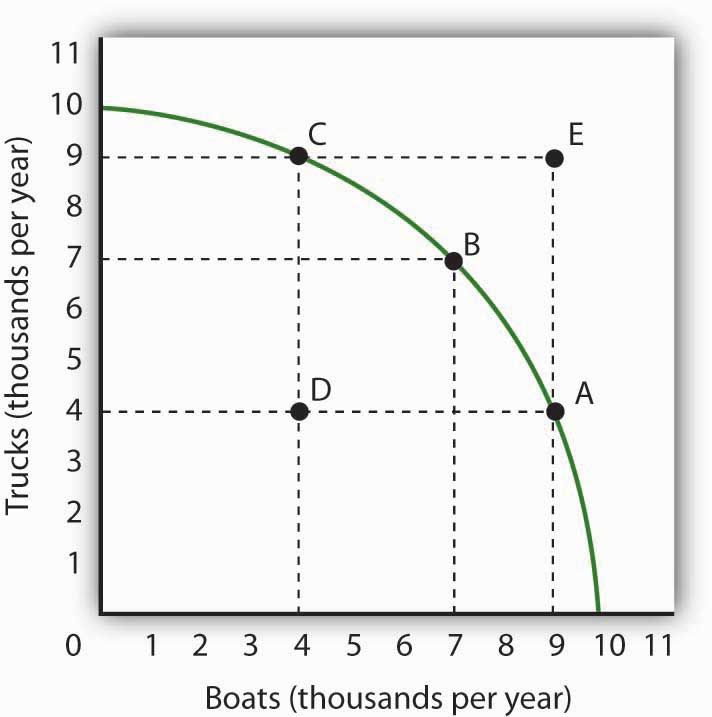
The opportunity cost of increasing production from 7 to 9 trucks is
a)
Scarcity
b)
2 boats
c)
2 trucks
d)
3 boats
88.
Which of the following would consumers MOST OFTEN need to consider when trying to make a rational economic decision? 
a)
The impact of government subsidies
b)
Potential opportunity costs
c)
Factors of Productions
d)
Net Exports
89.
The opportunity cost of increasing production from 4 to 7 boats is
a)
1 boat
b)
2 boats
c)
2 trucks
d)
3 trucks
90.
If a natural disaster strikes, the production possibilities curve can shift
a)
No shift
b)
To the left
c)
To the right
d)
Outward on one axis only
91.
If a mass immigration occurs, the production possibilities curve can shift
a)
No shift
b)
To the left
c)
To the right
d)
Outward on one axis only
92.
David decides to start his own business. He opens a shop that manufactures sports equipment. He pays Frank an hourly wage to make baseball bats, and Gene a salary to manage his finances. Three days after his grand opening, he is ecstatic because Mike, who runs the town's parks and recreation department, calls him and orders equipment for six Little League baseball teams. Which of the following statements is TRUE?
a)
Davis is a producer, Frank is labor, Gene is the entrepreneur of the business, and Mike has just ordered capital goods.
b)
David is producer, Frank and Gene are consumers, and Mike has just made an investment.
c)
David is a the entrepreneur, Frank and Gene are both labor, and Mike is a consumer.
d)
Frank and Gene are both entrepreneurs, David is the owner, and Mike has just made a capital investment
93.
What does point B represent?
a)
Production at greater than the country's minimum potential
b)
Production is less than the country's minimum potential
c)
Production is greater than the country's maximum potential
d)
Production at the country's maximum potential
94.
What does point Y represent on the PPC?
a)
Efficiency
b)
Unattainable / impossible
c)
Inefficency
d)
Nothing
95.
What influences productivity, economic growth, and future standards of living? 
a)
Government Regulations
b)
Public goods and services
c)
Factories, machinery, technology, and education
d)
Income, full employment, and market failures
96.

If Mr. White is given a pay raise, what would be the most likely effect?

a)

a decrease in the cost of his labor

b)

a decrease in the opportunity cost of quitting his job

c)

an increase in his human capital

d)

an increase in his standard of living

e)

a decrease in his income tax

97.

If the country is currently producing at Point C, it can choose to produce more computers by doing which of the following

a)

Moving to Point B

b)

Moving to Point D

c)

Moving to Point E

d)

Remaining at Point C, since computer production is maximized

98.

Which of the following statements about this production possibilities curve is true?

a)

Point D is not attainable given the society’s resources.

b)

Point A is not attainable in a developed society.

c)

Elimination of unemployment will move the production possibilities curve to the right, closer to Point E.

d)

Points C and D reflect equal amounts of computers and farm products.

e)

Point E might be achieved in the future because of technological improvements.

99.
What is opportunity cost?
a)
a graph that shows how much an economy can produce between 2 goods
b)
how much money something is
c)
the opportunity one has to give up in order to gain something else
d)
land, labor, capital, entrepreneurs
100.
The production possibilities curve is an illustration of what?
a)
Opportunity costs and trade-offs
b)
Only opportunity costs
c)
Only trade-offs
d)
none of the above
101.
This shows the various combinations and opportunity costs of production, when a company of country is efficiently using resources.  
a)
Production possibilities curve
b)
trade offs
c)
specialization
d)
comparative advantage
102.
SSEF1(d) The opportunity cost of shifting production from "Point E" to "Point C" would be:
a)
30 cans of cola
b)
30 chocolate bars
c)
70 cans of soda
d)
20 chocolate bars
103.
The opportunity cost of increasing production from point B to point C is...
a)
Scarcity
b)
2 boats
c)
2 trucks
d)
3 boats
104.
The opportunity cost of increasing production from point C to point A is...
a)
1 boat
b)
2 boats
c)
5 trucks
d)
3 trucks
105.
In Cost/Benefit Analysis, when does adding an additional unit pays off?
a)
Marginal benefits exceed marginal costs.
b)
Marginal costs exceed marginal benefits.
c)
Marginal costs equal marginal benefits.
d)
None of the above.
106.
The opportunity cost of increasing production from 4 to 7 boats is
a)
1 boat
b)
2 boats
c)
2 trucks
d)
3 trucks
107.
If you pay $5,000 a year in tuition and give up $20,000 a year of income to attend college, then the yearly opportunity cost of college is: 
a)
only $5,000 of tuition. 
b)
only $20,000 of foregone income.
c)
at least $25,000 of tuition and foregone income. 
d)
less than $20,000 and more than $5,000.
108.
Land, Labor, Capital, and Entrepreneurship 
a)
Diversification
b)
Deductions
c)
Portfolio
d)
Factors of Production 
109.
Max is studying for his spelling test.  Unfortunately, his favorite TV program is on right now.  If he studies for the test, he will miss watching the show.  Max decides to study for his test instead of watching TV.  What is the opportunity cost of his decision?
a)
studying for a test
b)
watching TV 
110.
The local government for a community must decide what to do with the sales tax collected.  They could build a new skate park or they could buy more computers for the public library.  The officials decide to build a skate park.  What is the opportunity cost of their decision?
a)
new skate park
b)
more computers 
111.
An Entrepreneur is ...
a)
A risk taker in search of profits who's initial investment must be returned
b)
A investor in search of profits who does something new with existing resources
c)
A investor in search of profits who's initial investment must be returned
d)
A risk taker in search of profits who does something new with existing resources
112.
which of these is a cause of shifting of demand curve in right hand side if goods are normal
a)
increase in income of consumer
b)
increase in price of substitute goods
c)
decrease in price of complementary goods
d)
all of these
113.
What does this curve represent?
a)
demand
b)
supply
c)
equilibrium
d)
shortage
114.
What does this curve represent?
a)
supply
b)
equilibrium
c)
demand
d)
surplus
115.
If the price of printers goes down, what happens in the market for ink cartridges?
a)
Supply increases.
b)
Supply decreases.
c)
Demand increases.
d)
Demand decreases
116.
Assume the image is showing the market for apples.  Which of the headlines could indicate the pictured shift is occurring in the market?
a)
Pesticides on apples linked to mouth cancer.
b)
Storms destroy apple orchards.
c)
An apple a day really does keep the doctor away.
d)
New genetic strain leads to apple trees that produce twice as many apples.
117.
A government payment made to a business is a
a)
tax
b)
regulation
c)
subsidy
d)
resource
118.
The following is a factor that will not cause the demand curve to shift:
a)
Advertising
b)
Population
c)
Price
d)
Consumer expectations
119.
If a consumer knows that a product will be going on sale this week, how will his/her CURRENT demand be affected?
a)
it will go up
b)
it will go down
c)
it will stay the same
d)
what does this have to do with the price of tea in China?
120.
Generally speaking, the lower the price, the greater the quantity demand.
a)
True
b)
False
121.
For the law of demand, as price rises, what happens to quantity demanded?
a)
it goes up
b)
it goes down
c)
it stays the same
d)
it is not effected
122.
For the law of supply, as price rises, what happens to quantity supplied?
a)
it goes up
b)
it goes down
c)
it stays the same
d)
it is not effected
123.

What are human resources?

a)

Workers and their skills used to produce a good or service

b)

Any physical environmental item that people perceive to be useful in the production of a good or service

124.
The following is a factor that will not cause the demand curve to shift:
a)
Advertising
b)
Population
c)
Price
d)
Consumer expectations
125.
Which of the following best describes the Law of Demand?
a)
As price goes down, demand goes down. (and vice versa).
b)
As price goes down, demand goes up (and vice versa).
c)
As demand goes down, supply goes up.
d)
As demand goes up, price becomes elastic.
126.
A change in demand is shown
a)
along the demand curve
b)
with a new demand curve above or below the original demand curve
c)
without a demand graph
d)
with a totally vertical line
127.
If a consumer knows that a product will be going on sale this week, how will his/her CURRENT demand be affected?
a)
it will go up
b)
it will go down
c)
it will stay the same
d)
what does this have to do with the price of tea in China?
128.
In a market economy, who decides on the prices of goods and services?
a)
government
b)
buyers and sellers
c)
firms
d)
local leaders
129.
According to the Law of Demand, when the price of a good is lowered, demand __________.
a)
increase
b)
decreases
c)
stays the same
d)
fluctuates
130.
Which economic concept is defined as the measure of how responsive consumers are to a price change?
a)
consumer expectations
b)
consumer taste
c)
decreasing marginal utility
d)
elasticity of demand
131.
What do various points on a demand curve represent?
a)
change in demand
b)
change in quantity demanded
c)
change in marginal utility
d)
change in elasticity
132.
Equilibrium price is the price at which the quantity of a product demanded by consumers and the quantity supplied by producers
a)
are different.
b)
are equal.
c)
is higher for the product demanded.
d)
is higher for the product supplied.
133.
According to the law of supply, when prices decrease
a)
quantity supplied decreases
b)
quantity supplied increases
c)
supply decreases
d)
supply increases