
 Worksheets
Revolutionary War Battles
Total questions: 100
Worksheet time: 2hrs 48mins
In the winter of 1777 General Washington launched a surprise attack on this town. This was during a long winter at Valley Forge.
Trenton
Charleston
Troy
Saratoga
The "first" real battle for the American "minutemen." The Patriots had to retreat - known for its "shot heard around the world."
Trenton
Bunker Hill
Princeton
Lexington & Concord
This was a great American Victory - France would enter the war on the side of the Americans after this victory. Known as the "turning point" battle of the Revolution.
Bunker Hill
Saratoga
Yorktown
Trenton
Patriot victories in the wilderness of N.C. and S.C. - extensive use of "guerilla warfare."
Lexington & Concord
Kings Mountain & Cowpens
Trenton & Concord
Star & Candor
The country that would come to the aide of the Americans toward the end of the war was?
England
Japan
Spain
France
The battle that would END the American Revolution is?
Trenton
Yorktown
Saratoga
Princeton
A British victory in N.C., but would tie-up and exhaust British troops. The battle would cause General Cornwallis to retreat toward the coast of Northern Virginia.
Guilford Courthouse
Kings Mountain
Winston-Salem
Black Ankle
After a fierce battle the Americans lose 400 men, but the British lose 1000. Though it will be a British victory, Americans claim a "moral" victory. (1775)
Saratoga
Bunker Hill
Trenton
Guilford
Soldiers that the British hired to help fight in the Americans were called Hessians, these troops were from the country of?
America
Russia
Indians
Germany
What was a reason that the British people were wanting the war over?
Sending sons, husbands, and friends off to war
The people having to PAY for the war
Public opinion and distance to the war
All the above
None of the above
What Battle is this?
"The shot heard round the world" This was the first battle of the American Revolution. The British won this first battle.
Lexington and Concord
Battle of Saratoga
Battle of Charleston
Battle of Bunker Hill
What battle is this?
The Colonists won this battle. The battle of Saratoga is important because it convinced the French to come to help the colonists. This battle is known as a “Turning Point” in the American Revolution.
Battle of Lexington
Battle of Saratoga
Battle of Bunker Hill
Battle of Charleston
This battle was called the "Bloodiest Battle" for the large amount of men that died.
Battle of Concord
Battle of Lexington
Battle of Cowpens
Battle of Bunker Hill
Which statement is true about the Battle of Charleston?
The colonist won.
No colonial troops were lost.
It was the biggest loss of troops suffered to the Continental Army in the war.
It was the first battle of the Revolutionary War.
"Surprise Attack"
This happened right after the Battle of Lexington and the Colonists won because they attacked the British from the woods. The British were not used to this type of fighting. This battle took place at the Old North Bridge.
Battle of Yorktown
Battle of Saratoga
Battle of Concord
Battle of Bunker Hill
The Colonists won this battle. It became known as the turning point of the war in the South, part of a chain of events leading to Patriot victory at Yorktown.
Battle of Cowpens
Battle of Yorktown
Battle of Lexington
Battle of Bunker Hill
The French Navy blocked the British Navy from bringing help to General Cornwallis. What battle am I?
Cowpens
Saratoga
The Battles of Lexington and Concord
Yorktown
During this battle the partisans (like the minutemen) and regular Continental Army cooperated to defeat the British army. What battle am I?
Battle of Charleston
Battle of Cowpens
Battle of Saratoga
Battle of Bunker Hill
Benjamin Franklin tried to convince France to help the Americans throughout the war. Which battle did the Americans win that caused France to become allies with the Americans?
Saratoga
Valley Forge
Charleston
Lexington
The Battles of Lexington and Concord were important during the American Revolution because:
It was the longest battle in the war.
It was the final battle in the war.
It was the first battle of the war.
It was the deadliest battle of the war.
The battles of the American Revolution that took place in the South (King’s Mountain, Camden, Charleston, Cowpens) were fought:
During the early years of the war.
After the war was officially over.
Before the war began.
During the final years of the war.
Which statement is not true about the battle of Bunker Hill?
It showed how powerful the Americans were by fighting behind rocks and trees, instead of being in formation.
It showed how vulnerable the Americans were.
They defeated the British.
It was the “bloodiest battle” and even though the colonists lost they felt encouraged to keep fighting.
Which battle was fought in New York?
Saratoga
Yorktown
Charleston
Cowpens
Which battle was fought in Virginia?
Saratoga
Yorktown
Bunker Hill
Charleston
The British won and blocked the Charleston Harbor for many days.
Cowpens
Yorktown
Concord
Charleston
May 1775; First major victory for the Americans; ammunition was sent to aid those laying siege to Boston
Bunker Hill
Lexington and Concord
Fort Ticonderoga
Moore's Creek
January 1777; Here, Washington continued gaining momentum that he had won at Trenton and helped gain control of much of New Jersey when he defeated a mostly Hessian regiment
Boston Siege
Long Island/Brooklyn Heights
Trenton
Princeton
June 1778; a tactical draw, but a moral victory for the Americans; after the winter at Valley Forge, this battle demonstrated that American troops could stand up to British regulars; this battle saw the occasion for the beginning of the Molly Pitcher legend
Brandywine and Germantown
Valley Forge
Saratoga
Monmouth
Winter 1777-8; the American camp during a tough winter; saw many die of starvation or the cold, but also saw the Continental Army turned into a tough, disciplined, cohesive unit
Brandywine and Germantown
Valley Forge
Saratoga
Monmouth
March 1781; a tactical loss for Nathaniel Greene, victory for Cornwalis, yet such heavy losses were suffered by the British that Cornwalis decided to retreat into Virginia, where defeat awaited him
Charleston
Camden
Cowpens
Guilford Court House
these were small victories by Washington that live on in the American memory as instances when the Continental Army stopped running and turned to bravely face the enemy
Yorktown
Saratoga
Lexington and Concord
Princeton and Trenton
marked the beginning of the Revolutionary War
Yorktown
Saratoga
Lexington and Concord
Princeton and Trenton


The first battles of the Revolutionary War were -
Medford and Concord
Lexington and Concord
Boston and New York
Richmond and Ashland


What happened in Yorktown that ended the war?
The Boston Massacre
The British surrendered
The Americans surrendered
Washington ran away


What was the name of the British king during the American Revolution?
Charles III
George III
William III
James III


Surrounded by French and Continental armies, a large British army surrendered here ending the war.
Saratoga
Yorktown
Bunker Hill
Lexington and Concord


This document made Great Britain officially recognize the United States as an independent country and gave the new country land reaching towards the Mississippi.
Declaration of Independence
Treaty of Paris
Yorktown
2nd Continental Congress
The French began to support the Americans after the battle of --
Lexington and Concord
Yorktown
Saratoga
Treaty of French
Soldiers froze here because of the harsh winter
Paris
Valley Forge
Rio Grande Valley
Yorktown

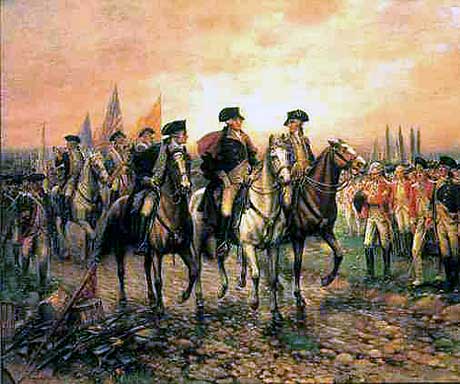

Who was the Commander in Chief of the Continental Army?
George III
George Washington
George Harrison
George Michael

What was the name of the army of the United States?
the Continental Army
the Redcoats
the Lobsterback
the Marines

What is another name for the British soldiers? (two possible answers)
Redcoats
Lobsterbacks
Continental Army
Yankee Doodle

What is a militia?
a group of volunteer soldiers to protect their native town.
The best soldiers in the army.
A special brigade of snipers
the British soldiers
Which is bigger?
battle
war
After this battle, the Americans learned that they would need allies to supply ammunition and assistance.
Bunker (Breed’s) Hill
Charleston
Saratoga
Lexington and Concord
During this battle, the Americans fought from behind rocks and trees. This style is presently known as guerilla warfare.
Bunker (Breed’s) Hill
Charleston
Saratoga
Lexington and Concord
This win encouraged the French to become allies with the Patriots.
Bunker (Breed’s) Hill
Charleston
Saratoga
Lexington and Concord
This battle was nicknamed “Shot Heard Round the World.”
Bunker (Breed’s) Hill
Charleston
Saratoga
Lexington and Concord
As a result of this battle, the 2nd Continental Congress met and named a Commander in Chief.
Bunker (Breed’s) Hill
Charleston
Saratoga
Lexington and Concord
First battle of the Revolutionary War
Bunker (Breed’s) Hill
Charleston
Saratoga
Lexington and Concord
During this battle, the Americans inflicted heavy casualties on the British regular army.
Bunker (Breed’s) Hill
Charleston
Saratoga
Lexington and Concord
Where were the Minutemen waiting when the British Redcoats arrived?
Bunker (Breed’s) Hill
Concord
Saratoga
Lexington
Who did the Americans name as Commander-in-Chief as a result of the first battle?
Thomas Jefferson
George Washington
Patrick Henry
King George III
Why did the British leave Boston and go to New York?
They lost the war.
They were looking for Patriots.
They did not like living in Boston.
They were looking for Loyalists.
Who were Loyalists?
People still loyal to America.
People still loyal to the colonies.
People still loyal to the King.
People who no longer support the King.
Who were Patriots?
People still loyal to America.
People who no longer supported Spain.
People still loyal to the King.
People who no longer supported the King.
What impact did the Battle of Bunker Hill have on the British?
It forced them to look for more Patriots.
It forced them to retreat and got to Great Britain.
The Battle at Bunker Hill had no impact on the British.
The British won but they lost a lot of men.


