wayground logo

Free Printable Worksheets

NEW

Font size

S
M
L
XL
Worksheets

Aerospace Engineering

Total questions: 42

Worksheet time: 27mins

Name
Class
Date
1.
What does the science of aerodynamics study?
a)
the weight of objects
b)
The movement of air around objects, like cars and airplanes
c)
the study of speed
d)
the study of NASCAR
2.
What are three key aerodynamics principles?
a)
Acceleration, height, and motion
b)
speed, weight, height
c)
Drag, downforce, and drafting
d)
drag, push, pull
3.
What is air pressure?
a)
Air pushes cause a car to flip over.
b)
force caused by the weight of air molecules pushing against an object’s surface.
c)
Air pulls a car along on a windy day.
d)
Air can make a car fly.
4.
True or false? Fast-moving air causes low air pressure, and slow-moving air creates high air pressure.
a)
True
b)
False
5.
"The more cars that are grouped in a drafting formation, the faster they all will go." Drafting is an example of:
a)
Brayton's principle that an increase in 7th graders will result in a rise of office referrals.
b)
Bernie Sanders's principle which states that a rise in wages will also be accompanied by a rise in consumer spending.
c)
Bernoulli's principle says that a fall in pressure in a flowing fluid must always be accompanied by an increase in the speed
d)
Bernoulli's principle which states that a rise in pressure in a flowing fluid must always be accompanied by an increase in the speed
6.
What is aerodynamics?
a)
A. Gravity pulling down on objects.
b)
B. The force that moves an aircraft forward.
c)
C. The way air moves around things.
d)
D. Changes in air pressure.
7.
What are the four forces of flight?
a)
A. lift, weight, thrust and drag
b)
B. up, down, faster and slower
c)
C. helicopter, airplane, glider, and drone
d)
D. jet, propeller, rotor blades and sail
8.
What is drag?
a)
A. The force that moves something forward
b)
B. Gravity pulling down on objects.
c)
C. The push that lets something move up.
d)
D. A force that tries to slow something down. 
9.
What is thrust?
a)
The push that moves something forward.
b)
The shape of an airplane's wing.
c)
The weight of an object.
d)
A shape that produces lift.
11.
What motion occurs on the Lateral axis?
a)
Pitch
b)
Roll
c)
Sway
d)
Yaw
11.
What motion occurs on the Lateral axis?
a)
Pitch
b)
Roll
c)
Sway
d)
Yaw
12.
What motion occurs on the Longitudinal axis?
a)
Pitch
b)
Roll
c)
Sway
d)
Yaw
13.
These two forces need to overcome their opposite force in order for an aircraft to fly.
a)
Drag & Weight
b)
Thrust & Weight
c)
Lift & Drag
d)
Lift & Thrust
14.
This is the name of the force that tries to push an aircraft up.
a)
Thrust
b)
Weight
c)
Drag
d)
Lift
15.
This is the name of the force that tries to hold an aircraft back.
a)
Thrust
b)
Weight
c)
Drag
d)
Lift
16.
This is the name of the force that tries to pull an aircraft down.
a)
Thrust
b)
Weight
c)
Drag
d)
Lift
17.
Which of the following is NOT one of the three primary movement of an aircraft?
a)
Pitch
b)
Roll
c)
Sway
d)
Yaw
18.
An object is _____ if its position changes relative to another object.
a)
in motion
b)
at reset
c)
a frame of refence
d)
magical
19.

Which shape is a good aerodynamic

a)

1

b)

2

c)

3

20.
This type of cloud is thin, wispy, and made of ice crystals
a)
cumulus cloud
b)
stratus cloud
c)
cirrus cloud
d)
cumulonimbus cloud
21.
This type of cloud is thick and puffy on top, and generally flat on the bottom. It has well-defined edges and can change shape rapidly.
a)
cumulus cloud
b)
stratus cloud
c)
cirrus cloud
d)
cloud 9
22.
Nimbostratus and cumulonimbus clouds can signal what type of upcoming weather?
a)
fair skies
b)
hot, sunny weather
c)
windy weather
d)
rainy weather
23.
Cumulus and cirrus clouds can signal what type of upcoming weather?
a)
fair skies
b)
hot, sunny weather
c)
windy weather
d)
rainy weather
24.
Clouds are made up of tiny drops of ______ or ice. The moisture in the cloud affects the weather.
a)
dust
b)
water
c)
cloud particles
d)
precipitation
25.

A Stratus cloud is?

a)

wispy and thin

b)

big and puffy

c)

dark and gray

d)

flat and low level

26.

Cumulus clouds are?

a)

dark and gray

b)

thin and wispy

c)

big and puffy

d)

flat and dark

27.

The three major types of clouds are

a)

cumulonimbus, altostratus, and nimbostratus

b)

cirrus, stratus, and nimbostratus

c)

cirrus, stratus, and cumulus

d)

stratus, altocumulus, and cumulus

28.

The amount of water vapor in the air is called ________________

a)

precipitation

b)

evaporation

c)

humidity

d)

condensatation

29.
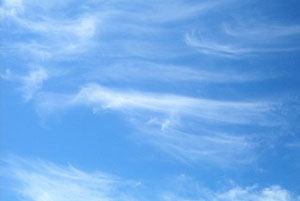
what type of cloud is shown?
a)
cumulus
b)
cirrus
c)
stratus
30.
According to Bernoulli's Principle, when the wind speed is high, wind pressure is ________
a)
high
b)
low
c)
not enough information
d)
None of the above
31.
According to Bernoulli's Principle, when the wind speed is low, wind pressure is ________
a)
high
b)
low
c)
not enough information
d)
None of the above
32.
To generate lift, a blade is angled so the _________ pressure air moves under the blade.
a)
high
b)
low
c)
not enough information
d)
None of the above
33.
The faster a fluid moves, the lower the pressure is in the moving fluid compared to the fluid not moving as fast. This is called
a)
Archimedes' Principle
b)
Bernoulli's Principle
c)
Pascal's Principle
d)
Vice Principle Snyder
34.
Whose Principle is used to describe why flight is possible?
a)
Newton
b)
Descartes
c)
Bernoulli
d)
Pascal
35.
Why is the top of an airplane wing curved?
a)
To create an area of low pressure above the wing
b)
To create an area of high pressure above the wing
c)
To create equal pressure above and below the wing
d)
To make the wing look really cool
36.
The design of a wing:
a)
causes the air above a wing to move faster than the air below the wing
b)
helps create lift
c)
creates a low pressure area above the wing
d)
all of these answers are correct
37.
Fluids tend to move from an area of ______pressure to an area of ______pressure
a)
high, low
b)
low, high
c)
fluids don't flow
38.

Why are the two arrow/vectors the same size? (Use the image to answer the question)

a)

The box is not moving, opposite forces are equal

b)

The gravitational forces

c)

It is stationary on the Earth

d)

One vector is longer than the other

39.

Identify the forces on an aircraft. What is A?

a)

Thrust

b)

Lift

c)

Drag

d)

Weight

40.

Identify the forces on an aircraft. What is B?

a)

Thrust

b)

Lift

c)

Drag

d)

Weight

41.

Identify the forces on an aircraft. What is C?

a)

Thrust

b)

Lift

c)

Drag

d)

Weight

42.

Identify the forces on an aircraft. What is D?

a)

Thrust

b)

Lift

c)

Drag

d)

Weight