
 Worksheets
Unit 1-Force & Motion
Total questions: 42
Worksheet time: 30mins
Which car is accelerating?
a car that is unmoving
a car that rounds a curve at a constant speed
a car that travels in straight line at a constant speed
a car that is set to a constant speed of 60 miles per hour
Why does an object in motion stay in motion unless acted on by an unbalanced force?
because forces are what stop and start motion
because balanced forces cannot exist in nature
because motion is the inherent state of all matter
because motion, once begun, continues to accelerate
Newton's First Law of Motion
Your car breaks down. As your friends help you get out and push. the car starts moving slowly and gains speed.
A tennis ball is rolling across the floor until Charlie kicks it.
A bowling ball and a baseball roll across your foot at the same speed. The bowling ball hurts much more.
When riding the bumper cars at the fair, you bump into your friend and your car bounces backwards.
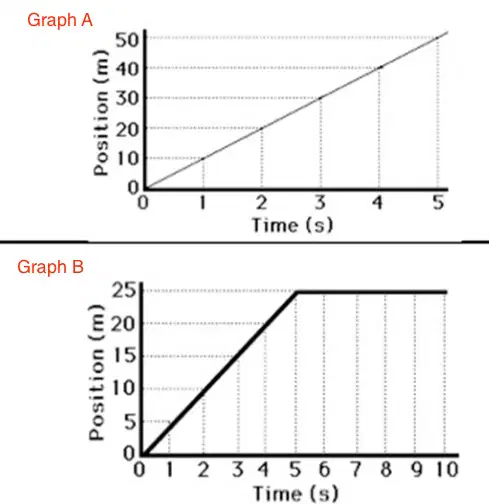
Choose all of the correct answers concerning speed. (Choose 3)
The object in graph B was moving at a greater speed than the object in graph A.
In graph B, the object is at rest for 5 seconds.
The total distance travelled by the object in graph B is greater than the object in graph A.
In graph A, the object travelled a distance of 40 meters in 4 seconds
In both graphs, speed will be measured in meters/second.

John and Caroline go out for a walk one day. This graph represents their distance from home.
Which statement accurately describes their walk?
They walked quickly, then they were still, then they walked slowly.
They walked forward fast, then they were still, then they walked backward slow.
They walked in one direction, then they were still, then they walked in the opposite direction.
They walked faster and faster until they walked at a constant rate, then they walked slower and slower.

John and Caroline go out for a drive one day. This graph represents the distance they traveled over time.
During what part of their drive are they not moving?
From 0 to 0.75 hours
From 1.25 to 2.0 hours
From 0.75 to 1.25 hours
They are moving the entire time.
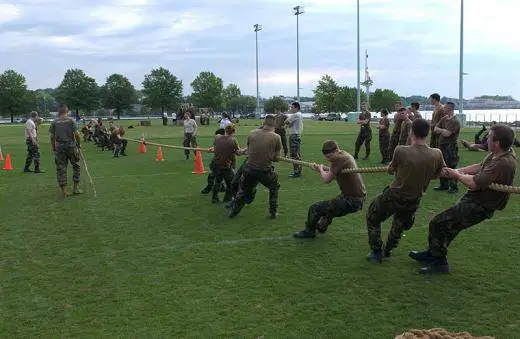
Two platoons line up for a tug of war. If both platoons have the same number of participants on a team, what other factor is critical to either platoon's win?
age of men
height of men
condition of the ground
total mass of the team
A wheelbarrow is experiencing two forces. One is pushing 25 N to the east and the other 25 N in the exact opposite direction. What must be true of the wheelbarrow's motion?
It isn't accelerating.
It is slowing down.
It is accelerating.
It is moving.
A car travels north for 5 miles turns east for 5 miles, turns south for 5 miles, and finally west for 5 miles. What is the car’s displacement?
20 miles, south
0 miles, all directions
5 miles north
5 miles west
The law of inertia states that an object in motion will stay in motion, and an object at rest will stay at rest unless acted upon by an unbalanced force. Which law of motion is this describing?
Newton's First Law
Newton's Third Law
The law of gravity
Newton's Second Law
An object in motion will stay in motion or an object at rest will stay at rest unless acted upon by what type of force?
balanced
electrical
magnetic
unbalanced
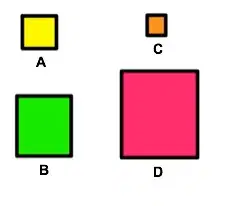
Four boxes of increasing size and weight must be pushed up a ramp. To push the boxes at the same speed, what must you do?
Push the boxes with the same force, smoothly up the ramp.
The larger and heavier the box, the more force you must use when pushing.
Push the boxes with the same force, at exactly the same speed, up the ramp.
Push the largest box with the most force; push the others with about the same force.
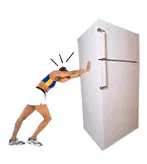
Ben helped his parents load boxes and furniture onto a moving truck. He easily carried several boxes out of the house and up a ramp into the truck. Then he loaded small pieces of furniture by pushing them up the ramp. Finally, Ben tried to move the refrigerator. He pushed and pushed, but it did not move. Why did the refrigerator not move?
because the refrigerator was so tall
because there was no wheels on the refrigerator
because Ben was tired from moving the boxes and furniture
because the refrigerator was much heavier than the other objects
Newton's second law can be expressed as a mathematical formula for the amount of force needed to accelerate an object. It is that force equals mass times acceleration, or, F=ma.
James is trying to prove Newton's 2nd law of motion. He tries to move four different objects with different masses, shapes, and sizes from point A to point B. The objects are a toy car, a car, a refrigerator, and a kitchen table. After some experimentation, he finds that force is dependent on the mass of the object, rather than it's size or shape. The object that takes the most force to move is the
Responses
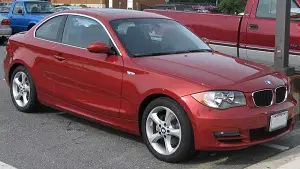


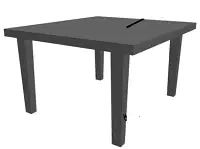
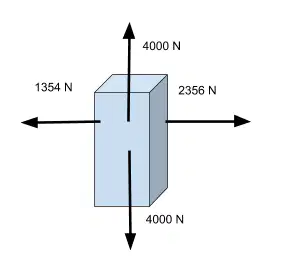
What if the net force (Fnet) acting on the rectangular object?
Fnet = 2, 356 N to the right
Fnet = 1, 002 N to the right
Fnet = 2, 356 N to the left
Fnet = 1, 002 N to the left
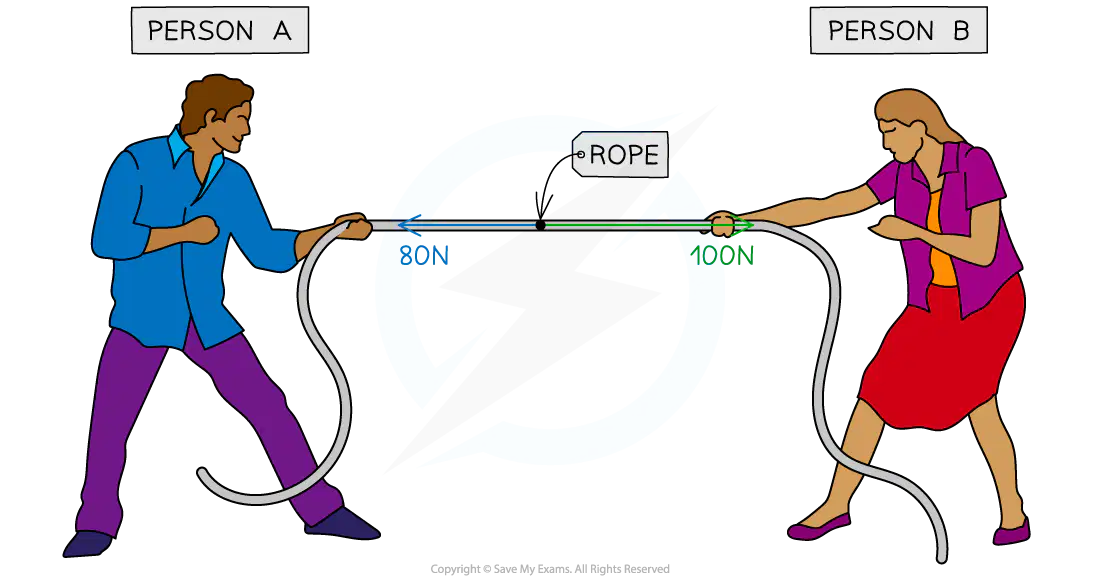
How much more force would Person A have to exert to balance Person B's force?
20 N to the right
20 N to the left
100 N to the left
100 N to the right
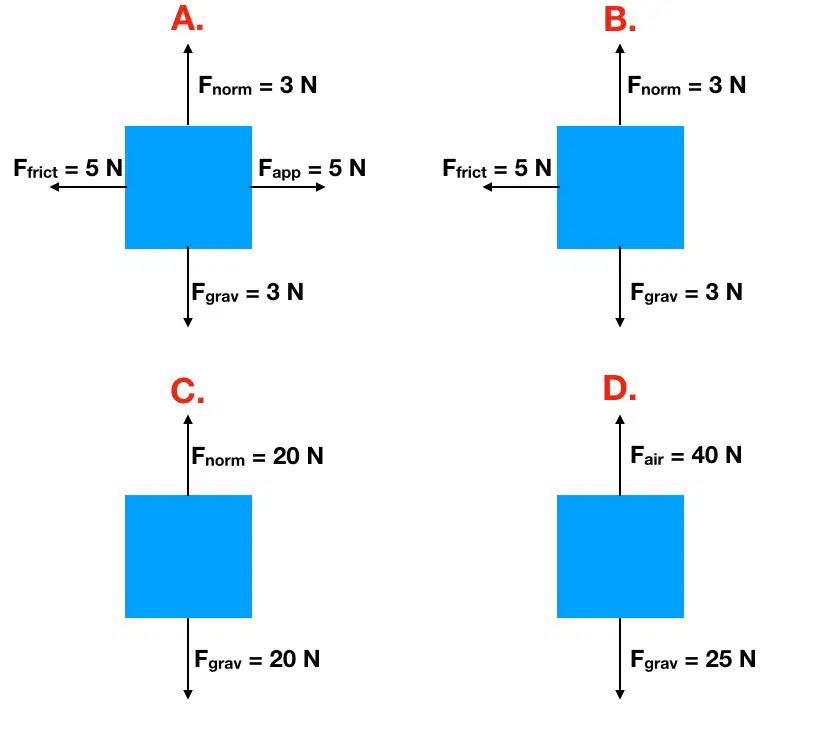
Which of the free body diagrams on the right show no motion of the object? Choose all that apply.
A
B
C
D
This is a force that resists all motion.
gravity
friction
force
Newton
This is an attractive force between any two objects due to mass.
force
gravity
Newton
friction
A train travels south for 100 km for 20 mimutes. What is the train’s velocity? v= d/t
2,000 km/min
2,000 km/min, south
5 km/min, south
5 km/ min
The SI unit of force.
Newton
gravity
force
friction
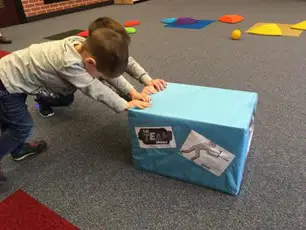
The two kids are pushing a box across carpet. What kind of friction does the carpet apply to the box?
rolling
static
microwelds
sliding
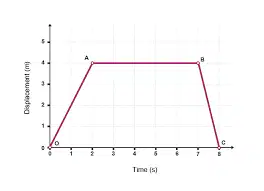
According to the graph, an object left from its original position, traveled for 2 seconds, then stopped for 5 seconds. What is the BEST answer for what the object is doing from 7 to 8 seconds?
slowing down only
returning back to its original position at a faster rate then when it left
returning back to its original position only
walking backwards only
In the 2nd law of motion it is Mass x Acceleration. The ability to apply a change in velocity on a given object is done with ____.
force.
gravity.
friction.
Newtons.
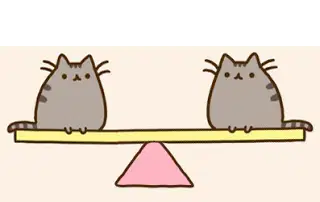
What can be said about the forces acting in the diagram?
They are unbalanced.
They are balanced.
Gravity is the only force acting on the cats.
Cannot be determined.
Which of Newton's laws explains the following example?
A fireman turns on his hose and is knocked backwards.
Newtons' 1st Law
Newton's 2nd Law
Newton's 3rd Law
Which of Newton's laws explains the following example?
It takes less force to move a tennis ball than a basketball.
Newton's 3rd Law
Newton's 2nd Law
Newton's 1st Law
Which of Newton's laws explains the following example?
A kickball will not move until a person kicks it.
Newton's 2nd Law
Newton's 1st Law
Newton's 3rd Law
If an inflated balloon is held sideways, air lets out of a balloon quickly from the right and pushes the balloon to the left.
Newton's 3rd Law
Newton's 2nd Law
Newton's 1st Law
F = ma
Newton's 1st Law
Newton's 2nd Law
Newton's 3rd Law
You are bowling at the bowling alley and you roll a strike, making the pins fly in all directions.
Newton's 3rd Law
Newton's 2nd Law
Newton's 1st Law
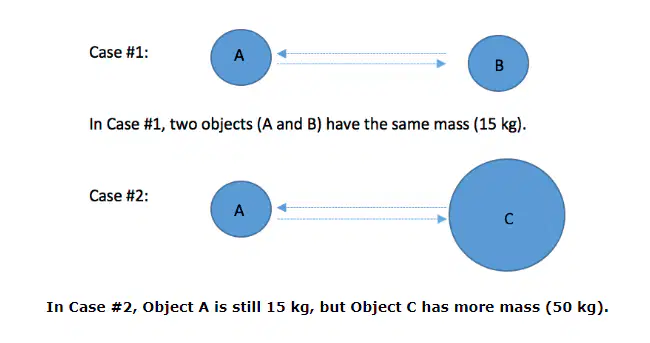
Which do you think is true of the gravitational force acting on Object A in Case #1 versus Case #2?
The gravitational force acting on Object A is greater in Case #1.
The gravitational force acting on Object A is greater in Case #2.
The gravitational force acting on Object A is the same in Case #1 as in Case #2.
It's impossible to tell.
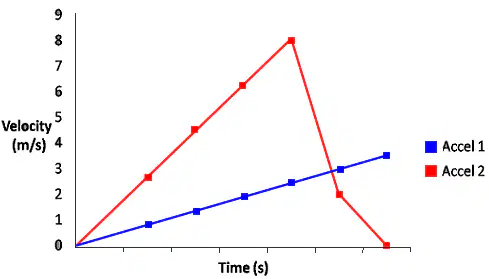
The graph depicts the motion of two objects. Which statement BEST describes the acceleration of the two objects?
Acceleration 1 - no acceleration. Acceleration 2 - negative acceleration.
Acceleration 1 - no acceleration. Acceleration 2 - speeds up and slows down.
Acceleration 1 - constant acceleration. Acceleration 2 - varied acceleration.
Acceleration 1 - positive acceleration. Acceleration 2 - negative acceleration.
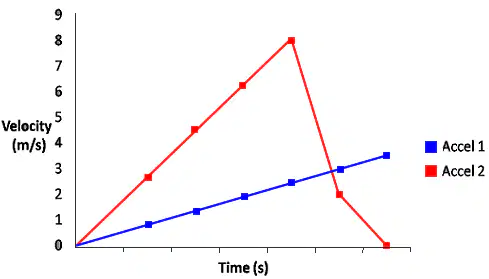
Find the four second mark on the X-axis of the graph. What comment BEST describes the two objects' motion from 0 to 4 seconds?
Both objects show constant acceleration.
Both show constant velocity but Accel 2 is about 4X faster than Accel 1.
Both have a constant rate of acceleration but Accel 2's rate is about 4X that of Accel 1.
Accel 1 has a constant rate of acceleration; Accel 2 accelerates at different rates during the trip.
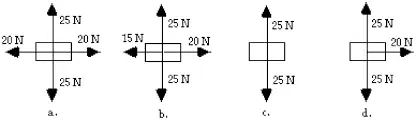
Which free body diagram would show a net force of of 5N to the right?
A
B
C
D

If this soccer player accelerates the 1.8 kg ball at 4 m/s2, what would be the force she used to kick the ball? (F =ma)
2.2 N
0.5 N
7.2 N
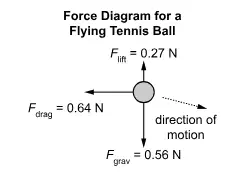
A force diagram of a tennis ball flying through the air toward the right is shown below. The arrows show the directions of the gravitational force (Fgrav), the drag force (Fdrag), the lift force (Flift), and the movement of the tennis ball. Which pair of statements is a valid description and explanation of the motion of the tennis ball based on evidence from the diagram?


Which statement is the BEST analysis of the data for the runner?
The runner covers the first 80 m running at a constant speed and then slows down, reaching a minimum speed during the final 20 m.
The runner starts slower and speeds up, reaching a constant speed between 20 and 80 m , and then speeds up again during the final 20 m.
The runner covers the first 70 m running at a constant speed and then speeds up, reaching a maximum speed during the final 30 m.
The runner starts slower and speeds up, reaching a maximum speed between 50 and 70 m , and then slows down during the final 30 m.

Which choice below would fill in the blanks correctly?
F1 and F2;
balanced;
perpendicular to
F1 and F2;
unbalanced;
in the same direction as
F3 and F4;
balanced;
perpendicular to
F3 and F4;
unbalanced;
in the same direction as

Which diagram for step 2 correctly predicts the distribution of charges on the stainless steel spheres?


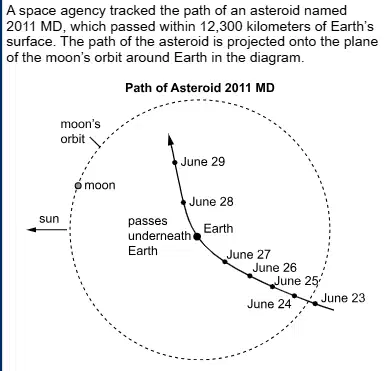
Space scientists claimed that Earth's strong gravitational field was responsible for the path of asteroid 2011 MD. Which argument BEST supports this claim?
The velocity of the asteroid changed as evidenced by the changing direction of the asteroid.
The velocity of the asteroid changed as evidenced by the straight line of the asteroid's path after it passes Earth.
The position of the asteroid bends slightly away from Earth as evidenced by the different locations relative to Earth.
The position of the asteroid bends slightly toward the sun as evidenced by the different locations relative to the sun.

Which statement is an accurate analysis of the vertical motion of the shotput?
The direction of the velocity is upward for the first second and then downward for the last second, and the acceleration decreases during the entire period.
The duration of the velocity is downward for both the first second and the last second, and the acceleration decreases during the entire period.
The direction of the velocity is upward for both the first second and the last second, and the acceleration remains constant for the entire period.
The direction of the velocity is upward for the first second and then downward for the last second, and the acceleration remains constant for the entire period.

