
 Worksheets
Velocity, Acceleration, and Free Body Diagrams - Review
Total questions: 37
Worksheet time: 9hrs 15mins
Whenever an object is moving, there is always this force opposing the motion:
inertia
momentum
friction
applied force
The force that keeps objects on top of surfaces instead of letting them sink into the surface is known as:
normal
abnormal
static
inertia
The force exerted by ropes and chains is called
tension
normal
elastic
mechanical
In a force diagram, or free-body diagram, the size/length of the arrow tells you this about the force:
relative strength
relative distance
relative direction
In a force diagram, or free-body diagram, the pointy-end of the arrow tells you this about the force:
relative strength
relative distance
relative direction
When determining the NET force on an object you should (select TWO correct answers)
subtract forces in opposite directions
add forces in the same direction
divide by velocity
multiply by acceleration
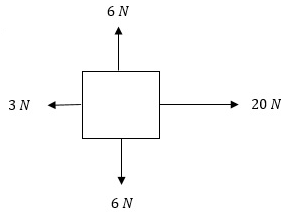
What is the NET FORCE of this diagram?
17 N, right
17 N, left
23 N, right
12 N, up
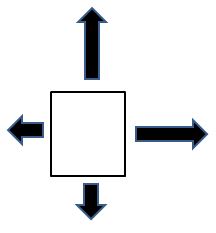
This object would be moving (pick all that are correct):
up
down
left
right
The down-arrow in this diagram is most-likely:
gravity
normal
a push or pull
friction
Which diagram best shows person pushing a couch (accelerating) across the floor?


This diagram can be used to indicate which of the following? (TWO correct answers)
a object at rest
an object moving at a constant velocity (speed)
an object accelerating
(Trick question -- there is only one correct answer)
an object decelerating
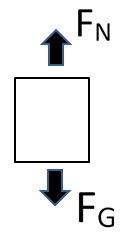
Which of the following is true about this free-body diagram?
the forces are are balanced
the object is free-falling
the object is moving upward
the forces are unbalanced


Match description with free-body diagram.
A force is applied to the right to drag a sled across loosely packed snow with a rightward acceleration. Neglect air resistance.
A football is moving upwards towards its peak after having been booted by the punter. Neglect air resistance.
A car is coasting to the right and slowing down. Neglect air resistance.
A skydiver is descending with a constant velocity. Consider air resistance.


Describe the direction of the motion of this object.
The object is stopped because the forces are balanced.
The object is moving down because the down arrow is bigger.
The object is moving down because Drag is going up.
The object is moving up because the up arrow is bigger.

A golf ball accelerates off a tee, changing its velocity from 0m/s to 50 m/s down the fairway in 5 seconds. What is the golf ball's acceleration?
250 m/s2
45 m/s2
10 m/s2
0 m/s2

A ball of clay is thrown at a wall at a velocity of 28.0 m/s. The final velocity is 0.0 m/s. After it hits the wall, it takes 0.020 seconds to stop. What is the acceleration of the clay when it hits the wall?
1400 m/s2
-1400 m/s2
0.56 m/s2
-0.56 m/s2
The SI unit for acceleration is
mph
ft/sec2
m/s2

A man covers 80 miles every 4 hours on his skateboard what was his speed
24 mi/h
34 mi/h
20 mi/h
28 mi/h

the motorcycle was going 280 miles every 7 hours what was his speed
50 mph
40 mph
30 mph
60 mph

a jet was moving uncontrollably to figure out the distance we had to get a stopwatch and the time was 9 minutes its speed was 900 kilometers per minute what is the distance
8,100 km
7,100 km
6,200 km
10 km

If a car had to travel 320 miles and it was only driving at 4 miles per hour, how long would it take to reach its destination?
60 hours
80 hours
60 minutes
80 minutes

A biker pedaled 63 miles and her total trip took 7 hours. What was the average speed during her trip?
7 mph
9 mph
70 mph
422 mph

The 28th Annual Northern Scooter race is 42 kilometers long. The contestant who came in 7th place traveled at an average speed of 14 kilometers per hour. How long did it take this contestant to finish the race?
2 hours
3 hours
6 hours
14 hours

Marty McFly hoped to use his hoverboard to travel 24 miles in 4 hours. What speed would he have to travel in order to arrive on time?
22 mph
88 mph
28 mph
6 mph
A car is driving down the freeway at 40 m/s. Six seconds later, there was as slow moving traffic jam and the driver had to slow down to 5 m/s. What is the acceleration rate for this car?
Just type the numerals, rounded to the hundreths place (two decimals). We will assume you know the units.
(a)
A girl cycles for 2.5 hours at a speed of 27 km/h. What distance did she travel?
Include the correct unit of measurement.
(a)
The Waltons are going on vacation to Cedar Point. The distance between their home and the amusement park is 210 miles. It takes the family 3 hours to drive to the park. What speed did they travel at?
include units in your answer!
(a)
The bus taking the soccer team to the state finals was driving at an average speed of 100 km/h. The game was at a stadium 225 kilometers away. How long did it take the bus to get to the game?
make sure to include the unit of measurement!
(a)

