
 Worksheets
Atoms, Ions, Isotopes- AKS 1
Total questions: 40
Worksheet time: 41mins
Name
Class
Date
1.
The positive particles of an atom are
a)
electrons
b)
positrons
c)
neutrons
d)
protons
2.
the central region of an atom where its neutrons and protons are is its
a)
nucleus
b)
electron cloud
c)
core
d)
center
3.
an atom with atomic number 6 would have how many protons
a)
6
b)
12
c)
3
d)
cannot be determined
4.
Particles in an atom that are neutral and have no charge are
a)
negatrons
b)
electrons
c)
neutrons
d)
protons
5.
True or False? Neutrons have a negative charge
a)
True
b)
False
6.
What is the atomic number for an element with three protons?
a)
2
b)
1
c)
3
d)
6
7.

What does the 1.00794 stand for?
a)
Hydrogen
b)
atomic number
c)
atomic mass
d)
atomic explosion
8.

What is the charge on the calcium ion?
a)
1+
b)
2+
c)
Sometimes 1+, sometimes 2+.
d)
2-
9.
How many protons does the following particle have? 52Cr6+
a)
52
b)
24
c)
28
d)
18
10.
How many neutrons does the following particle have? 52Cr6+
a)
52
b)
24
c)
28
d)
18
11.

What is an ion?
a)
A Charged Atom
b)
A Large Atom
c)
A Small Atom
d)
A Cute Atom
12.

Cations are...
a)
Positive
b)
Negative
c)
Neutral
d)
Purring
13.

Anions are...
a)
Positive
b)
Negative
c)
Neutral
d)
Crying
14.

An atom becomes _________ when it gains electrons.
a)
Positive
b)
Negative
c)
Neutral
d)
Invinsible
15.

An atom becomes _______ when it loses electrons.
a)
Positive
b)
Negative
c)
Neutral
d)
Invinsible
16.
Valence electrons are:
a)
Electrons farthest away from the nucleus
b)
Electrons closest to the nucleus
c)
Electrons that just come and go - they don't stay with the atom
17.

Why are ions formed?
a)
To make our lives difficult
b)
Because atoms want 8 valence electrons
c)
Because atoms have the same number of protons and electrons
d)
Because atoms gained neutrons
18.
How many neutrons does the isotope of lithium-8 have?
a)
8
b)
3
c)
4
d)
5
19.
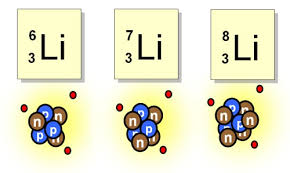
which atom has 4 neutrons?
a)
Li-6
b)
Li-7
c)
Li-8
d)
they have the same # of neutrons
20.

What is the charge on a lithium atom that looses 1 electron?
a)
+1
b)
0
c)
-1
d)
-2
21.
The atomic mass is equal to _.
a)
the number of protons only
b)
the number of neutrons only
c)
the total number of protons and neutrons
d)
the number of protons, neutrons, and electrons.
22.
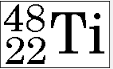
How many protons does this isotope of titanium have? Hint titanium has an atomic number of 22.
a)
48
b)
22
c)
26
d)
70
23.

How many neutrons does B (Boron) contain?
a)
5
b)
11
c)
6
d)
10.811
24.
What quantities vary between isotopes of an element?
a)
protons, electrons, and atomic mass
b)
protons, electrons, and atomic number
c)
neutrons and electrons
d)
neutrons and atomic mass
25.
Two isotopes of carbon are carbon-12 and carbon-14. These isotopes differ from one another by two protons.
a)
true
b)
false
26.
What is the charge on an Aluminium ion?
a)
3
b)
+3
c)
+2
d)
+1
27.
How many total electrons does O-2 (an oxide ion) have?
a)
8
b)
10
c)
6
d)
18
28.
What subatomic particles would you find in the nucleus of an atom?
a)
Protons only
b)
Protons and Neutrons
c)
Neutrons and Electrons
d)
Protons and Electrons
29.
Which subatomic particles contribute the most to the mass of an atom?
a)
Protons, Neutrons, Electrons
b)
Protons only
c)
Protons and Electrons
d)
Protons and Neutrons
30.
If an atom has 12 positively charged subatomic particles, which of the following must it also have to be considered a neutral atom?
a)
12 neutrons
b)
12 electrons
c)
12 protons
d)
24 protons and neutrons
31.
An atom has 10 protons, 15 neutrons and 10 electrons what is its mass number.
a)
20
b)
10
c)
5
d)
25
32.
What is the charge of a sodium ion?
a)
+2
b)
+1
c)
-1
d)
-2
33.
Group 17 always has ions with a charge of
a)
+1
b)
+2
c)
-1
d)
-2
34.
What charge will an Oxygen ion have?
a)
+1
b)
-1
c)
+2
d)
-2
35.
If an element has 3 valence electrons, what charge will likely form on its ion ?
a)
+3
b)
+5
c)
-3
d)
-5
36.
Vertical columns of elements (families) on the periodic table with similar properties
a)
groups
b)
periods
c)
quadrants
d)
rows
37.
Which group of the periodic table is composed of inert (not reactive) gases?
a)
alkali metals
b)
alkaline earth metals
c)
halogens
d)
noble gases
38.
Which is a halogen?
a)
Helium
b)
Chlorine
c)
Oxygen
d)
Neptune
39.
Which is an alkali metal?
a)
Magnesium
b)
Iron
c)
Sodium
d)
Europium
40.
What happens to the number of valence electrons as you go from element 1 to element 36?
a)
Valence electrons increase
b)
Valence electrons decrease
c)
Valence electrons increase and then decrease in a pattern
d)
Valence electrons decrease and then increase in a pattern
100 %

