wayground logo

Free Printable Worksheets

NEW

Font size

S
M
L
XL
Worksheets

Exam 4.1 Review

Total questions: 67

Worksheet time: 2hrs 56mins
Name
Class
Date
1.

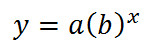
In an exponential function, what does the 'a' represent?

a)

SLOPE

b)

RATE OF CHANGE

c)

INITIAL VALUE

d)

COMMON RATIO

2.
What is a, the starting term, for the function: f(x) = 300(1.16)x?
a)
300
b)
1.16
c)
.16
d)
x
3.
Which of the following functions shows an initial amount of $15 and an increase of 35% each year?
a)
y = 15(35)x
b)
y = 15(1.35)x
c)
y = 15(0.35)x
d)
y = 35(1.15)x
4.
Classify the model as Exponential GROWTH or DECAY.
A=1200(.85)6
a)
Growth
b)
Decay
5.
Classify the model as Exponential GROWTH or DECAY.
A=10(1.01)3
a)
Growth
b)
Decay
6.
Suppose a culture of bacteria begins with 5000 cells and dies by 30% each year. Write an equation that represents this situation.
a)
y=5000(0.7)x
b)
y=30(5000)x
c)
y=5000(1.3)x
d)
y=5000xx
7.
Write an equation that models the following situation:
Samantha's hair was known to grow very rapidly. It began at a length of 6 in and grew at a rate of 14% a week.
a)
y=6(0.14)x
b)
y=6(1+14)x
c)
y=6(1.14)x
d)
y=6(0.86)x
8.
Which of the following functions shows an initial amount of $15 and an increase of 35% each year?
a)
y = 15(35)x
b)
y = 15(1.35)x
c)
y = 15(0.35)x
d)
y = 35(1.15)x
9.
Identify the y-intercept (initial value) in the function f(x)=13(.27)x
a)
(.27)x
b)
.27
c)
13
d)
3.51
10.
Identify the y-intercept (initial value) of the function f(x)=2(4)x.
a)
2
b)
4
c)
(2)x
d)
8
11.
What is r, the decay rate, for the function: f(x) = 800(0.85)x?
a)
800
b)
0.85
c)
0.15
d)
x
12.

Does the function y=3(0.25)x represent

a)

exponential growth

b)

linear growth

c)

exponential decay

d)

linear decay

13.
What is a, the starting term, for the function: f(x) = 300(1.16)x?
a)
300
b)
1.16
c)
.16
d)
x
14.

What is the starting point in the function:

y = 1.275(2.983)x ?

a)

1.275

b)

2.983

15.

What is the starting point in the function:

y = 7x ?

a)

1

b)

7

16.

What is a, the starting point, for the function: y= 300(1.16)x?

a)

300

b)

1.16

c)

.16

d)

x

17.

The initial value of an exponential function is 0.73. The rate of decay is 6%. Which function models the value of the function, y, over time t?

a)
b)
c)
d)
18.

An exponential function decays at a rate of 20% and has an initial value of 13. Which represents the function?

a)

y=-13(0.2)t

b)

y=13(1.8)t

c)

y=13-(0.2)t

d)

y=13(0.8)t

19.

The initial value of an exponential function is 1.8. The rate of growth is 4.2%. Which models the value of the function, y, over time t?

a)

y=1.8(1.42)t

b)

y=1.8+4.2t

c)

y=1.8(1.042)t

d)

y=1.8(4.2t)

20.

An exponential function has a growth rate of 9% and an initial value of 350. Which represents the function?

a)

y=3.5+(1.09)x

b)

y=350(1.09)x

c)

y=350(1.9)x

d)

y=350+(1.09)x

21.

My money tripled each month after I initially started with $6.

a)

f(x)=6(1.03)x

b)

f(x)=6(3)x

c)

f(x)=3(6)x

d)

f(x)=6(.97)x

22.

I initially had 50 bacteria in science class and they decreased by 12% each year.

a)

f(x)=50(.12)x

b)

f(x)=50(1.12)x

c)

f(x)=1.12(50)x

d)

f(x)=50(.88)x

23.

I started with $2,000 in my bank account and it increased by 7% each year.

a)

f(x)=2000(0.07)x

b)

f(x)=.07(2000)x

c)

f(x)=2000(1.07)x

d)

f(x)=1.07(2000)x

24.
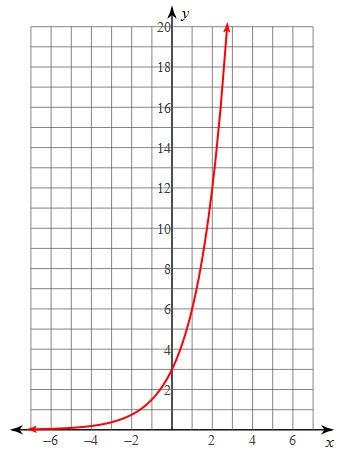
What is the y-intercept of the function?
a)
2
b)
3
c)
1
d)
-2
25.
What type of function is f(x)=2(1/7)x ?
a)
Exponential Growth
b)
Linear
c)
Exponential Decay
d)
None of the Abovee
26.
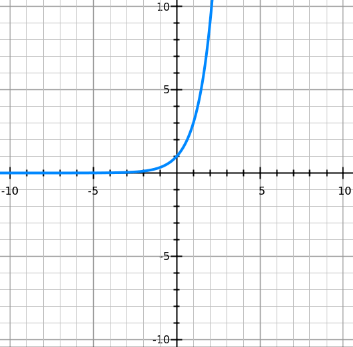
What is the equation of the horizontal asymptote?
a)
y=1
b)
y=0
27.
This graph represents:
a)
Exponential Growth
b)
Exponential Decay
c)
Direct Variation
d)
None of the above
28.
Is the pictured graph growth, decay, or linear?  
a)
Exponential Growth
b)
Exponential Decay
c)
Linear
d)
None of the above
29.
What type of function is y = 7(5/4)x?
a)
Exponential Growth
b)
Exponential Decay
c)
Linear
d)
None of the above
30.
What is the y-intercept of the function?
a)
(0,2)
b)
(0,3)
c)
(0,1)
d)
(0,-2)
31.
Find the exponential model of the function.
a)
y = 100(8.8)x
b)
y = 100(1.88)x
c)
y = 100(.88)x
d)
y = 100(.12)x
32.
Write the exponential regression equation for this data.
a)
Y = 8.16(2.7)X
b)
Y = 81.6(2.7)X
c)
Y = 8.16(.27)X
d)
Y = 8.16(27)X
33.
Write the exponential regression equation for this data.
a)
Y = 8.16(2.7)X
b)
Y = 81.6(2.7)X
c)
Y = 8.16(.27)X
d)
Y = 8.16(27)X
34.
After 9 days, approximately how many grams of this substance will exist?
a)
about 64244
b)
about 173602
c)
about 23774
d)
about 469111
35.
Predict the year when Sugar Land’s population will reach 75,000.
a)
2015
b)
1991
c)
1992
d)
2010
36.
Greenville is having a blizzard.  It has already snowed 1 inch and the total will double each hour.  Write an equation for the total inch of snow in x hour.
a)
y=1(2)x
b)
y=1(1/2)x
c)
y=2(1/2)x
d)
y=2(2)x
37.
In an exponential function, what does the 'a' represent? 
a)
SLOPE
b)
RATE OF CHANGE
c)
Y-INTERCEPT
d)
COMMON RATIO
38.
What is the equation of this table?
a)
y=512(1/4)x
b)
y=32(4)x
c)
y=32(1/4)x
d)
y=512(4)x
39.
A new savings account is opened with $400 and gains 3% every year. What is the exponential function?
a)
f(x)=400(1+3)x
b)
f(x)=400(1-0.03)x
c)
f(x)=400(1+0.03)x
d)
f(x)=400(0.03)x
40.
The value of a car is $15,000 and depreciates at a rate of 8% per year. What is the exponential equation?
a)
y=8(15,000)x
b)
y=15,000(1.08)x
c)
y=15,000(0.92)x
d)
y=15,000(0.08)x
41.
g(x)=3(2)x
Find g(3)
a)
216
b)
24
c)
18
d)
28
42.
An adult takes 800 mg of ibuprofen. Each hour, the amount of ibuprofen in the person’s system decreases by about 29%. How much ibuprofen is left after 6 hours? 
a)
101
b)
102
c)
103
d)
104
43.
Your shiny new boat cost $7650.  The depreciation for your boat is 14% per year. What is the decay factor?
a)
0.14
b)
14
c)
1.14
d)
.86
44.
Which of the equations below represent this table?
a)
y=3⋅(36)x
b)
y=36⋅(3)x
c)
y=3⋅(⅓)x
d)
y=36⋅(⅓)x
45.
Write the equation that represents the table below:
a)
y=½(4)x
b)
y=2(4)x
c)
y=4(2)x
d)
y=4(½)x
46.
Use the exponential regression to find an equation that fits the​ data, where x is the years since 1990.
a)
y=8.92•1.23x
b)
y=1.23•8.92x
c)
y=8.92+1.23x
d)
y=8.92x+1.23
47.

If the Exponential Regression for the table above is f(x)= 8.9(1.23)^x What is the estimated number of cell phone subscribers in 2018, if x represents the number of years since 1990?

a)

2936 millions

b)

847 millions

c)

4441 millions

d)

370 millions

48.
Find the 22nd term of the following sequence:
5, 8, 11, ...
a)
14
b)
68
c)
63
d)
71
49.
Identify the common difference.
97, 86, 75, 64, ...
a)
8
b)
11
c)
-11
d)
-8
50.
Identify the common difference.
3, 7, 11, 15, ...
a)
6
b)
5
c)
4
d)
2
51.
Find the 32nd term of this sequence.
34, 37, 40, 43, ...
a)
32
b)
64
c)
127
d)
356
52.
Find the 32nd term of this sequence.
9, 4, -1, -6, -11, ...
a)
81
b)
-34
c)
-146
d)
-225
53.
Find the 25th term of the sequence if a1 = 5 and d = 0.5
a)
18
b)
17
c)
15
d)
14
54.
The next two terms of the sequence 4,7,10,13 are ....
a)
16 and 19
b)
15 and 19
c)
16 and 18
d)
15 and 18
55.
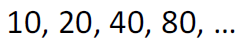
Determine whether the sequence is arithmetic, geometric, or neither.
a)
arithmetic
b)
geometric
c)
neither
56.
Determine whether the sequence is arithmetic, geometric, or neither.
a)
arithmetic
b)
geometric
c)
neither
57.
Determine whether the sequence is arithmetic, geometric, or neither.
a)
arithmetic
b)
geometric
c)
neither
58.
Find the common ratio for the geometric sequence.
a)
10
b)
1/2
c)
2
d)
4
59.
Write the explicit formula for the geometric sequence.
a)
an = 10(2)n-1
b)
an = 2(10)n-1
c)
an = 10(2)n
d)
an = 2(10)n
60.
Find the common ratio for the geometric sequence.
a)
-4
b)
4
c)
1/4
d)
-1/4
61.
Write the explicit formula for the geometric sequence.
a)
an = 4(3)n-1
b)
an = 3(4)n-1
c)
an = -4(3)n-1
d)
an = 3(-4)n-1
62.
Find the common ratio for the geometric sequence.
a)
2/3
b)
3/2
c)
-2/3
d)
-3/2
63.
Write the explicit formula for the geometric sequence.
a)
an = 162(2/3)n-1
b)
an = (2/3)(162)n-1
c)
an = 162(3/2)n-1
d)
an = 162 + (n-1)(-54)
64.
Find the common ratio for the geometric sequence.
a)
2
b)
-2
c)
1/2
d)
-1/2
65.
Write the explicit formula for the geometric sequence.
a)
an = 2(100)n-1
b)
an = 100(2)n-1
c)
an = 100(1/2)n-1
d)
an = (1/2)(100)n-1
66.
What is the 14th term of the geometric sequence?
a)
14,348,907
b)
4,782,969
c)
1,594,323
d)
45
67.
What is the 11th term of the geometric sequence?
a)
-5120
b)
97,656,250
c)
19,531,250
d)
-19,531,250