
 Worksheets
Adv. Geometry Semester 1 Review
Total questions: 70
Worksheet time: 2hrs 30mins


Dilate a figure by a scale factor of 3 with the origin as the center of dilation. What are the coordinates of the image?
A(3,3) B(6,6) C(9,3)
A'(9,9) B'(18,18) C'(27,9)
A'(6,6) B'(9,9) C'(12,6)
A'(0,0) B'(3,3) C'(6,0)
A'(1,1) B'(2,2) C'(3,1)

Identify the angle of rotation that maps the image to itself.
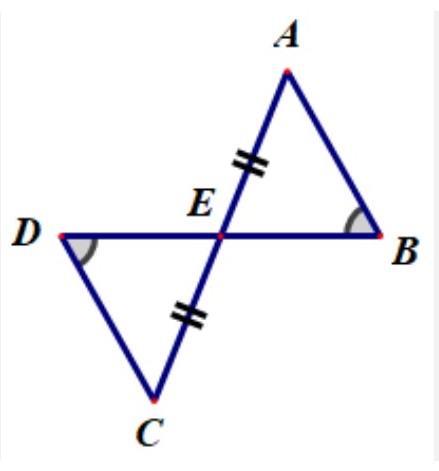
Are these two triangles congruent? If so, how?
Yes, by SAS
Yes, by AAS
Yes, by ASA
Yes, they look congruent.
No they are not congruent
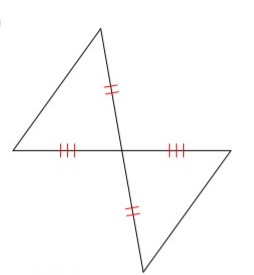
Are these two triangles congruent? If so, how?
Yes, by SAS
Yes, by SSS
Yes, by ASA
Yes, they look congruent
No they are not congruent
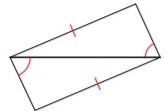
Are these two triangles congruent? If so, how?
Yes, by SAS
Yes, by SSA
Yes, by AAS
Yes, they look congruent
No, they are not congruent
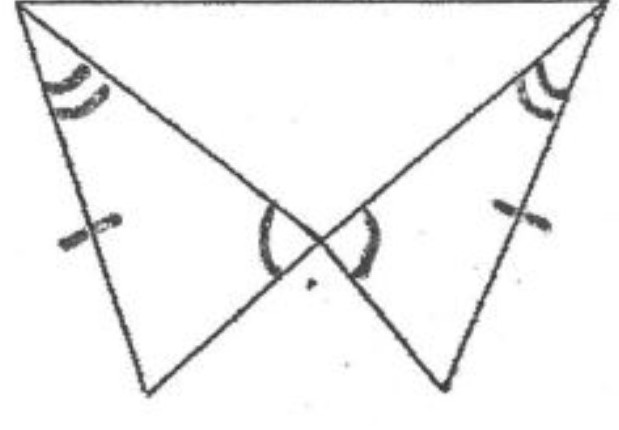
Are these two triangles congruent? If so, how?
Yes, by ASA
Yes, by AAA
Yes, by AAS
Yes they look congruent
No they are not congruent
If ∆LMK ≅ ∆LMT, then
∠K ≅ ____
MT
∠T
∠M
∠L

Classify the triangle.
Equilateral
Scalene Acute
Scalene Right
Scalene Obtuse

Classify the triangle.
Equilateral
Isosceles Acute
Isosceles Right
Isosceles Obtuse

Classify the triangle.
Equilateral
Isosceles Acute
Isosceles Right
Isosceles Obtuse

What is the measurement of the 3rd side of this isosceles triangle?
(a)

What is the measurement of angle x for this isosceles triangle?
(a)

What is the measurement of ED if EF = 16?
(a)
Can the following 3 numbers be side measures of a triangle
7, 5, 4
Yes
No
Can the following 3 numbers be side measures of a triangle
1, 13, 13
Yes
No
Can the following 3 numbers be side measures of a triangle
3, 6, 2
Yes
No

What is the measure of angle c?
102
26
82
108

What is the value of x?
143
40
77
103


c = 7.5
Is this a right triangle?

4, 5, 6




Solve for x.
A
B
C
D

Solve for x.
A
B
C
D

Solve for x.
A
B
C
D

Solve for x.
A
B
C
D

Solve for x.
A
B
C
D

Find the measure of the angle indicated in bold.
A
B
C
D

Find the center: (x+4)2+(y−2)2 = 25
(4, 2)
(-4, -2)
(-4, 2)
(4, -2)
Find the radius: (x+4)2+(y−2)2 = 25
2.5
5
25
50

Find the center: (x−7)2+y2 = 25
(7, 0)
(-7, 0)
(7, 1)
(-7, -1)
What is the equation of the circle?
center: (5, 3), radius: 2
(x−5)2+(y−3)2=2
(x−5)2+(y−3)2=4
(x+5)2+(y+3)2=2
(x+5)2+(y+3)2=4

Write the equation of the circle graphed above.
(x-2)2+(y+2)2=9
(x+2)2+(y-2)2=9
(x-2)2+(y+2)2=3
(x+2)2+(y-2)2=3
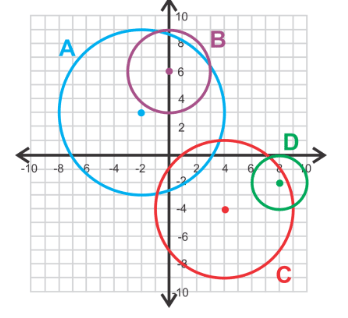
(x)2+ (y-6)2=9
Which two lines are parallel?
y=73x−25
y=73x+2
y=37x−25
y=3x+13
y=7x+9
Which line is parallel to the line: 5x+6y=12
y=−65x−2
y=65x+13
y=5x+11
y=−5x−100
Which lines are parallel to the line: 5x+8y=32
y=85x−1
y=−85x+13
y−12=85(x+13)
y−5=85(x+8)
y−2=−85(x+3)
Which two lines are perpendicular?
y=73x−25
y=−73x+2
y=−37x−25
y=3x+13
y=7x+9
Which line(s) are perpendicular to the line: 8x+2y=22
y=41x−1
y=−41x+13
y−12=−41(x+13)
y−5=4(x+8)
y−2=41(x+3)
Which line is perpendicular to the line: 5x+6y=12
y=−65x−2
y=65x+13
y=56x+11
y=−56x−100
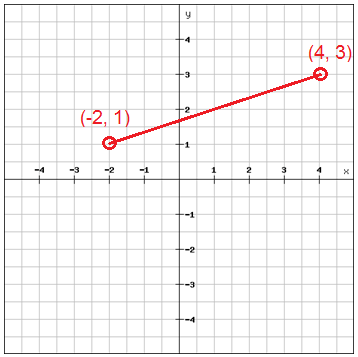
What is the distance between the two points?
4
410
102
What is the midpoint of the segment with endpoints (1, 9) and (-3, 5)?
(-1, 7)
(2, 7)
(7, -1)
(2, 2)

Which is the correct way to name ∠q?
∠RPQ
∠QPR
∠PQR
Refer to the following statement: "If a polygon is a quadrilateral, then it is a trapezoid."
What is the converse of this statement?
If a polygon is not a quadrilateral, then it is not a trapezoid.
If a polygon is not a trapezoid, then it is not a quadrilateral.
If a polygon is a trapezoid, then it is a quadrilateral.
A rectangle is also a quadrilateral.
Refer to the following statement: "If a polygon is a quadrilateral, then it is a trapezoid."
What is the inverse of this statement?
If the polygon is not a quadrilateral, then it is not a trapezoid.
If the polygon is not a trapezoid, then it is not a quadrilateral.
If the polygon is a trapezoid, then it is a quadrilateral.
A rectangle is also a quadrilateral.
Refer to the following statement: "If a polygon is a quadrilateral, then it is a trapezoid."
What is the contrapositive of this statement?
If a polygon is a trapezoid, then it is a quadrilateral.
If a polygon is not a quadrilateral, then it is not a trapezoid.
If a polygon is not a trapezoid, then it is not a quadrilateral.
A rectangle is also a quadrilateral.
Refer to the following statement: "If a polygon is a quadrilateral, then it is a trapezoid."
What is a counterexample of this statement?
If a polygon is a trapezoid, then it is a quadrilateral.
If a polygon is not a quadrilateral, then it is not a trapezoid.
If a polygon is not a trapezoid, then it is not a quadrilateral.
A rectangle is also a quadrilateral.
The statement "an angle is a right angle if and only if its measure is 90o" is an example of what type of statement?
Conditional
Conjecture
Biconditional
Factor
k2 -2k - 24
(k+4)(k-6)
(k+4)(k+6)
(k+6)(k-1)
(k-4)(k+6)
Factor
k2+7x+10
(k+2)(k+5)
(k-2)(k-5)
(k+10)(k+4)
(k+2)(k-5)
x2 + 12x + 36
Solve by elimination:
7x+y=-9
-3x-y=5
No solution
(1,8)
(-1,-3)
(-1,-2)
Solve by elimination.
6x - y = 2
-3x - 6y = 12
(2,0)
no solution
(0,-2)
infinite solutions
What is the solution to this system of equations?
4x + y = 6
x - 2y = 6
(2,-2)
(1,2)
( 1/2 , 4 )
(-2,2)
(2, 4)

