Worksheets
Quadratic Unit Review
Total questions: 68
Worksheet time: 6hrs 0mins

Which equation is equivalent to the equation below


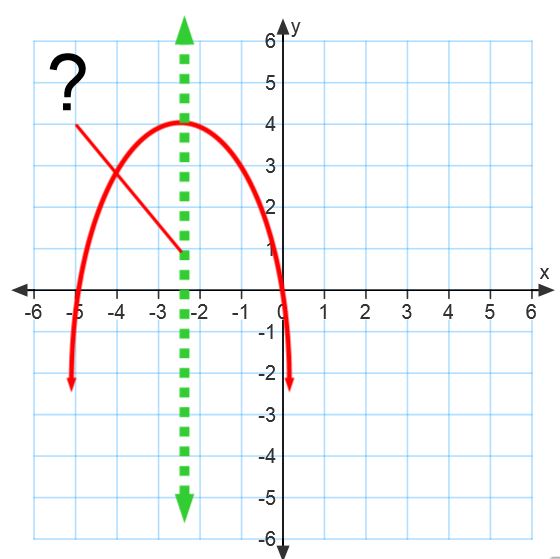
Write the equation of the graph .
x2 + 2x - 3
x2 - 2x - 3
x2 - 2x + 3
x2 + 2x + 3
Which graph represents the f(x) = x2 + 4x + 4


Choose two factors that could represent the following graph.
(x + 3) ( x - 3)
(x + 3) (x + 2)
(x + 3) (x + 3)
(x + 3) (x - 2)

Which equation represents the following quadratic function?


Find the solution(s) to the following quadratic function
(x + 9)(x + 3)
(x - 9)(x - 3)
(x - 9)(x + 3)
(x - 1)(x + 27)
Find the root(s) to the following quadratic function 5x2 – 30x +45 = 0
x = 5
x = -5
x = -3
x = 3
Factor x2 -5x = -4
(x - 1)(x + 4)
(x - 2)(x + 2)
(x - 1)(x - 4)
(x + 1)(x + 4)
Find the zero (s) to the following quadratic function x2 -5x = -4
x = 1, x = 4
x = -1, x = -4
x = -1, x = 4
x = 1, x = -4

What is the domain and range of the
quadratic function graphed?
D: x > 1 R: All real numbers
D: x ≥2 R: y≥1
D: All Real numbers R: y≥2
D: All Real numbers R: y ≥1

Which function has the same roots.
5(x - 2)(5x + 2)
4(x + 2)(2x + 3)
12(x - 2)(3x - 2)
9(x + 2)(2x - 5)
The roots of an equation are -2/3 and 9/10. Which expressions are the factors
(10x + 9)(2x + 3)
(9x - 10)(3x + 2)
(10x - 9)(3x +2)
(9x + 10)(2x - 3)
Which equation has imaginary or complex solutions?
−2x2−6x+2=0
3x2−5x+3=0
4x2+x −5=0
−6x2+2x+7=0
If the function f(x)= −3x2 is shifted 4 to the right and 2 up, which of the following is the new equation?
f(x)=−3(x+2)2−4
f(x)=−3(x−2)2−4
f(x) = −3(x+4)2+2
f(x)=−3(x−4)2+2
If the function f(x)= −3x2 is shifted 4 to the left, which of the following is the new equation?
f(x)=−3x2+4
f(x)=−3x2−4
f(x) = −3(x+4)2
f(x)=−3(x−4)2
A graph of the function has x-intercepts of (3,0) and (-2,0). Which function represents the graph?
f(x)=x2+x−6
f(x)=x2−5x+6
f(x)=x2+5x+6
f(x)=x2−x−6

What is the next step?
x2+10x + 25 =−2+25
x2+10x+100=−2+100
x2+10x+5=−2+5
x2+10x+20=−2+20


How many solution(s) does the quadratic equation have for the graph?
1 real solution
2 real solutions
No real solutions it has 1 imaginary solution
No real solutions it has 2 imaginary solutions

Which of the following inequalities represents the graph shown?
y<−x2+6
y>−x2+6
y≤−x2+6
y≥−x2+6
In x2−52x+c what value of c would
complete the square?
254
251
252
51
Solve x2−8x−1=x−19
x=-6 and x = -3
x = -6 and x = 3
x = 6 and x = -3
x = 6 and x = 3

5 seconds
6 seconds
7 seconds
8 seconds

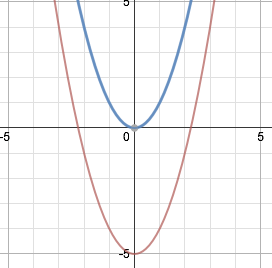
They have the same y-intercept
The have the same vertex
They both have a minimum point
They both open up
How did we transform from the parent function y = x2 to y = -1/5(x - 1)2 + 7 ?
reflection, vertical shrink, horizontal shift right, vertical shift up
vertical shrink, horizontal shift left, vertical shift up
reflection, horizontal shift right, vertical shift down
reflection, vertical stretch, horizontal shift left, vertical shift up

What is the "real part" of the complex number (-2+7i)?
2
-2
7i
-7i
What is the "imaginary part" of the complex number (-2+7i)?
2
-2
7i
-7i
2i - 7i + 10
Which of the following is equivalent to
(5-3i)+(-6+2i)?
-1-5i
-1-i
11-i
-30-6i
What can we find easily in standard form?
vertex
x-intercepts
y-intercept
What can we find easily in factored form?
y-intercept
vertex
x-intercepts
What can we find easily in vertex form?
vertex
y-intercept
x-intercepts
Identify the form of the quadratic function:
f(x ) = (x + 1)2 - 3
Standard
Factored
Vertex
Identify the form of the quadratic function:
f(x) = 3(x + 2)(x - 1)
Vertex
Standard
Factored
Identify the form of the quadratic function:
f(x) = (x - 8)(x + 8)
Vertex
Standard
Factored
y = 3(x + 5)2 - 4,
what is the vertex of the parabola?
y=-(x-4)2-3,
does this parabola have a maximum or minimum value?
For f(x)=a(x-5)(x-4), what are the coordinates of the x-intercepts?
(-5,0) and (-4,0)
(4,0) and (-5,0)
(5,0) and (-4,0)
(5,0) and (4,0)

y < 2x2 -3x+1

Solve:
2x2 + 5x ≥ 12
[-4, 1.5]
(−∞, -4) U (1.5, ∞)
(−∞, -4] U [1.5, ∞)
no solution
Solve: 5x - 10x2 < 0
(0, ½)
[0, ½]
(−∞, 0) U (½, ∞)
(- ½ , 0)

For the function above, is the discriminant positive, negative, or zero?
For the function below, is the discriminant positive, negative, or zero?
___________
y = x² + 4x + 4
Positive
Negative
Zero
Not Sure

For the function above, is the discriminant positive, negative, or zero?
______________
How many solutions does it have?
Determine the values of
a, b, and c for
the quadratic equation:
4x2 – 8x = 3
a = 4, b = -8, c = 3
a = 4, b =-8, c =-3
a = 4, b = 8, c = 3
a = 4, b = 8, c = -3