Wayground logo

Free Printable Worksheets

Font size

S
M
L
XL
Worksheets

Entrepreneurship Unit 3

Total questions: 65

Worksheet time: 56mins

Name
Class
Date
1.
Which of the following best describes the Law of Demand?
a)
As price goes down, demand goes down. (and vice versa).
b)
As price goes down, demand goes up (and vice versa).
c)
As demand goes down, supply goes up.
d)
As demand goes up, price becomes elastic.
2.

What goes on the horizontal axis (x axis) of a demand graph?

a)

price

b)

quantity demanded

c)

quantity supplied

d)

change in demand

3.
Which of the following would NOT cause a demand curve to shift?
a)
a change in a consumer's income level
b)
a change in population
c)
a change in a consumer's expectations
d)
a change in the price of a product.
4.
The demand curve always slopes
a)
down and to the right
b)
straight up and down
c)
down and to the left
d)
up and to the right
5.
The price of petrol/gas is expected to increase next week. Then today the demand for petrol/gas will
a)
increase
b)
decrease
6.

Which of the following does the law of supply assume?

a)

Nothing is constant

b)

Producers try to maximize their profits

c)

Lower price means larger quantity

7.

Supply and demand are __________ related.

a)

Not

b)

Rarely

c)

Inversely

d)

Uniformly

8.

The place where the supply curve intersects the demand curve is known as which of the following?

a)

Utility

b)

Equilibrium

c)

Marginal cost

9.
Which of the following best describes the Law of Demand?
a)
As price goes down, demand goes down. (and vice versa).
b)
As price goes down, demand goes up (and vice versa).
c)
As demand goes down, supply goes up.
d)
As demand goes up, price becomes elastic.
10.
The diagram represents a
a)
increase in demand
b)
decrease in demand
11.
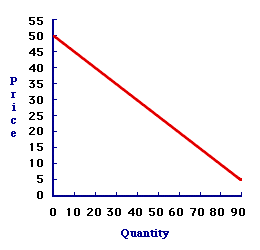
What does this curve represent?
a)
demand
b)
supply
c)
equilibrium
d)
shortage
12.
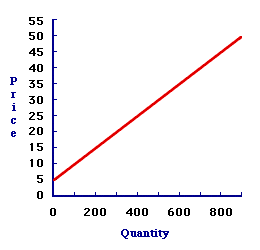
What does this curve represent?
a)
supply
b)
equilibrium
c)
demand
d)
surplus
13.

Which graph below shows the SUPPLY CURVE?

a)

A

b)

B

c)

C

d)

D

14.
The diagram represents a(n)
a)
increase in supply
b)
decrease in supply
c)
change in quantity supplied
d)
none of the above
15.
The Law of Supply states:
a)
as price increases, supply increases
b)
as prices decrease, supply increases
c)
as price increases, quantity demanded decreases
d)
as price decreases, quantity demanded decreases
16.

Free warranty offered on new purchases

a)

Cost leadership

b)

Differentiation

c)

Focus

17.

Our company does not test product on animals

a)

Cost leadership

b)

Differentiation

c)

Focus

18.

A % of sales gifted to charity of your choice

a)

Cost leadership

b)

Differentiation

c)

Focus

19.

When businesses are in direct competition, competitors' pricing strategies are very important.

a)

True

b)

False

20.

Companies must be careful not to base their positioning decisions solely on the actions of their competitors.

a)

True

b)

False

21.

Which of the following is an example of indirect competition

a)

Nike vs. Reebok

b)

McDonald's vs. Burger King

c)

Netflix vs. Showcase Movie Cinema

d)

Holiday Inn vs. Ramada Inn

22.

Which company would NOT be an indirect competitor of McDonalds

a)

Wendy's

b)

Qdoba

c)

Applebees

d)

Golden Corral

23.

All of the following are an indirect competitor of Coke EXCEPT

a)

Pepsi

b)

Bottled Water

c)

Orange Juice

d)

Lipton Nestea

24.

All of the following are consumer benefits of competition EXCEPT?

a)

lower prices

b)

better products

c)

wider variety of products

d)

fewer places to buy a product

25.
A competitor's strengths should be viewed as threats to your business.
a)
True
b)
False
26.
Which of the following would be an indirect competitor of McDonald's?
a)
KFC
b)
Pizza Hut
c)
Subway
d)
All of these
27.
A competitive analysis does all of the following except
a)
identify competitors
b)
summarize the products and prices offered by competitors
c)
identify threats from a competitor
d)
research a competitor's business plan
28.
Every sale has related expenses
a)
True 
b)
False
29.
A business can only make profit if all of the expenses associated with that product or service are more than the selling price for that product or service 
a)
False
b)
True 
30.
___________ is what a customer actually buys from you.  It’s the amount of product (or service) that you use to figure your operations and profit.
a)
Unit of sale 
b)
COGS
c)
Variable Expense 
d)
Contribution 
31.
____________ are expenses that changes based on the amount of product or service a business sells (Example: shipping or commission).
a)
fixed expenses
b)
variable expenses
c)
product expenses 
d)
expenses 
32.
Goods produced abroad and brought in
a)
Imports
b)
Exports
33.
Goods produced at home and sold abroad
a)
Imports
b)
Exports
34.
A general increase in prices
a)
price
b)
inflation
c)
scarcity
d)
demand
35.

Sam owns a T-shirt printing business. His expenses are $4 per shirt. Sam sells each shirt for $10. He sold 327 shirts last month. How much total profit did Sam make on T-shirts last month?

a)

$1,962

b)

$327

c)

$1,308

d)

$989

36.
Reagan made 30 beaded bracelets.  She plans to sell the bracelets at a weekend craft fair.  She spent a total of $12 on beads and $3 on wire and clasps.  She sells each bracelet for $20.  What is her total profit?
a)
$500
b)
$150
c)
$75
d)
$585
37.
Melissa sells homemade cupcakes for $2 each.  Each cupcake cost $1 to make. What is the amount of profit Melissa makes if she sells 50 cupcakes?
a)
$50
b)
$75
c)
$100
d)
$175
38.
Rodney has a lemonade stand.  He spent $24 on ingredients for lemonade and $16 on cups and ice. He charged $1 for each cup of lemonade ad he sold 220 cups.  How much profit did he make?
a)
$40
b)
$180
c)
$236
d)
$244
39.
Dexter bought a video game on sale for $17.99, and then he sold it online for $32.50. What was Dexter's profit on the sale of the video game?
a)
$14.55
b)
$50.49
c)
$14.51
d)
$6.12
40.

What is a loss?

a)

One of the 4 L's of marketing

b)

an increase in financial value

c)

Where one owes money because the profit did not reach the money spent

d)

I have no idea

41.
When is a business making a profit?
a)
When revenues are higher than costs
b)
When revenues equal costs
c)
When revenues are less than costs
42.

How do you calculate Net Profit Margin?

a)

net profit / sales (revenue) x 100

b)

net profit x sales (revenue) / 100

c)

net profit / sales (revenue) / 100

d)

net profit x sales (revenue) x 100

43.

How do you calculate revenue?

a)

sales x price

b)

price x cost

c)

cost + sales

d)

sales - total price

44.
The market equilibrium price is the price at which
a)
surpluses depress the number of goods supplied
b)
shortages and surpluses will have no effect on the market
c)
the government will not intervene in the market
d)
the quantity demanded is the same as the quantity supplied
45.
What is the Equilibrium Quantity?
a)
50
b)
60
c)
70
d)
80
46.
Minimum wage is an example of a 
a)
price floor
b)
price ceiling
c)
price system
d)
externality
47.
Price that "clears the market" 
a)
Equilibrium Price
b)
Income Effect
c)
Marginal Utility
d)
Surplus
48.

What is a Tariff?

a)

A tax on imported and exported goods

b)

A price marked on goods

c)

Profit made from manufactured goods

49.

Which do you want more of?

a)

Imports

b)

Exports

c)

None

50.
A tariff is when a _______ is put on an imported good
a)
Tax
b)
Limit
c)
Block
51.
A country might place a limit or __________ on another country to weaken their economy.
a)
Embargo
b)
Tariff
c)
Quota
52.
True or False an embargo is meant to increase the amount of trade between two countries?
a)
True 
b)
False
53.
What is a quota?
a)
A government order to stop trade.
b)
A limit placed on imports.
c)
A tax placed on imports.
54.
Which of the following costs would be considered production overhead in the production of bread?
a)
Flour
b)
Electricity
c)
Yeast
d)
Sugar
55.
What is the best description of overheads?
a)
Indirect costs which are not easily identifiable in a product
b)
Indirect costs which are easily identifiable in a product
c)
Direct costs which are not easily identifiable in a product
d)
Direct costs which are easily identifiable in a product
56.
What is NOT an example of an overhead cost?
a)
Rent of premises
b)
Power costs
c)
Direct materials
d)
Depreciation
57.
What is NOT an example of an overhead cost?
a)
Rent of premises
b)
Power costs
c)
Direct materials
d)
Depreciation
58.

What is a market?

a)

A group of people or industry who are interested in buying a product

b)

A group of people interested in selling a product

c)

Your stakeholders

d)

Your shareholders

59.
What is market share?
a)
The amount of total sales over a time period
b)
The amount of total profit over a time period
c)
The amount of praise over a time period
d)
Taking a piece of the market
60.

What are the benefits of high market share

a)

high economies of scale

b)

stronger brand recognition

c)

influence price changes in the market

d)

all of the above

61.

what is a disadvantage of high market share

a)

higher economies of scale

b)

additional taxes and tariffs

c)

increase in sales

d)

brand recognition

62.
Which of these activities is unlikely to help a business gain market share?
a)
Cheaper prices
b)
Better service
c)
Range of products
d)
Early closing hours
63.

The market share formula is:

a)

Total Sales/Total Market Size

b)

Net Sales/Operating Expense X 12 (months)

c)

Total Sales x Total products/Total Market Size

d)

Total Sales x Total Products

64.

EOU stands for

a)

Economics of One Unit

b)

European Occupational Union

c)

Equilibrium On Units

65.

Which of the following statements about competition is false?

a)

Competition motivates entrepreneurs to introduce new products to consumers

b)

Competition between suppliers drives prices upward

c)

Competition between consumers benefits suppliers

d)

Competition occurs between suppliers and between consumers