wayground logo

Free Printable Worksheets

Font size

S
M
L
XL
Worksheets

Science Midterm Review 2019

Total questions: 138

Worksheet time: 5hrs 2mins

Name
Class
Date
1.
Jack has a rock. The rock has a mass of 14g and a volume of 2cm3. What is the density of the rock?
a)
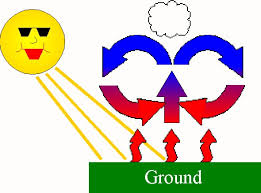
7 mL
b)
7 g/cm3
c)
28 g/cm3
d)
1/7 g/cm3
2.
Which units of measurement are used for volume?
a)
grams
b)
centimeters
c)
grams/milliliter
d)
milliliter
3.
Which lab tool might you use to measure the volume of a liquid?
a)
electric scale
b)
bunsen burner
c)
test tube
d)
graduated cylinder
4.
What is the volume of Object X?
a)
10.0 cm3
b)
15.0 cm3
c)
20.0 cm3
d)
25.0 cm3
5.
I have two objects with the same volume but different masses.  Which object will be more dense?
a)
The object with less weight.
b)
The object with more weight.
c)
The object with more mass.
d)
The object with less mass.
6.
What is the formula for density?
a)
density = mass x volume
b)
density = mass / volume
c)
density = mass + volume
d)
density = mass - volume
7.
Which property of matter is determined by dividing its mass by its volume?
a)
elasticity
b)
buoyancy
c)
density
d)
viscosity
8.
Which of these would be correct to put at the end of a density answer?
a)
g/cm
b)
cm3
c)
g/ml
d)
g/lb
9.
The density of Prof. Tesfay can be measured using which of these quantities?
a)
mass and weight
b)
mass and volume
c)
height and weight
d)
length and volume
10.
Which box has a higher density?  
a)
Box A
b)
Box B
c)
cannot be determined
d)
they are the same
11.
Which box has a higher density?  
a)
Box A
b)
Box B
c)
cannot be determined
d)
they are the same
12.
What is the formula for density?
a)
density = mass x volume
b)
density = mass / volume
c)
density = mass + volume
d)
density = mass - volume
13.
Volume is ...
a)
Mass/Volume
b)
The amount of matter in an object.
c)
The amount of space an object occupies.
d)
Anything that has mass and occupies space.
14.
Density is...
a)
the amount of mass in an object
b)
the amount of space an object takes up
c)
the amount of mass in a given space
d)
the weight of an object
15.
Define the term "mass".
a)
Mass/Volume
b)
Anything that has mass and takes up space 
c)
The amount of space an object occupies.
d)
The amount of matter in an object.
16.
Wind always blows from areas of _______ to areas of ______ pressure.
a)
hot; cold
b)
low; high
c)
high; low
d)
cold; hot
17.
What concept describes how warm air and cool air circulate to keep the temperature stable in the atmosphere?
a)
prevailing winds
b)
convection
c)
air pressure
d)
Coriolis effect
18.
air masses are named according to their source region, which describes which 2 characteristics?
a)
temperature and density
b)
high and low pressure
c)
moisture and location
d)
temperature and moisture
19.
Which has a lower density?
a)
A
b)
B
20.
Which has a higher density?
a)
A
b)
B
21.
Which has a higher pressure?
a)
A
b)
B
22.
Which has a lower pressure?
a)
A
b)
B
23.
High pressure items have a high density
a)
True
b)
False
24.
LOW pressure items have a high density
a)
True
b)
False
25.
HIGH Pressure air have air particles that are far apart
a)
True
b)
False
26.
HIGH Pressure air is....
a)
Cool
b)
Warm
27.
LOW Pressure air is....
a)
Cool
b)
Warm
28.
Low pressure air will
a)
Rise
b)
Fall
29.
High pressure air will
a)
Rise
b)
Fall
30.
What causes warm air to rise?
a)
the fact that it's less dense than cold air 
b)
The fact that it weighs more than cold air 
c)
The fact that it has higher pressure than cold
d)
the fact that its more dense than cold air 
31.
What causes wind to blow?
a)
Differences in longitude 
b)
Shock waves from clouds 
c)
Differences in air temperature and pressure 
d)
The rotation of the earth
32.
Which term best describes how the earth's atmosphere is heated?
a)
Spirally
b)
Unevenly
c)
Circularly
d)
Kinetically
33.
What creates the air pressure difference between the equator and the poles?
a)
The length of the seasons
b)
The shape of the earth 
c)
the duration of the solar year
d)
The amount of direct sunlight each area receives 
34.
When Earth's rotation causes the wind to curve 
a)
cloudy 
b)
Coriolis effect
c)
high pressure
d)
low pressure 
35.
When heat rises cools then sinks 
a)
high pressure 
b)
convection current 
c)
low pressure 
d)
stratospheric pressure  
36.
The curving of air to the right in the Northern hemisphere is caused by ___________ and is called the _________ effect.
a)
Earth's rotation...Coriolis
b)
Earth's revolution...Coriolis
c)
Earth's rotation...Doppler
d)
Earth's revolution...Doppler
37.
Where does the initial source of energy come from that creates winds?
a)
the moon
b)
the sun
c)
the Earth's surface
d)
the rotation of the Earth
38.
The Coriolis effect causes ___________.
a)
the Earth to rotate on its axis
b)
continental deflection
c)
global winds and surface currents to move in a curved path instead of a straight line
d)
global winds and deep ocean currents to move in a curved path instead of a straight line.
39.
How do differences in air pressure affect the movement of air?
a)
Air always moves from areas of high pressure to areas of low pressure.
b)
Air always moves from areas of low altitudes to high altitudes.
c)
Air always moves from areas of low pressure to areas of high pressure.
d)
Air always moves from east to west.
40.
Which statement correctly describes the properties of cold air?
a)
less dense and less pressure than warm air
b)
more dense and more pressure than warm air
c)
more dense and less pressure than warm air
d)
less dense and more pressure than warm air
41.
Why does warm air rise?
a)
Warm air is more dense than cooler air.
b)
Warm air has more pressure than cooler air.
c)
Warm air is less dense than cooler air.
d)
Warm air has a higher dew point than cooler air.
42.
What is water doing when it is changed to water vapor?
a)
evaporating
b)
condensing
c)
precipitating
d)
runoff
43.
Winds are caused by 
a)
equal heating 
b)
unequal heating
44.
What causes wind?
a)
differences in pressure
b)
conduction currents
c)
density
d)
tropical currents
45.
This is a lava lamp. When the light bulb heats the wax, the wax rises. When the wax cools, it falls. This cycle of rising/falling is an example of:
a)
Conduction.
b)
Convection.
c)
Radiation.
46.

p. 417 Surface currents are

a)

found only in streams

b)

stream like movements of water at the ocean's surface

c)

only able to flow in one direction

d)

responsible for fish migration patterns

47.

p. 418 The curved paths of global winds and surface currents are caused by

a)

the Coriolis Effect

b)

the rotation of the Earth

c)

continental deflection

d)

warm wind near the equator

48.

p. 418 The apparent curving of moving objects from a straight path due to the Earth's rotation is

a)

the Coriolis effect

b)

the reason for surface currents

c)

due to a prevailing wind

d)

like a merry go round

49.

p. 418 One reason ocean currents do not travel in a straight pattern across the Earth's surface is due to

a)

continental deflection

b)

continental drift

c)

the continental divide

d)

continental reflection

50.

p.418 When a surface current deflects it

a)

gains speed

b)

meets another ocean current

c)

changes direction

d)

moves toward warm waters

51.
What is the definition of CONDUCTION?
a)
When heat is transferred from objects like rays of light or electromagnetically.
b)
a  hot liquid or air that  expands, becomes less dense, and rises or becomes more dense, and sinks.
c)
When heat transfers from objects that are touching.
d)
When heat transfers through the heater or AC in your house.
52.
What kind of heat transfer happens when the sun is heating your body?
a)
Conduction
b)
Radiation
c)
Convection
d)
Density
53.
Warm air rises and the cool air sinks demonstrates this type of heat transfer. 
a)
conduction
b)
convection
c)
radiation
d)
Insolation 
54.
Ironing a shirt is an example of...
a)
condensation
b)
conduction
c)
convection
d)
radiation
55.
Warm air is __________ dense than cold air and rises creating convection currents.
a)
more
b)
less
56.
Johnny accidentally grabbed the handle of the hot pot.
a)
conduction
b)
convection
c)
radiation
57.
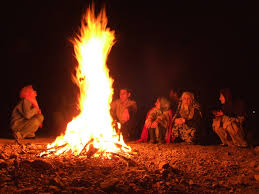
A group of friends gather around a fire to stay warm.
a)
conduction
b)
convection
c)
radiation
58.
Transfer of thermal energy through "space"
a)
conduction
b)
convection
c)
radiation
59.
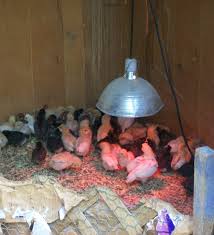
The baby chickens are kept warm from the heat lamps demonstrates this type of heat transfer. 
a)
conduction
b)
convection
c)
radiation
60.
Conduction occurs in...
a)
solids
b)
liquids
c)
gases
61.
Heat would best be transferred by conduction between
a)
a candle and the air.
b)
an oven and a glass dish.
c)
a stove and a copper pot.
d)
water and a wooden spoon
62.
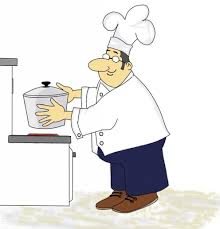
The man goes to take the hot pot off the stove with his bare hands.
a)
conduction
b)
convection
c)
radiation
63.
What is this tool called?
a)
Beaker
b)
Flask
c)
Graduated Cylinder
d)
Measuring Cup
64.
The base unit of metric length.
a)
Meter
b)
Liter 
c)
Kilogram
d)
milligram
65.
The correct abbreviation for milliliter is..
a)
ML
b)
Ml
c)
mL
d)
ml
66.
The basic unit of metric volume is called a_____.
a)
Kilogram
b)
milligram
c)
Liter
d)
milliliter
67.
How many cm's is in a meter?
a)
1000
b)
10
c)
100
d)
1
68.
The appropriate abbreviation of centimeter is..
a)
cm
b)
Cm
c)
cM
d)
CM
69.
The abbreviation for gram is...
a)
G
b)
gg
c)
g
70.
What is the volume?
a)
 50.0 mL
b)
53.0 mL
c)
54.0 mL
71.
What is the volume of liquid in this graduated cylinder?
a)
40.0 mL
b)
40.3 mL
c)
43.0 mL
d)
44.0 mL
72.
Calculate the volume of the rock
a)
10.0 cm3
b)
16.0 cm3
c)
30.0 cm3
d)
40.0 cm3
73.
What is the volume of the fish?
a)
18.0 cm3
b)
6.0 cm
c)
38.0 cm3
74.
Which formula can be used to find the volume of a rectangular prism?
a)
length x width
b)
length x width x height
c)
height x length
d)
length + width + height
75.

What is the volume displacement of the hammer?

a)

3

b)

4

c)

5

d)

6

76.

Amy finds the volume of a graduated cylinder with a pencil in it. The volume was 37 mL. If the volume before the pencil was added was 35 mL. Then what is the volume displacement?

a)

1 mL

b)

1

c)

2

d)

2 mL

77.

What is the volume displacement of the dinosaur?

a)

0.2

b)

0.4

c)

0.6

d)

0.8

78.
What is measured with a graduated cylinder?
a)
Passage of time
b)
Distance from one thing to another
c)
Weight of an object
d)
Volume of liquid
79.
Where do we read the level of liquid?
a)
The highest point the liquid touches
b)
The bottom of the meniscus,flat surface,eye level
c)
Half way between, we make an educated guess and round it
d)
Somewhere about there
80.
What is the length of the screw?
a)
5cm
b)
6cm
c)
5mm
d)
6m
81.
What is the length of the eraser?
a)
3 cm 
b)
2 cm 
c)
5 cm
d)
7 cm
82.
What is the length of the straw?
a)
8 cm 
b)
0 cm 
c)
7 cm 
d)
1 cm 
83.
What is the length of this object?
a)
5.0 cm
b)
5.5 cm
c)
5.3 cm
d)
5.1 cm
84.
What is the mass?
a)
272.1 cm
b)
270.2 g
c)
272.1 g
d)
270.1 g
85.
What is happening when my ice cream changes from a solid to a liquid?
a)
freezing
b)
melting
c)
burning
d)
evaporation
86.
What is happening when my water bottle in the freezer goes from a liquid state to a solid state?
a)
melting
b)
evaporating
c)
freezing
d)
cutting
87.
What happens when my glass of water is sitting in the sun and disappears into a gas?
a)
evaporation
b)
burning
c)
melting
d)
freezing
88.
My glass of ice water is sitting in the sun and has droplets of water on the outside of the glass. What is happening?
a)
condensation
b)
evaporation
c)
melting
d)
freezing
89.
What are the two main factors that determine the climate of an area?
a)
precipitation and humidity
b)
temperature and air pressure
c)
wind conditions and humidity
d)
temperature and precipitation
90.
What causes winds to form on Earth?
a)
solar energy
b)
ocean currents
c)
elevation differences
d)
uneven heating of the Earth by the sun
91.
What is the condition of the Earth's atmosphere at a certain time and place?
a)
climate
b)
temperature
c)
weather
d)
air pressure
92.
Which sentence best describes how latitude and temperature are related?
a)
LOWER latitude = COLDER air temperature
b)
HIGHER latitude = COLDER air temperature
c)
HIGHER latitude = WARMER temperatures
93.
What is the weather conditions in an area over a long period of time?
a)
climate
b)
temperature
c)
elevation
d)
precipitation
94.
Which sentence best describes the relationship between elevation and air temperatures?
a)
LOWER elevation = COLDER temperatures
b)
HIGHER elevation = COLDER temperatures
c)
HIGHER elevations = WARMER temperatures
95.

Which material will absorb the most heat?

a)

a black sand beach

b)

a white sand beach

c)

a grassy playground

d)

a snow covered mountain

96.
The ____________ plays a major role in regulating the weather and climate of the planet.
a)
weather
b)
climate
c)
ocean
d)
movement
97.
 The more inland (away from the ocean and coast) climates are subject to more extreme or _______ temperatures.
a)
mild
b)
harsh
98.
Coastal climates, which are insulated by nearby water are generally _______.
a)
mild
b)
harsh
99.
Where can you find a more harsh climate?
a)
inland
b)
on the coast
100.
Where can you find a more mild climate?
a)
inland
b)
on the coast
101.
Is the climate warmer near the ocean or inland?
a)
inland
b)
near the ocean
102.
The ocean does an excellent job of absorbing excess _______ from the atmosphere.
a)
cool airs
b)
heat
103.
Which best describes why cities near oceans are often warmer in the winter than cities far from the ocean at the same latitude?
a)
Oceans cool more slowly than land.
b)
Ocean waves move more quickly in the winter.
c)
The moon heats the air over the ocean.
104.
How do we characterize an air mass that forms over the ocean?
a)
Dry
b)
Wet
c)
Cold
d)
Warm
105.
How do we characterize an air mass that forms over land?
a)
Dry
b)
Wet
c)
Cold
d)
Warm
106.
How do we characterize an air mass that forms over near the equator?
a)
Dry
b)
Wet
c)
Cold
d)
Warm
107.
How do we characterize an air mass that forms near the poles?
a)
Dry
b)
Wet
c)
Warm
d)
Cold
108.
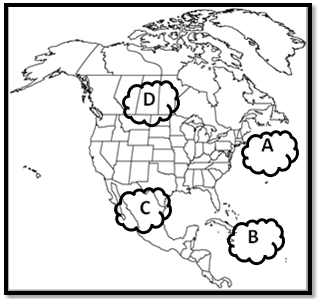
Which type of air would you find at air mass A?
a)
cold, dry
b)
warm, humid
c)
warm, dry
d)
cold, humid
109.
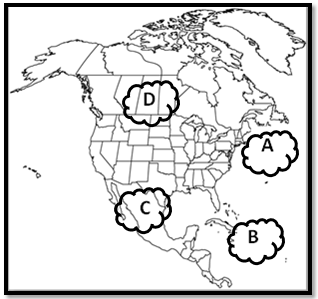
Which type of air would you find at air mass B?
a)
cold, dry
b)
warm, humid
c)
warm, dry
d)
cold, humid
110.
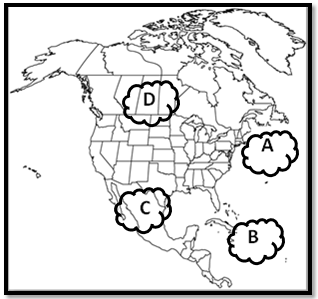
Which type of air would you find at air mass C?
a)
cold, dry
b)
warm, humid
c)
warm, dry
d)
cold, humid
111.
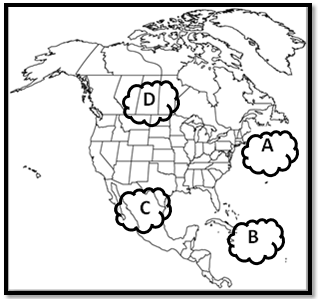
Which type of air would you find at air mass D?
a)
cold, dry
b)
warm, humid
c)
warm, dry
d)
cold, humid
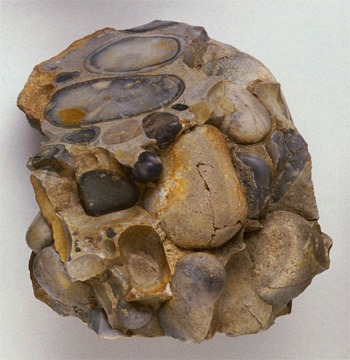
112.
This rock formed when bits of other rocks became pressed into a solid. What type of rock is it?
a)
Sedimentary Rock
b)
Metamorphic Rock
c)
Igneous Rock
113.
This rock was formed when magma cooled very slowly inside the Earth. What specific type of rock is it?
a)
Intrusive Igneous Rock
b)
Extrusive Igneous Rock
c)
Foliated Metamorphic Rock
d)
Clastic Sedimentary Rock
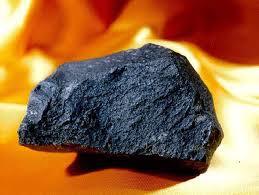
114.
This rock formed when lava cooled very quickly on Earth's surface. What specific type of rock is it?
a)
Extrusive Igneous Rock
b)
Intrusive Igneous Rock
c)
Non-Foliated Metamorphic Rock
d)
Biochemical Sedimentary Rock
115.
When you watch a volcano erupt molten rock, you are seeing _____
a)
Lava
b)
Magma
c)
Mineral Crystals
d)
Igneous Rocks
116.
When you are describing the sizes of the mineral grains in a rock, you are detailing the rock's _____
a)
Texture
b)
Composition
c)
Sedimentation
d)
Igneous-ness
117.
The individual particles that make up a rock are known as _____
a)
Grains
b)
Textures
c)
Metamorphs
d)
Lava
118.
What are the 3 major types of rocks?
a)
Igneous, Metamorphic, Sedimentary
b)
Metamorphic, Igneous, Cementation
c)
Brown, Red, Gray
d)
Streak, Hardness, Breakage
119.
Two ways to describe types of igneous rocks are _____
a)
Extrusive and Intrusive
b)
Foliated and Non-Foliated
c)
Clastic and Biochemical
d)
Black and Gray
120.
What process is used to form sedimentary rocks?
a)
Lava cools and hardens to form a rock.
b)
Weathering, Erosion, Deposition, Compaction, Cementation
c)
Extreme heat and pressure from inside the Earth turn rocks into new rocks.
d)
Magma trapped under the Earth's surface cools and solidifies.
121.
Which of the words below describe broken up rock?
a)
stalactites
b)
magmas
c)
metamorphs
d)
sediments
122.
This rock was formed by smaller pieces of rock that settled at the bottom of a lake millions of years ago. What type of rock is this?
a)
Sedimentary
b)
Igneous
c)
Metamorphic
123.
This rock was found near the mouth of a volcano. What type of rock is this?
a)
Sedimentary
b)
Igneous
c)
Metamorphic
124.
The process in which sediment are fused or glued together.
a)
compaction
b)
deposition
c)
organic rock
d)
cementation
125.
What is deposition?
a)
Dropping off sediment
b)
Movement of sediment
c)
Breaking down of sediment 
126.
The process when rocks break into smaller pieces due to exposure to natural elements is called
a)
erosion
b)
weathering
c)
sediments
d)
deposition
127.
The movement of weathered material (sediment) is called?
a)
weathering
b)
erosion
c)
deposition
d)
cementation
128.
Which type of rock is formed from INTENSE heat and pressure?
a)
igneous
b)
sedimentary
c)
metamorphic
129.
The three groups of rocks are classified by
a)
How they form
b)
Color
c)
Grain size
d)
Chemical Composition
130.
Fossils are only found in
a)
Sedimentary rocks
b)
Foliated Metamorphic rocks
c)
Igneous Rocks
d)
Nonfoliated Metamorphic rocks
131.
Extreme Heat and Pressure creates a _________ rock.
a)
Igneous
b)
Metamorphic
c)
Sedimentary
d)
Mineral
132.
A metamorphic rock changes into an igneous rock by what two processes?
a)
Melting and cooling
b)
Extreme heat and pressure
c)
Compaction and cementation
d)
Weathering and erosion
133.
What is the MAIN way rocks are classified?
a)
Their color and shapes
b)
How they form
c)
Mineral bands
d)
Where they form
134.
After lots of time, pressure, and heat, you get this kind of rock. What type of rock is this?
a)
Sedimentary
b)
Igneous
c)
Metamorphic
135.
Fossils are often found in ____________ because it is formed from the remains of once living things.
a)
metamorphic
b)
magma
c)
igneous
d)
sedimentary
136.
This rock was formed by lots of fossils that settled on top of each other over time. What type of rock is this?
a)
Sedimentary
b)
Igneous
c)
Metamorphic
137.
What is the MAIN way rocks are classified?
a)
Their color and shapes
b)
How they form
c)
Mineral bands
d)
Where they form
138.
Metamorphic rocks form from ___.
a)
igneous rocks
b)
other metamorphic rocks
c)
sedimentary rocks
d)
all types of rocks