Wayground logo

Free Printable Worksheets

Font size

S
M
L
XL
Worksheets

5.8 A,B,C,D

Total questions: 78

Worksheet time: 2hrs 47mins

Name
Class
Date
1.

Which statement best compares the length of Earth’s rotation to the length of Earth’s revolution?

a)

Rotation is equal to 28 days, and revolution is equal to 365 days.

b)

Rotation is equal to 365 days, and revolution is equal to 28 days.

c)

Rotation is equal to 24 hours, and revolution is equal to 365 days.

d)

Rotation is equal to 28 days, and revolution is equal to 24 hours.

2.

A student learned that the movement of Earth in the solar system causes changes that can be seen on the planet. Which change could be seen on Earth in the time it takes Earth to rotate once on its axis?

a)

day becoming night

b)

winter changing to spring

c)

January changing to February

d)

A new moon becoming a full moon

3.

Four students have drawn and labeled pictures on the chalkboard.

Which drawing best shows the cause of day and night on Earth?

a)

Earth revolving around Sun

b)

Sun orbiting Earth

c)

Moon moving between Earth and Sun

d)

Earth rotating on its axis

4.

A fifth grader watches the Sun set in the evening sky. What causes the setting of the Sun?

a)

The distance between Earth and the Sun is increasing.

b)

The tilt of Earth on its axis is constantly changing.

c)

Earth is revolving around the Sun.

d)

Earth is rotating on its axis.

5.

Look at the pictures in order from left to right.

Which best explains what happens at Point X as Earth rotates?

a)

Night becomes day.

b)

Fall becomes winter.

c)

A full moon appears

d)

A solar eclipse occurs.

6.

Two friends were playing outside at sunset. They had to go inside their homes when it became dark. Which best explains why the day became night?

a)

Part of Earth faces away from the Sun at night.

b)

Earth moves far away from the Sun each night.

c)

The Moon blocks light from the Sun at night.

d)

The Sun stops producing light each night.

7.

A teacher demonstrates the day and night cycle to a group of students using a globe and a lamp. Students are asked to write a valid conclusion about how the day and night cycle occurs naturally on Earth.

a)

The sun rotates on its axis once approximately every 30 days.

b)

The sun revolves around the Earth approximately every 365

days.

c)

The Earth rotates on its axis once approximately every 24 hours.

d)

The moon revolves around the Earth once approximately every

28 days.

8.

Examine the chart above.

Which answer choice best fits in the missing blank?

a)

High and low tides

b)

Gravitational pull

c)

Moon phases

d)

Apparent movement of the Sun across

the sky

9.

All of the following picture are like Earth’s rotation EXCEPT-

a)

A

b)

B

c)

C

d)

D

10.

Which of the following best demonstrates the motion of rotation?

a)

A

b)

B

c)

C

d)

D

11.

Students used a globe and a light to demonstrate Earth’s rotation. Which answer describes what happens when earth rotates?

a)

One year has gone by.

b)

The moon has taken one month to orbit the Earth

c)

Seasons change.

d)

The Sun appears to move across the sky

12.

Which best describes Earth’s rotation?

a)

24 hours, causes changing length of shadows and day and night

b)

24 hours, causes day and night and tides

c)

29 ½ days, causes orbiting around the Sun and day and night

d)

29 ½ days, causes Moon phases and tides

13.

Which of these models represents the reason Earth has day and

night?

a)

A

b)

B

c)

C

d)

D

14.
What is the energy source for the water cycle?
a)
the sun
b)
the earth
c)
water
d)
the moon
15.
Which of these is an example of precipitation?
a)
snow
b)
air
c)
clouds
d)
vapor
16.
Which is the opposite of condensation?
a)
runoff
b)
evaporation
c)
precipitation
d)
transpiration
17.
Which best explains why runoff is important?
a)
It returns water to other locations on Earth
b)
It increases the chance of flooding
c)
It makes evaporation occur faster
d)
It increases condensation
18.
Snow, sleet, hail, and rain are all examples of  ________________. 
a)
evaporation
b)
condensation
c)
accumulation
d)
precipitation
19.
What happens after groundwater at the very end/beginning of the water cycle?
a)
Evaporation
b)
Transpiration
c)
Condensation
d)
Groundwater
20.
What is it called when plants give off water vapor as a waste product?
a)
condensation
b)
evaporation
c)
sublimation
d)
transpiration
21.
When water _________, dew forms.
a)
Melts
b)
Evaporates
c)
Condenses
d)
Precipitates
22.
What is the water cycle?
a)
the 3 forms of water
b)
the movement of water on, above, or below the surface of the Earth
c)
when water melts
d)
when clouds form
23.
During which stage do clouds form?
a)
condensation
b)
evaporation
c)
precipitation
24.
Which stages does liquid water from the ocean turn into water vapor?
a)
condesantion
b)
evaporation
c)
precipitation
d)
run off
25.
Which stage does ground water try to return to the ocean or soak into the ground?
a)
condensation
b)
evaporation
c)
precipitation
d)
run off
26.
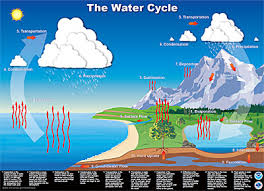
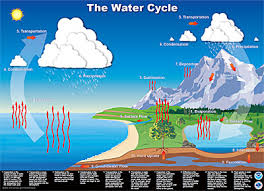
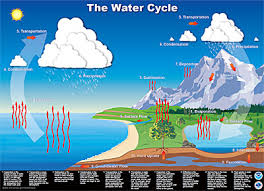
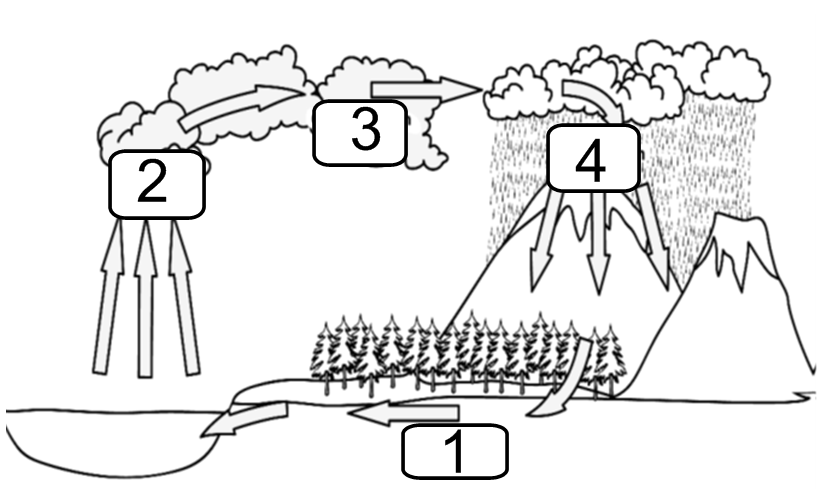
Which stage does the #2 show in the diagram?
a)
condensation
b)
evaporation
c)
precipitation
d)
run off
27.
Which stage does the #3 show in the diagram?
a)
condensation
b)
evaporation
c)
precipitation
d)
run off
28.
what does the #4 show in the diagram?
a)
condensation
b)
evaporation
c)
precipitation
d)
run off
29.
What does this illustration show?
a)
Sunrise
b)
The Water Cycle
c)
Sunset
d)
the recycling of snow
30.
This is what heats up the water to start the  water cycle. 
a)
sun
b)
moon
c)
stars
d)
Mars
31.
Dew also forms directly onto items, as water droplets.  What part of the water cycle is this?
a)
run-off 
b)
condensation
c)
evaporation
d)
precipitation
32.
What is water doing when it is changed to water vapor?
a)
evaporating
b)
condensing
c)
transpiring
d)
freezing
33.
On which kind of day would you expect the most evaporation from the surface of a  pond?
a)
sunny and hot
b)
sunny and cold
c)
rainy and hot
d)
rainy and cold
34.
The turning or spin of Earth on its axis.
a)
Revolution
b)
Rotation
c)
Rounding
d)
Rousting
35.
What is the result of the Earth’s rotation?
a)
Seasons
b)
Eclipses
c)
Moon Phases
d)
Day and Night
36.
What is the name of the imaginary line that the Earth rotates on?
a)
North Pole
b)
equator
c)
axis
d)
South Pole
37.
How long does it take for the Earth to make one complete rotation?
a)
365 days/1 year
b)
1 week
c)
24 hours/1 day
38.
What 2 things cause seasons on Earth?
a)
axis and orbit
b)
Winter and Fall
c)
Summer and Spring
d)
Sun and Moon
39.
The Earth revolves around the Sun every...
a)
month
b)
year
c)
day
d)
3 years
40.
The Sun moves around the Earth and the Earth stays still.
a)
True
b)
False
41.
As the Earth rotates, the part of the Earth facing the sun has ________.
a)
an axis
b)
darkness (night)
c)
daylight
d)
winter
42.
As the Earth rotates, the part of the Earth facing away from the sun has ________.
a)
daylight 
b)
darkness (night)
c)
summer 
d)
nice weather
43.
Earth is tilted on its _______. 
a)
side
b)
axis
c)
hemisphere
d)
equator
44.
The orbit is the same as ____________.
a)
Rotating
b)
Revolving
c)
Spinning
45.
Rotation causes ___________.
a)
Day and Night
b)
Seasons
c)
The Earth to be tilted
46.
What does the Earth orbit around?
a)
axis
b)
sun
c)
orbit
d)
moon
47.
If the earth didn't rotate on its axis.  What natural cycle would this affect?
a)
seasons
b)
tides
c)
day and night
d)
moon phases
48.
How long does it take the earth to revolve once around the sun?
a)
12 hours
b)
24 hours
c)
30 days
d)
365.25 days
49.
Precipitation happens when clouds of water droplets are too ______________.
a)
cold
b)
light
c)
heavy
d)
hot
50.
Does evaporation happen before or after condensation?
a)
before
b)
after
c)
during
51.
What is the weather conditions in an area over a long period of time?
a)
climate
b)
temperature
c)
elevation
d)
precipitation
52.
____ is a low ground level cloud
a)
mist
b)
fog
c)
rain
d)
sunshine
53.
Winters in Maine can reach temperatures below zero.
a)
Climate
b)
Weather
54.
Changes from minute-to-minute, hour-to-hour, day-to-day
a)
Climate
b)
Weather
55.
A tornado warning was issued for Kansas City this morning.
a)
Climate
b)
Weather
56.
Texas has long, hot summers.
a)
Climate
b)
Weather
57.
Meteorologists forecast this.
a)
Climate
b)
Weather
58.
It snowed for three days last week.
a)
Climate
b)
Weather
59.
What is climate?
a)
 What's going on with the atmosphere at any particular time
b)
The type of weather that occurs during a particular season
c)
An area's pattern of weather over a long period of time
d)
How much sunshine an area gets 
60.
Which weather tool measures temperature?
a)
thermometer
b)
barometer
c)
psychrometer
d)
anememeter
61.
This weather tool measures wind speed and direction
a)
thermometer
b)
barometer
c)
anemometer
d)
psychrometer
62.
What part of the illustration shows Evaporation? 
a)
1
b)
2
c)
3
d)
4
63.
The amount of moisture (water vapor) in the air
a)
Barometer
b)
Humidity
c)
Rain gauge
d)
Evaporation
64.
 A student needs approximately 250 mL of water for an experiment. Which letter in the illustration bestrepresents this estimate?
a)
W
b)
X
c)
Y
d)
Z
65.
Which of the following is a characteristic of both the Earth and the Moon?
a)
Atmosphere containing oxygen
b)
Rocky surface covered with landforms
c)
Flowing water in oceans and rivers
d)
Fossils and fossil fuels under the surface
66.
Among the Earth, Sun, and Moon, what makes the Earth unique? Only the Earth –
a)
can generate energy
b)
lacks an atmosphere
c)
is made mostly of rock
d)
contains water in liquid form
67.
Which of the following lists the Earth, Sun, and Moon in order of size, from largest to smallest?
a)
Earth, Sun, and Moon
b)
Earth, Moon, and Sun
c)
Sun, Earth, and Moon
d)
Sun, Moon, and Earth
68.
Which has landforms?
a)
Sun
b)
Sun, Earth, Moon
c)
Earth and Moon
d)
only Earth
69.
Which of these physical characteristics are found on the Earth but NOT on the Moon? 
a)
mountains
b)
valleys
c)
lakes
d)
plains
70.
The moon’s surface has many more craters than the Earth’s. What best explains the difference in the number of craters on the surface of the Moon and the Earth?
a)
The Moon rarely gets impacted by meteorites.
b)
The Earth’s atmosphere protects it from impacts.
c)
The Moon’s gravity attracts more meteorites than Earth's.
d)
The Earth rotates on its axis more quickly than the Moon.
71.

The Sun, Earth, and the Moon share the same similarities in their

a)

Shape (Sphere)

b)

Color

c)

Size

72.
This model can be used to show some relationships between the Earth, Sun, and Moon.
The model shows all of the following EXCEPT –
a)
the relative sizes of the Moon and Earth
b)
the way the Moon revolves around the Earth
c)
the composition of the Moon, Earth, and Sun
d)
how the Moon and the Earth revolve around the Sun
73.
Of the Earth, Sun, and Moon, which ones orbit another object?
a)
the Sun and the Earth
b)
the Sun and the Moon
c)
the Moon and the Sun
d)
the Moon and the Earth
74.

Which of the characteristics best describes both the Earth and Moon?

a)

Experiences high and low tides

b)

Has 100% oxygen in the atmosphere

c)

Has severe storms

d)

Has craters

75.
Which of the following is a characteristic of both the Earth and the Moon?
a)
Atmosphere containing oxygen
b)
Rocky surface covered with landforms
c)
Flowing water in oceans and rivers
d)
Fossils and fossil fuels under the surface
76.
The Moon rotates around the Earth once, about every -
a)
year
b)
week
c)
month
d)
180 days
77.
Why does the Moon have different phases?
a)
It follows the Sun around the Earth.
b)
It moves around the Earth.
c)
It moves around the Sun.
78.

Do you like having Mrs. Ocampo for science Rotations? ;)

a)

Yes, because I always learn something new.

b)

Yes, because she explains concepts well.

c)

Yes, because she makes science fun.

d)

All of the above