wayground logo

Free Printable Worksheets

Font size

S
M
L
XL
Worksheets

Meiosis and Sexual Reproduction

Total questions: 50

Worksheet time: 25mins

Name
Class
Date
1.
Meiosis occurs
a)
in all sexually reproducing organisms
b)
In all reproducing organisms
c)
In all asexually reproducing organisms
d)
During gametogenesis
2.
Which of following does NOT lead to genetic variation?
a)
Binary fission
b)
Independent assortment
c)
Random fertilization
d)
Crossing-over
3.
During meiosis, two successive divisions
a)
result in the formation of two identical cells
b)
cause the formation of a zygote
c)
are responsible for the formation of four haploid cells
d)
must occur before mitosis can form gametes
4.
In humans, each gamete receives
a)
23 pairs of chromosomes from each parent
b)
one chromosome from each of the 23 pairs
c)
46 chromosomes
d)
23 homologous chromosome pairs
5.

Random arrangement and distribution of homologous chromosomes during meiosis

a)

Crossing-over

b)

Independent Assortment

c)

Homologous Chromosomes

d)

Life-Cycle

6.
A cell that contains one set of chromosomes
a)
Haploid
b)
Diploid
c)
Singloid
d)
Complete
7.

All copies of the single parent's genes are passed to the offspring

a)

Genetic Singularity

b)

Crossing-over

c)

Independent Assortment

d)

Asexual Reproduction

8.
Portions of a chromatid on one homologous chromosome breaks off and trades places with the corresponding portion on one of the chromatids of the other homologous chromosome
a)
Gene Swap
b)
Independent Assortment
c)
Crossing-over
d)
Genetic Diversity
9.
The process by which gametes are produced in male animals
a)
Spermatic Fission
b)
Spermatogenesis
c)
Gametogenesis
d)
Oogenesis
10.
The union of sperm and egg cells to produce a diploid zygote
a)
Gametofusion
b)
Zygogenesis
c)
Fertilization
d)
Implantation
11.
The activities in the life of an organism from one generation to the next
a)
Circle of Life
b)
Life-loop
c)
Carbon Cycle
d)
Life Cycle
12.
Chromosomes that are similar in shape and size and have similar genetic information
a)
Homologous Chromosomes
b)
Monogamous Chromosomes
c)
Polyamorous Chromosomes
d)
Variosomes
13.
A cell that contains two sets of chromosomes
a)
Haploid Cell
b)
Gamete
c)
Diploid Cell
d)
Oocyte
14.
The process by which gametes are produced in female animals
a)
Ovulation
b)
Adulation
c)
Eggogenesis
d)
Oogenesis
15.
The process of changing chromosome number from 2n to 1n is known as:
a)
Fission
b)
Fussion
c)
Mitosis
d)
Meiosis
16.
Which process and type of resulting cells are represented?
a)
mitosis, gametes
b)
mitosis, body cells
c)
meiosis, gametes
d)
meiosis, body cells
17.
Why do we need meiosis?
a)
To double the number of chromosomes going into sex cells
b)
To halve the number of chromosomes going into sex cells
c)
To triple the number of chromosomes going into sex cells
d)
To not change the number of chromosomes going into sex cells
18.
What is an advantage of sexual reproduction?
a)
Allows genetic variation (a mixed population)
b)
Only needs one parent
c)
Happens very quickly
d)
Offspring are exact copies of parent
19.
A human has 46 chromosomes in their body cells.  What is the haploid number in their sex cells?
a)
46
b)
92
c)
23
d)
12
20.
If cells produced as a result of meiosis each contain 16 chromosomes, how many chromosomes would be present after fertilization?
a)
8
b)
16
c)
32
d)
24
21.
A Goat has 20 chromosomes in its sperm cells.  What is the number of chromosomes in its skin cells?
a)
40
b)
30
c)
10
d)
60
22.
A dog has 24 chromosomes in its sperm cells.  How many chromosomes in its stomach cells?
a)
48
b)
12
c)
46
d)
72
23.
Gametes have haploid or diploid number of chromosomes?
a)
Haploid
b)
Diploid
24.
Both mitosis and meiosis have PMAT, 
True or False
a)
True
b)
False
25.
What is the difference between prophase I and prophase II in meiosis?
a)
The nuclear membrane disappear only in prophase I.
b)
The chromosomes are formed only in prophase II.
c)
The crossing over takes place only in prophase I.
d)
The two phases are identical.
26.
How many chromosomes and chromatids are present in prophase I?
a)
46 chromosomes, 92 chromatids
b)
92 chromosomes, 184 chromatids
c)
23 Chromosomes, 46 chromatids
d)
23 chromosomes, 23 chromatids
27.
What are the homologous chromosomes?
a)
 They are similar chromosomes. Each carries the same genes in the same order, but the alleles could be different.
b)
They are totally different chromosomes.
c)
 They are  identical chromosomes. Each carries the same genes in the same order.
d)
They are totally the same chromosomes.
28.
What is the difference between metaphase I and II?
a)
They are the same.
b)
In metaphase I,  homologous chromosomes are separated.
c)
In metaphase I,  chromatids are separated.
d)
The homologous chromosomes line up in the middle only in the metaphase I.
29.
What is separated in the anaphase I and II?
a)
I and II= chromatids
b)
I=Chromatids, II=Homologous chromosomes
c)
I and II= Homologous chromosomes
d)
I= Homologous chromosomes, II= chromatids
30.
How many chromosomes do the cells have after telophase I and how many in prophase II?
a)
Telophase I= 46 chromosomes, prophase 23 chromosomes
b)
Telophase I=23 chromosomes, Prophase II=23 chromosomes
31.
How many cells do we have after meiosis II?
a)
2
b)
3
c)
4
d)
5
32.

What do we called the sperm and the egg?

a)

ovum

b)

sperm and egg

c)

Gametes

d)

ovum and sperm

33.

Turner syndrome is a genetic disorder caused by the absence of one X chromosome in pair 23. Therefore it is called:

a)

Non-disjunction in sex chromosomes

b)

Non-disjunction in autosomal chromosomes

34.

Down syndrome is a chromosomal disorder caused by an extra chromosome in the pair 21.Therefore we called:

a)

Non disjunction disorder in autosome chromosome

b)

Non disjunction disorder in the sex chromosome

35.
A cell that contains two sets of chromosomes
a)
Haploid Cell
b)
Gamete
c)
Diploid Cell
d)
Oocyte
36.

The following events occur during sexual reproduction:


A. mitosis

B. meiosis

C. fertilization

D. birth


Which sequence represents the correct order of these events during sexual reproduction?

a)

A-->C-->B-->D

b)

B-->C-->A-->D

c)

C-->B-->A-->D

d)

B-->A-->C-->D

37.

Which diagram correctly represents a step in the normal process of human reproduction?

a)
b)
c)
d)
38.

Some cells involved in the process of reproduction are represented in the diagram below


The process of meiosis formed

a)

cell 1, only

b)

cells 1 and 2

c)

cell 3, only

d)

cells 2 and 3

39.

Most cells in the body of a fruit fly contain eight chromosomes. In some cells, only four chromosomes are present. What is this condition a direct result of?

a)

mitotic cell division

b)

meiotic cell division

c)

embryonic differentiation

d)

internal fertilization

40.

Random separation and distribution of homologous chromosomes occurs during

a)

cleavage

b)

mitotic cell division

c)

fertilization

d)

meiotic cell division

41.

Which two structures of a frog would most likely have the same chromosome number?

a)

skin cell and fertilized egg cell

b)

zygote and sperm cell

c)

kidney cell and egg cell

d)

liver cell and sperm cell

42.

Homologous pairs of chromosomes are not normally found in

a)

zygotes

b)

body tissue cells

c)

gametes

d)

embryonic nerve cells

43.

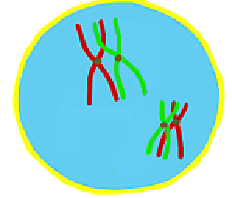
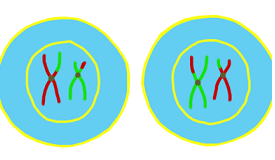
what phase am I?

a)

Prophase 1

b)

Metaphase 1

c)

Anaphase 1

d)

Telophase 1

e)

Cytokinesis

44.

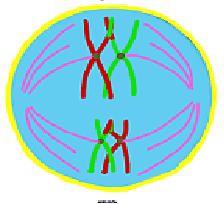
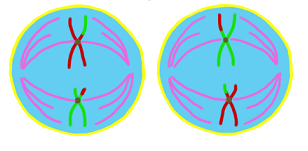
what phase am I?

a)

Prophase 1

b)

Metaphase 1

c)

Anaphase 1

d)

Telophase 1

e)

Cytokinesis

45.

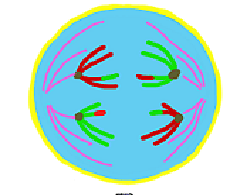
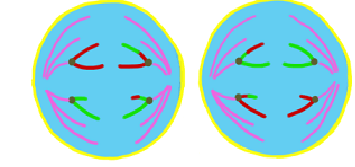
what phase am I?

a)

Prophase 1

b)

Metaphase 1

c)

Anaphase 1

d)

Telophase 1

e)

Cytokinesis

46.

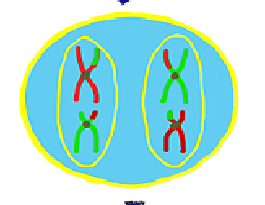
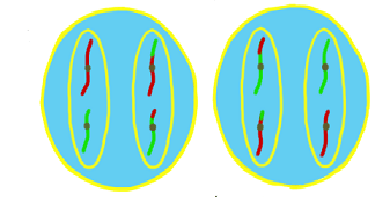
what phase am I?

a)

Prophase 1

b)

Metaphase 1

c)

Anaphase 1

d)

Telophase 1

e)

Cytokinesis

47.

what phase am I?

a)

Prophase II

b)

Metaphase II

c)

Anaphase II

d)

Telophase II

e)

Cytokinesis

48.

what phase am I?

a)

Prophase II

b)

Metaphase II

c)

Anaphase II

d)

Telophase II

e)

Cytokinesis

49.

what phase am I?

a)

Prophase II

b)

Metaphase II

c)

Anaphase II

d)

Telophase II

e)

Cytokinesis

50.

what phase am I?

a)

Prophase II

b)

Metaphase II

c)

Anaphase II

d)

Telophase II

e)

Cytokinesis