wayground logo

Free Printable Worksheets

Font size

S
M
L
XL
Worksheets

Karyotypes and Chromosomal Abnormalities

Total questions: 33

Worksheet time: 54mins

Name
Class
Date
1.

The structure that holds two sister chromatids together until they separate for cell division is called a...

a)

chromosome

b)

chromatin

c)

centromere

d)

centriole

2.

A pair of identical chromosomes shown in a karyotype, one inherited from mom, and one inherited from dad are called....

a)

sister chromotids

b)

centromeres

c)

homologous chromosomes

d)

autosomes

3.

A photograph or picture of chromosomes grouped in ordered pairs is called a.....

a)

Pedigree

b)

Chromosome chart

c)

Mitotic index

d)

Karyotype

4.

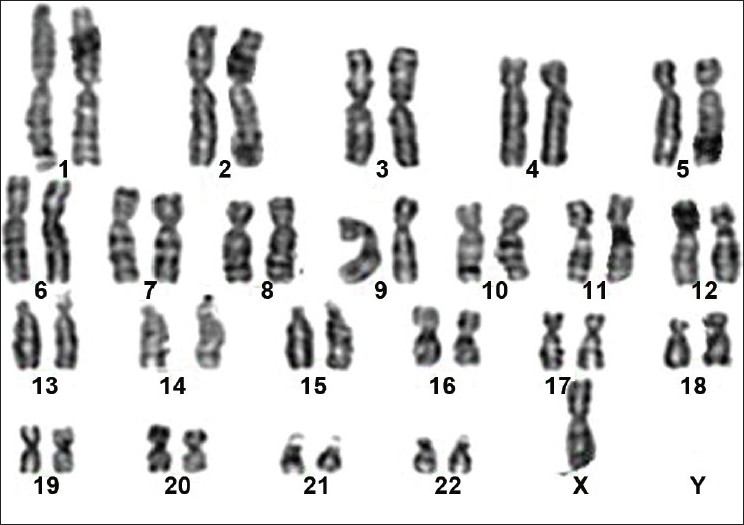
What is the gender of the individual whose karyotype is seen in the image?

a)
b)
5.

In a human karyotype the 'X' and 'Y' chromosomes determine the sex of the offspring. Which of the following two statements are true?

a)

Girls are XX

b)

Boys are YY

c)

Girls are YY

d)

Boys are XY

e)

Girls are XY

6.

How is the number of chromosomes counted?

a)

By the number of chromatids

b)

By the number of centromeres

c)

By the number of homologous chromosomes

d)

By the number of genes

7.
What is the gender of the individual whose karyotype is seen in the image?
a)
Male
b)
Female
8.
The doctors use karyotypes to examine the chromosomes. A karyotype is a picture of all the chromosomes in a cell.
a)
True
b)
False
9.
What would indicate a normal human male?
a)
XX
b)
X
c)
XY
d)
XXY
10.
Which statement is NOT true about Karyotypes
a)
Chromosomes (pairs 1-22) are arranged by size
b)
Sex chromosomes are found at the end
c)
A normal karyotype has 46 chromosomes or 23 pairs
d)
Having missing or extra chromosomes does not indicate a disorder
11.
The results of the karyotype indicate that an individual has 3 chromosome #21. Which of the following genetic disorders do they have?
a)
Edwards Syndrome
b)
Patau's Syndrome
c)
Down's Syndrome
d)
Klinefelter's Syndrome
12.
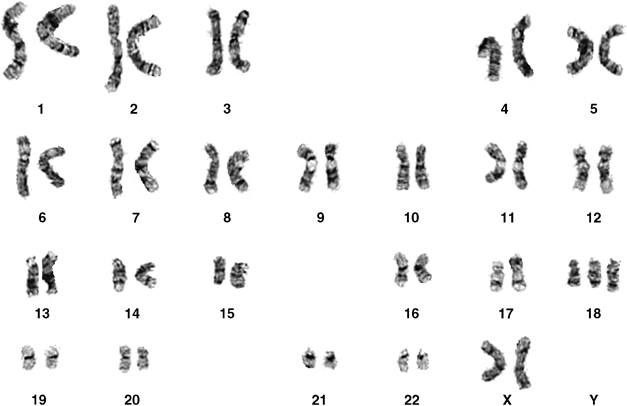
What is the chromosomal condition of the individual whose karyotype is seen in the image?
a)
Turner's Syndrome
b)
Trisomy 21 (Down Syndrome)
c)
Trisomy 13
d)
Trisomy 18
13.
What is the gender of the individual whose karyotype is seen in the image?
a)
Male
b)
Female
14.
a)
This karyotype reveals a trisomy of the 13th chromosome
b)
This karyotype could be from a sperm cell
c)
This karyotype contains homologous chromosome pairs
d)
This karyotype reveals a trisomy of the 21st chromosome
15.
What is the sex of this baby?
a)
Male
b)
Female
16.
Down Syndrome is also known as...
a)
Trisomy 21
b)
Monosomy 23
c)
Cri-du-chat
d)
Mauvaise-réponse
17.
What is the sex of this baby?
a)
Male
b)
Female
18.
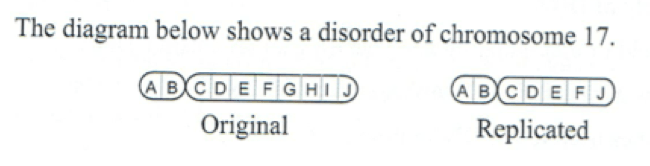
Identify the mutation in the picture.
a)
Inversion
b)
Deletion
c)
Duplication
d)
Translocation
19.
Identify the mutation in the picture.
a)
Inversion
b)
Duplication
c)
Deletion
d)
Translocation
20.
Identify the mutation in the picture.
a)
Deletion
b)
Inversion
c)
Duplication
d)
Translocation
21.
What type of chromosomal mutation has occurred?
a)
substitution
b)
insertion
c)
deletion
d)
nondisjunction
22.
What process occurs during meiosis that can result in chromosomal disorders?
a)
crossing over
b)
non-disjunction
c)
anaphase I
d)
prophase II
23.

Which of the following is a true statement?

a)

This karyotype shows Trisomy 21

b)

This karyotype has no abnormality

c)

This karyotype is missing a sex chromosome (monosomy x)

d)

This karyotype is from a gamete

24.
What is the chromosomal condition of the individual whose karyotype is seen in the image?
a)
Monosomy X (Turner's Syndrome)
b)
Trisomy 21 (Down's Syndrome)
c)
Trisomy 13 (Patau Syndrome)
d)
Trisomy 18 (Edwards's Syndrome)
25.
Which sex chromosomes would indicate a typical human male?
a)
XX
b)
X
c)
XY
d)
XXY
26.

The chromosomal mutation shown in the image is a

a)

deletion

b)

duplication

c)

inversion

d)

translocation

27.

A piece of a chromosome is lost

a)

deletion

b)

duplication

c)

inversion

d)

translocation

28.

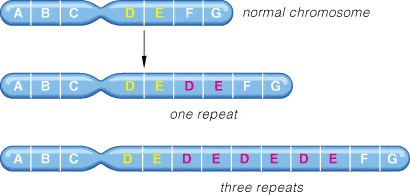
A piece of a chromosome is copied and remains within the chromosome

a)

deletion

b)

duplication

c)

inversion

d)

translocation

29.

A piece of the chromosome detches, turns 180 degrees, and reattaches

a)

deletion

b)

duplication

c)

inversion

d)

translocation

30.

A piece of one chromosome detaches and reattaches to a different chromosome

a)

deletion

b)

duplication

c)

inversion

d)

translocation

31.

The chromosomal mutation shown in the image is a

a)

deletion

b)

duplication

c)

inversion

d)

translocation

32.

The chromosomal mutation shown in the image is a

a)

deletion

b)

duplication

c)

inversion

d)

translocation

33.

The chromosomal mutation shown in the image is a

a)

deletion

b)

duplication

c)

inversion

d)

translocation