wayground logo

Free Printable Worksheets

NEW

Font size

S
M
L
XL
Worksheets

Astronomy - Universe, galaxies and Stars

Total questions: 20

Worksheet time: 16mins

Name
Class
Date
1.

What type of galaxy is Galaxy Y

a)

Spiral

b)

Irregular

c)

Elliptical

2.
What color of star is the hottest?
a)
Blue
b)
Red
c)
Yellow
d)
Orange
3.
What is the name of baby stars?
a)
Dwarf
b)
Supergiant
c)
Protostars
d)
Nebulas
4.
What is the name of the gas/dust clouds that form stars?
a)
Nebulas
b)
Protostars 
c)
Supernova
d)
Neutron Star
5.
The category that contains the most stars is...
a)
Main Sequence
b)
Supergiants
c)
Giants
6.
At 10,000 degrees Celsius, hydrogen begins to change into helium and energy is released in a process called
a)
supernova
b)
pulsar
c)
nuclear fusion
d)
nuclear fission
7.
If a star is being observed from Earth and it's light has shifted towards the red side of the electromagnetic spectrum it would be...
a)
Moving towards the Earth
b)
Moving away from the Earth
c)
This is a trick question that cannot be answered
d)
It isn't a star, it is a very large blueberry.
8.

Which of the following is NOT evidence of the Big Bang Theory?

a)

most galaxies are red-shifted

b)

CMBR everywhere

c)

the universe is gaining matter

d)

the universe is expanding

9.
Galaxies are composed of (best answer)
a)
stars
b)
stars and gas
c)
stars, dust, and gas
d)
stars, dust, and gas held together by gravity
10.
Place these objects in order from smallest to largest.
a)
Planets, solar system, universe, galaxy
b)
Solar system, planets, galaxy, universe
c)
Planets, solar system, galaxy, universe
d)
Galaxy, solar system, planets, universe
11.
What type of galaxy is this?
a)
Spiral
b)
Elliptical
c)
Irregular
d)
Irrational
12.
What does the Big Bang theory suggest?
a)
The universe was just there
b)
The Milky Way is the only solar system
c)
The universe is continually expanding
d)
The universe started as a point and is moving towards each other
13.

What type of galaxy must likely can be described as a large, flat disk surrounded by arms of stars and dus

a)

elliptical

b)

irregular

c)

sprial

d)

ring

14.

more massive stars generally have shorter life cycles than less massive stars because massive stars...

a)

are older

b)

Use fuel much faster than less massive stars

c)

have a stronger gravitational pull

d)

formed earlier than less massive stars

15.

What keeps a star from collapsing from their own gravity?

a)

The outward pressure from nuclear fusion

b)

The gravitational pull caused by orbiting planets

c)

The centrifugal force caused by rapid rotation

16.

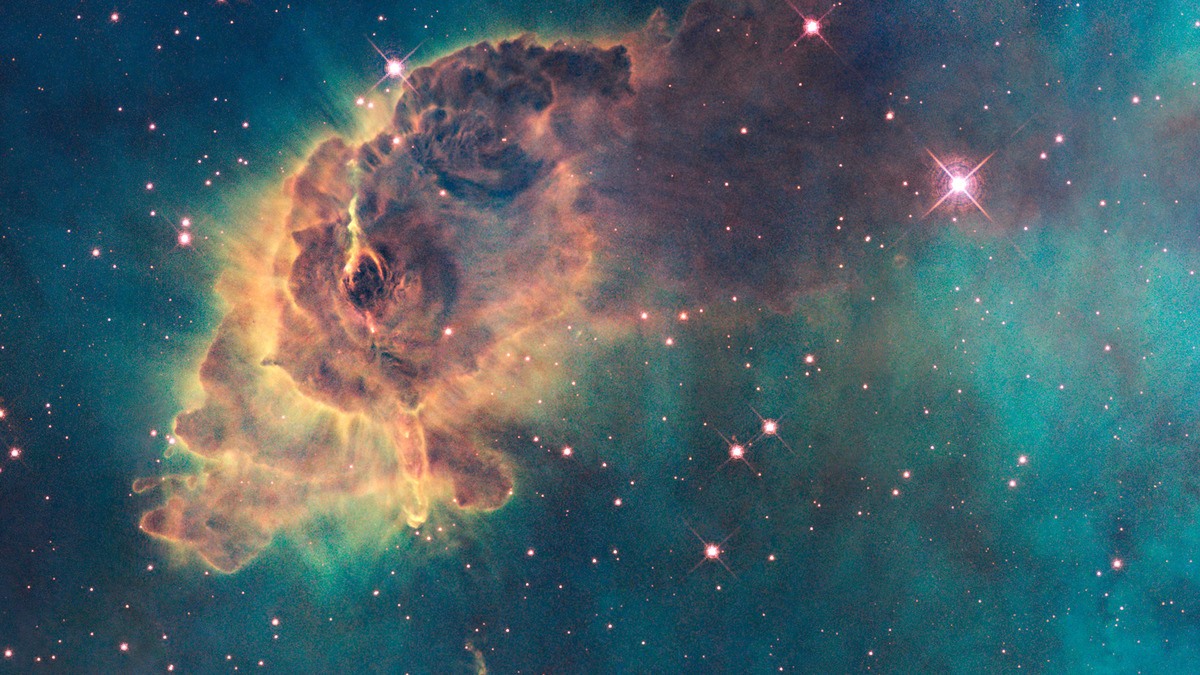
What is this structure?

a)

a galaxy

b)

a star

c)

a nebula

d)

a gas giant

17.

What layer of a star does nuclear fusion take place

a)

The photosphere

b)

The radiation zone

c)

The convection zone

d)

The core

18.
What does it mean if there a redshift in galaxies? (page 329)
a)
the galaxies are moving closer together
b)
the galaxies are moving farther apart
c)
the stars are changing color
19.
what is the Cosmic Microwave Background (CMB) (page 329)
a)
a telescope
b)
a place to make food
c)
an early radiation
d)
a galaxy
20.

What is a characteristic of the White Dwarf?

a)

Low Luminosity, not very bright

b)

Extremely hot

c)

High Luminosity, very bright

d)

Larger than the earth