Wayground logo

Free Printable Worksheets

Font size

S
M
L
XL
Worksheets

LC3 Year 10 Chemistry

Total questions: 45

Worksheet time: 11hrs 15mins

Name
Class
Date
1.

Alkanes are a homologous series of organic compounds, what is there general formula?

a)

CnH2n+2

b)

CnH2n

c)

CnH2n+1

d)

C2nH2n

2.

What catalyst is needed for catalytic cracking

a)

Hydrogen peroxide

b)

Nickel

c)

Zeolite

d)

Platinum

3.
What is the correct definition for a hydrocarbon?
a)
A compound made of hydrogen and carbon
b)
A mixture made of hydrogen and carbon only
c)
A mixture made of only hydrogen and carbon
d)
A compound made of only hydrogen and carbon
4.
The process of separating the different length hydrocarbons from crude oil is known as...
a)
Distillation
b)
Cracking
c)
Fractional Distillation
d)
Filtering
5.
The longer the hydrocarbon, the ________ the flammability?
a)
Lower
b)
Higher
6.
The longer the hydrocarbon, the _________ the viscosity?
a)
Lower
b)
Higher
7.
The longer the hydrocarbon, the ______ the volatility
a)
Lower
b)
Higher
8.
The longer the hydrocarbon, the _______ the boiling point
a)
Lower
b)
Higher
9.
During the process of fractional distillation, the petroleum compounds are separated according to the difference in their _______________.
a)
boiling point
b)
density
c)
unsaturation
d)
mass
10.
How does the temperature change from top to bottom?
a)
Increases
b)
Decreases
c)
It does not change
d)
Cannot be determined
11.
What is the correct general formula of the alkanes?
a)
CnH2n + 2
b)
C2nH2n + 2
c)
CnH2n 
d)
C2nHn + 2
12.
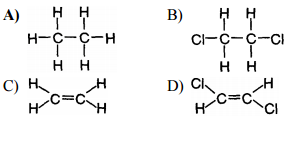
Which formula represents a saturated hydrocarbon?
a)
A
b)
B
c)
C
d)
D
13.
Which formula represents an unsaturated hydrocarbon?
a)
A
b)
B
c)
C
d)
D
14.
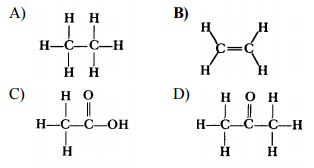
Which compound belongs to the alkene family?
a)
C2H2
b)
C2H4
c)
C6H6
d)
C6H14
15.
How many carbon atoms are in methane?
a)
1
b)
2
c)
3
d)
4
16.
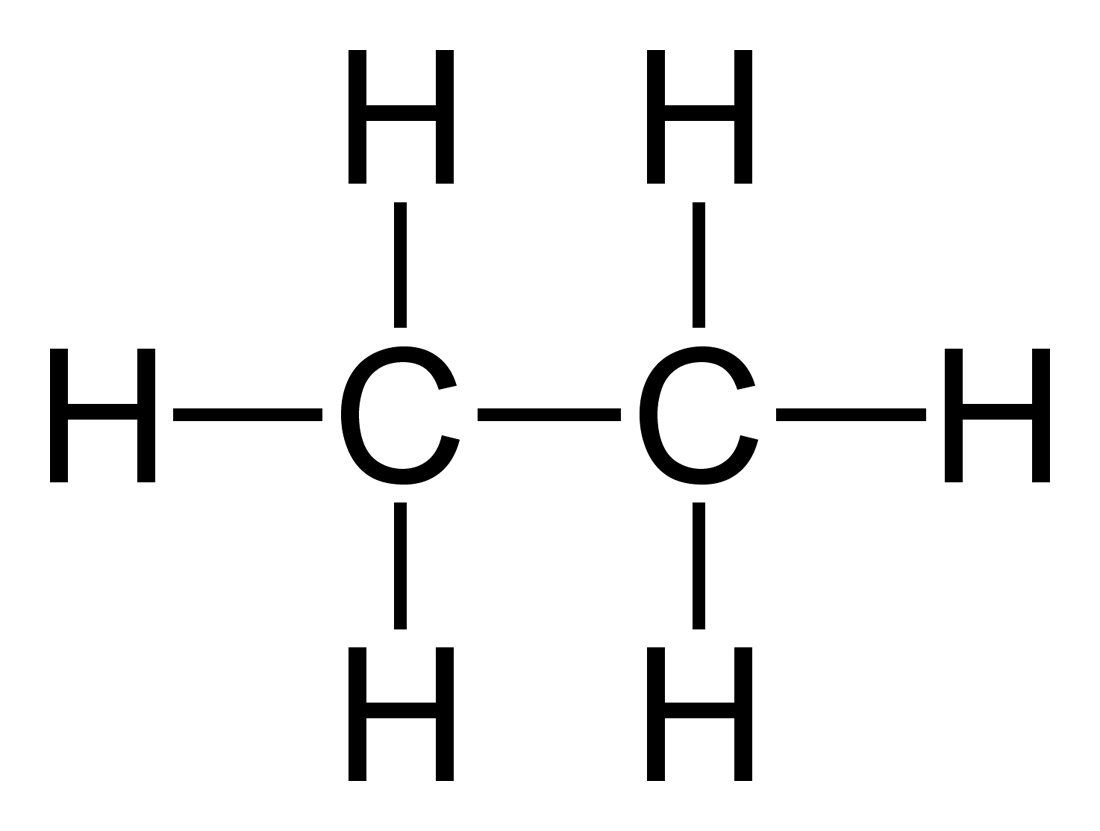
Name this alkane
a)
Methane
b)
Ethane
c)
Propane
d)
Butane
17.

What would you observe when bromine water reacts with an alkene?

a)

The solution turns from reddish-brown to colourless

b)

The solution turns from purple to colourless

c)

The solution turns from reddish-brown to clear

d)

The solution turns cloudy

18.
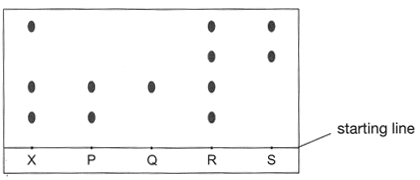
The diagram below shows a chromatogram obtained when a sample X was analysed together with four other known dyes P, Q, R and S. Dye Q was known to cause cancer. Which of the following dye(s) is/are safe for use?
a)
P only
b)
S only
c)
P and S
d)
P and X
19.

A student extracts the colour from some green smarties and uses paper chromatography to separate components colours. She finds blue has a Rf =0.38 and yellow Rf =0.75 this suggests

a)

the yellow is more strongly adsorbed onto the stationary phase and is less soluble in the mobile phase.

b)

the yellow is more strongly adsorbed onto the stationary phase and is more soluble in the mobile phase.

c)

the blue is more strongly adsorbed onto the stationary phase and is less soluble in the mobile phase.

d)

the blue is more strongly adsorbed onto the stationary phase and is more soluble in the mobile phase.
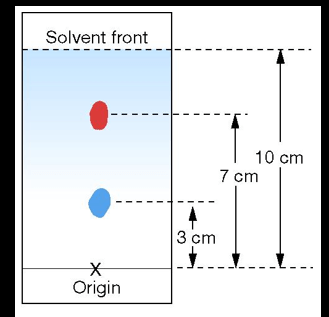
20.
The Rf value  for the blue component is 
a)
0.3
b)
0.7
c)
10
d)
3
21.
Define chemical equilibrium.
a)
A reaction is reversible.
b)
The concentration of the reactants is equal to the concentration of the products.
c)
The rate of a forward reaction is equal to the rate of the reverse reaction.
d)
The reaction stops and no further change in concentration occurs.
22.
For the reaction...
SO2 + O2  <−>  SO3
If the concentration of SO2 is increased, the equilibrium of the reaction will shift ___________.
a)
left
b)
right
c)
left and right 
d)
neither left nor right
23.
For the reaction...
SO2 + O2 <−>  SO3
If the equilibrium shifts to the right, the concentration of O2 will ___________.
a)
increase
b)
decrease
c)
remain the same
d)
double
24.
For the reaction...
N2 (g) +  3 H2 (g) <−> 2 NH3 (g)

If the pressure in the system is increased,  which substance will increase in concentration?
a)
N2
b)
H2
c)
N2 and H2
d)
NH3
25.
Consider the following reaction:
2SO2(g) + O2(g) ⇄ 2SO3(g)                      +  197 kJ/mol
 Which of the following will not shift the equilibrium to the right?
a)
Adding more O2
b)
Adding a catalyst
c)
increasing the pressure
d)
Increasing the temperature
26.
Why is equilibrium called a dynamic state?
a)
Chemists try to convert as much reactants as possible into products.
b)
The reactions at equilibrium continue to take place once equilibrium is established.
c)
The products of a forward reaction are favored, so equilibrium lies to the right.
d)
All chemical reactions are considered to be reversible under suitable conditions.
27.
Le Chatelier's Principle states that if a chemical system at equilibrium is stressed,
a)
the system will adjust to increase the stress
b)
the system will adjust to reduce the stress
c)
the system will not adjust
28.
This symbol indicates that a reaction is ____________
a)
reversible
b)
irreversible
29.
How do catalysts increase the rate of reaction?
a)
The frequency of collisions is the increased
b)
The activation energy is lowered
c)
The energy of collisions is increased
d)
Both the frequency and energy of collisions is increased
30.
For the reaction...
SO2 + O2 <−>  SO3
If the equilibrium shifts to the right, the concentration of SO3 will ___________.
a)
increase
b)
decrease
c)
remain the same
d)
double
31.
For the reaction...
SO2 + O2 <−>  SO3
If the concentration of O2 is decreased, the equilibrium of the reaction will shift ___________.
a)
left
b)
right
c)
left and right
d)
neither left nor right
32.
For the reaction...
SO2 + O2 <−>  SO3
If the equilibrium shifts to the left, the concentration of SO3 will ___________.
a)
increase
b)
decrease
c)
stay the same
d)
triple
33.

For the reaction...

SO2 + O2 <−> SO3

If a catalyst is added the equilibrium shifts to the ______________?

a)

left

b)

it has no effect

c)

right

d)

neither

34.
For the reaction...
heat  +  N2  +  O2  <−>  2NO
If  NO is removed  from the system, the concentration of N2 will _______.
a)
increase
b)
decrease
c)
remain the same
d)
double
35.
Which of the following is NOT true at equilibrium?
a)
The forward and reverse reactions proceed at the same rate.
b)
The concentrations of reactants and products do not change.
c)
The concentration of the reactants is equal to the concentration of the products.
d)
The forward and reverse reactions continue to occur.
36.

List four factors that affects the rate of a reaction

a)

temperature

b)

concentration

c)

surface area

d)

volume

e)

catalysts

37.

Why does a higher concentration increase the rate of reaction?

a)

it increases the amount of reactants

b)

it lowers the activation energy

c)

it increases the energy of particle collisions

d)

it increases the frequency of particle collisions

38.

Why does a higher temperature increase the rate of a reaction?

a)

it increases both the frequency and energy of particle collisions

b)

it only increases the frequency of particle collisions

c)

it only increases the energy of particle collisions

d)

it reduces the activation energy of the reaction

39.
What is the rate of reaction?
a)
How fast a reaction is 
b)
How big a reaction is
c)
How loud a reaction is
d)
How much gas a reaction produces
40.

The minimum amount of energy needed for colliding particles to react is called

a)

Chemical Energy

b)

Kinetic Energy

c)

Activation Energy

d)

Potential Energy

41.

Is this an example of an endothermic or exothermic reaction?

a)

Endothermic

b)

Exothermic

42.
Describe the energy change that takes place when a chemical reaction occurs.
a)
a) Energy is given out
b)
b) Energy is taken in
c)
c) Energy is taken in and then given out
d)
d) Energy is given out and then taken in
43.

Is this an example of an endothermic or exothermic reaction?

a)

Endothermic

b)

Exothermic

44.

An exothermic reaction has

a)

+ΔH

b)

-ΔH

45.

An endothermic reaction has

a)

+ΔH

b)

-ΔH