
 Worksheets
Chapter 11 Intro of NS Exam Review
Total questions: 40
Worksheet time: 26mins


Label the Neuron-What does the letter "D" represent?
Dendrite
Axon
Myelin Sheath
Soma
What is the insulating membrane that surrounds parts of the axon that helps the impulses travel faster called?
Axon
Dendrites
Soma
Myelin Sheath
These carry signals from tissues and organs to the brain and spinal cord
Afferent Neurons/Pathway
Motor Neurons
Efferent Neurons/Pathway
Glial Cells
Electrical nerve impulses within a neuron are called...
action potential
resting potential
hyperpolarization
polarization

The tiny gap between neurons where nerve impulses are sent from one neuron to another.
synapse
axon terminal
impulse
myelin
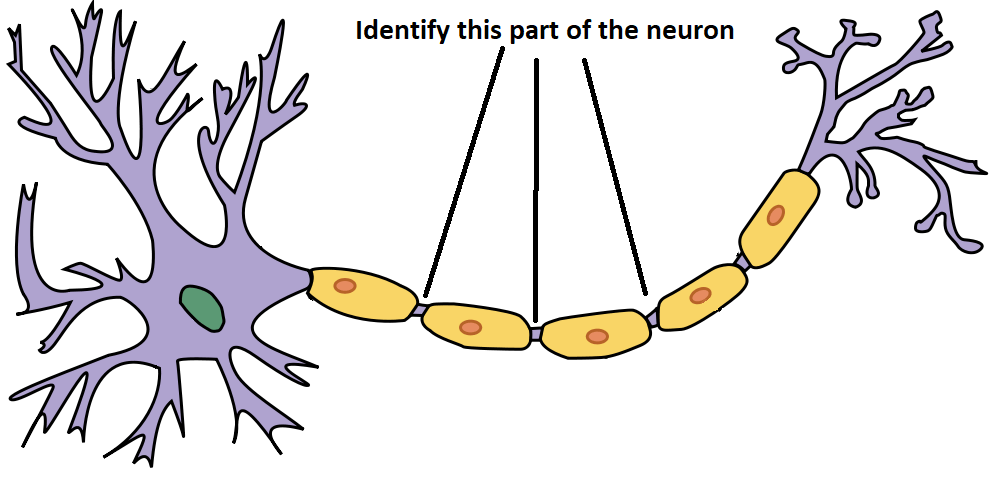
What are the spaces between the schwann cells?
Nucleus
Cell Body
Axon
Node of Ranvier

Which nervous system contains sensory and motor neurons that carry information between the central nervous system and the rest of the body?
Peripheral Nervous System
Central Nervous System
If Jessica accidentally touches the stove while cooking and she immediately pulls her hand back, this is an example of the autonomic nervous system.
True
False
Alexa is presenting a project in front of her class. She starts sweating and her heart rate increases. This is an example of the autonomic nervous system, sympathetic division.
True
False
The function of the autonomic system is to
Calm the body down and conserve and replenish energy.
take messages to and from the body’s internal organs, monitoring such processes as breathing, heart rate, and digestion.
convey information from the skin and muscles to the CNS about conditions such as pain and temperature.
Arouse the body, mobilize its energy during physical exercise and in stressful situations, and activate the adrenal gland to release epinephrine into the bloodstream.
Which of the following neuroglia brace neurons and anchor them to nutrient lines and blood capillaries?
microglia
astrocytes
ependymal
oligodendrocytes
Which of the following glial cells use cilia to help circulate the cerebrospinal fluid (CSF)?
microglia
astrocytes
ependymal cells
oligodendrocytes
In the Peripheral Nervous System, the myelin sheath is formed by
oligodendrocytes
satellite cells
astrocytes
schwann cells
microglial
Which glia cells are branched and produce myelin for the Central Nervous System?
microglia
astrocytes
ependymal cells
oligodendrocytes
Which glial cells transform into microphages to engulf dead cells?
microglia
astrocytes
ependymal cells
oligodendrocytes

What number(s) on the graph represents the Resting Potential (polarized)?
1 and 2
1 and 5
2 and 3
3 and 4


Dopamine is responsible for feelings of...
sadness
pleasure
fear
despair
Reflexes keep animals out of __________________.
water
food
danger
money
Reflexes in your body start when receptors in your body detect _________________.
messages
stimuli
reactions
movement
Reflexes involve receptors sending messages to the ______________.
brain
heart
nerves
spinal cord
The spinal cord sends a message to the part of the body that needs to ___________.
react
sleep
stop working
eat
Reflexes work _______________ than instincts.
faster
slower
Reflexes occur ______________ the brain knows what happened.
before
after
A reflex is a voluntary response.
true
false

