
 Worksheets
Unit #7 Investigating Chemical formulas and Reactions
Total questions: 44
Worksheet time: 1hrs 28mins
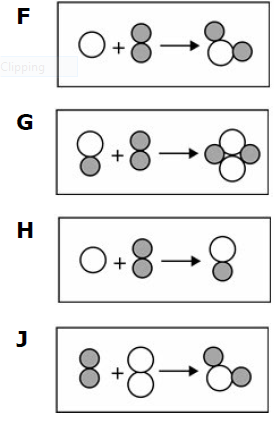
The formula below represents carbohydrate known as glucose. How many carbon atoms are present?
C6H12O6
4
3
12
6

The chemical formula for glucose, a simple sugar, is C6H12O6. The formula for ethanol is C2H6O. What differences are there in these compounds?
The elements that make up glucose are different than the elements that make up ethanol
The number of atoms of the elements is different in ethanol than in glucose
The chemical properties of the elements are different in glucose and ethanol
Glucose has more elements than the ethanol

Which of these formulas contain equal numbers of nitrogen atoms?
Formulas I and III
Formulas I and IV
Formulas II and III
Formulas I, II, and V
Two clear colorless solutions were combined.
The student observed that the temperature changed from 25 •C to 23 •C when the solutions were combined and that a white substance rapidly formed and settled to the bottom of the container. What most likely happened to produce these results?
One of the original elements came out of one of the solutions.
The solutions reacted chemically and formed a precipitate.
Some of the water froze into ice crystals.
Rapid evaporation of water occurred, leaving a solid.

The equation below represents a chemical reaction that occurs in living cells. How many atoms are represented in the reactants of this equation?
6 total atoms
12 total atoms
24 total atoms
36 total atoms
In which of these compounds are there twice as many oxygen atoms as to hydrogen atoms?
H3PO4
H2SO4
HCIO3
H2O

How many total atoms are in one molecule of serotonin?
C10H12N2O
22
24
25
4
Coal contains carbon and other elements. Carbon dioxide forms when coal burns in the presence of oxygen. Which of these is the best evidence that a chemical reaction occurs when coal burns?
The shape of the coal changes.
Oxygen is present.
A new substance is produced called Carbon dioxide gas.
Coal is made up of more than one element
What is the mass of the reactant in the reaction above?
Reactants --> Products
2H2O2 --> 2H2O + O2
___________g --> 24.11g + 21.44 g
24.11
45.55
21.44
91.10
Which of the following BEST describes a chemical reaction?
A compound is crushed into a fine powder.
Atoms break apart into even smaller particles.
Existing valence electron bonds break and reattach to other atoms.
Molecules move faster until they fly apart from each other.

A scientist performed four investigations using eight different liquids. In each investigation, the scientist combined two of the liquids under a fume hood and recorded observations in the table below.In which investigation is it least likely that the liquids reacted chemically?
1
2
3
4


Which chemical formulas are the reactants in the chemical equation pictured?
CH4 and CO2
CH4 and 2O2
CO2 and H2O
O2 and H2O

Which chemical formulas are the products of the chemical reaction pictured?
CH4 and CO2
CH4 and O2
CO2 and 2H2O
O2 and H2O


According to the law of conservation of mass...
sometimes atoms are lost
sometimes atoms are gained
atoms are never lost nor gained are only rearranged.
atoms are lost and gained
In an endothermic reaction energy is...
released and heats up
absorbed and cools down
protons
neutrons
H2 + O → H2O
H2 + O → H2O
During an endothermic reaction, what happens to the energy in relation to the surrounding environment?
released and temperature increases.
absorbed from the environment and temperature drops.
mixed with the environment and no change happens.
During an exothermic reaction, what happens to energy in relation to the surroundings?
released to the environment at heat.
absorbed from the environment and the temperature drops.
mixed with the environment and no change happens.
In a cold pack, which type of reaction draws heat from the surroundings?
exothermic reaction
endothermic reaction
endoexothermic reaction
H2 + O --> H2O
Example: H2
At the end of chemical reactions, what is the total mass of the reactants compared to the total mass of the products?
the product is doubled
the product is half the mass of the reactants
the masses are the same or equal
the masses changes depending on the reaction
What is a coefficient?
The small number on the right of the chemical symbol.
The large number to the left of a chemical formula.
How many Al atoms are in this compound? 4Al2O3
2
8
6
4
How many Fluorine atoms are present in this compound?
6MgF2
2
6
8
12
According to the law of conservation of mass. Mass is never created nor destroyed it is only rearranged.
True
False
Which model best represents the chemical formula for carbon dioxide?
CO2
C6H12O6
H2O
None of the above.
How many Al atoms are in this compound? 4(Al2O3)2
2
16
8
4
How many molecules are present in this chemical formula?
4(Al2O3)2
2
16
8
4
Based on the following chemical formulas, which formula contains the most atoms.
C6H12O6
C12H24O12
20H2O
5(CO2)6
C6H12O6
C12H24O12
20H2O
5(CO2)6
Based on the following chemical formulas, which formula is not a molecule
C6H12O6
C45
O
H36
C6H12O6
C45
O
H36

