
 Worksheets
Engineering Fundamentals 1
Total questions: 20
Worksheet time: 11mins

What is the SI Base unit for Time?
Hour
Minute
Second
Day

Which prefix has a value of 106?
G
M
k
m
μ

Which option is an example of a Vector?
3km North
100 km/h
40 s
27 ms-1

Which arrow is pointing to the 'sense' of the vector?
A
B
C
D

Which option describes Newton's 1st Law of Motion?
F = ma
For every action there is an equal & opposite reaction
A body will remain stationary or at constant velocity unless an unbalanced force acts upon it
Which option describes Newton's 2nd Law of Motion?
F = ma
For every action there is an equal & opposite reaction
A body will remain stationary or at constant velocity unless an unbalanced force acts upon it

Mr O'Brien placed this coin on the balance in the classroom. How much does it weigh?
5.67 g
5.67 kg
0.0567 N
56.7 N
Mr O'Brien placed this coin on the balance whilst he was on the moon (Acceleration due to gravity on the moon is 1.620 m/s2). What is the mass of the coin on the moon?
5.67 g
5.67 kg
0.0091854 N
9.1854 N

Which property is being defined - "The ability of a material to be hammered or rolled into thin sheets"
Ductility
Malleability
Strength
Stiffness
What is the physical property that can be calculated by measuring the mass and dividing it by volume?
Weight
Porosity
Density
Mass

What subatomic particles would you find in the nucleus of an atom?
Protons only
Protons and Neutrons
Neutrons and Electrons
Protons and Electrons

Which subatomic particle has a neutral or no charge?
Proton
Electron
Neutron

When an atom loses an electron, it becomes a:
positive ion
negative ion
neutral ion
neutral atom
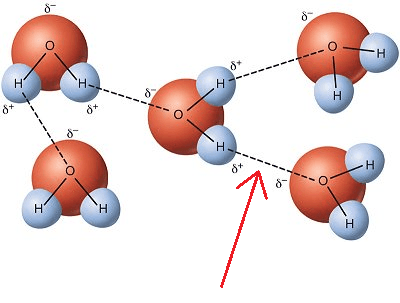
What type of bond is shown in this picture? It is the WEAKEST type & attracts one water compound to another!
Ionic bond
Polar Covalent (dipole)
Nonpolar Covalent
Van der Waals force (dipole)
Which of the following is the most workable of crystal structures?
FCC
BCC
HCP
Simple cubic

Identify the unit cell
simple cubic
BCC
FCC
HCP

Define the term 'allotrope'
Atoms with same proton number but different number of neutrons
Atoms with same proton number but different mass number
Atoms in different arrangement in structure
Atoms in different arrangement and different physical form

