wayground logo

Free Printable Worksheets

NEW

Font size

S
M
L
XL
Worksheets

Warm up Feb. 12

Total questions: 80

Worksheet time: 4hrs 12mins

Name
Class
Date
1.
What is the measure of the following angle?  
a)
10 degrees.
b)
40 degrees.
c)
67 degrees.
d)
168 degrees. 
2.
What is the measurement of angle FAD?
a)
20 degrees
b)
90 degrees
c)
30 degrees
d)
160 degrees
3.
Measure to the nearest 10 degrees.
a)
40°
b)
50°
c)
130°
d)
140°
4.
Measure to the nearest 10 degrees.
a)
60°
b)
70°
c)
10°
d)
110°
5.
Measure to the nearest 5 degrees.
a)
90°
b)
95°
c)
100°
d)
85°
6.
Measure to the nearest 10 degrees.
a)
20°
b)
30°
c)
160°
d)
150°
7.
Measure to the nearest 5 degrees.
a)
70°
b)
75°
c)
80°
d)
105°
8.
Measure to the nearest 5 degrees.
a)
15°
b)
25°
c)
165°
d)
175°
9.
Measure to the nearest 10 degrees.
a)
40°
b)
30°
c)
150°
d)
140°
10.
A producer?
a)
Eats other plants and animals
b)
Makes its own food
c)
Eats dead plants or animals
d)
Makes toys for kids
11.
A consumer?
a)
Makes its own food
b)
Eats dead plants and animals
c)
Eats plants and other animals for energy
d)
Buys toys for kids
12.
A decomposer?
a)
Eats dead plants or animals and breaks down to put nutrients in the soil
b)
Eats plants or other animals for food
c)
Makes its own food
d)
Machine that gathers trash
13.
Frog. Is it a....
a)
Producer
b)
Conusmer
c)
Decomposer
14.
Flower 
a)
Producer
b)
Consumer 
c)
Decomposer 
15.
Bacteria 
a)
Producer
b)
Consumer 
c)
Decomposer 
16.
How do you find the area of a rectangle?
a)
Length + Length + Length + Length
b)
Length + Width
c)
Length x Width
d)
Width x Width
17.
The area of a rectangle is 25 square cm. What could the length and the width of that rectangle be?
a)
6 ft and 4 ft
b)
5 ft and 5 ft 
c)
10 ft and 15 ft
18.
The distance around an object is called the 
a)
area
b)
perimeter
19.
The space inside an object is called it's
a)
area
b)
perimeter
20.
Cole is creating a fence around his yard for his new puppy.  The length of the yard is 9 feet and the width is 5 feet.  How much fencing will Cole need?  
a)
45 feet
b)
28 feet
c)
25 feet
d)
14 feet
21.
This organism draws its water from the ground, traps sunlight in its chlorophyll, and makes glucose (sugar) in broad green parts of its body. Is it a...
a)
Producer
b)
Consumer
c)
Decomposer
22.
This organism traps its prey in a web, stings it, paralyzes it, and sometimes saves it to eat later. Is it a.....
a)
Producer
b)
Consumer
c)
Decomposer
23.
This organism draws its nutrients from dead organisms as it releases enzymes to cause the organisms to break down and break apart. Is it a...
a)
Producer
b)
Consumer
c)
Decomposer
24.
Fungi. Is it a...
a)
Producer
b)
Consumer
c)
Decomposer
25.
Pine Tree. Is it a...
a)
Producer
b)
Consumer
c)
Decomposer
26.
Squirrel 
a)
Producer
b)
Consumer 
c)
Decomposer 
27.
Cow 
a)
Producer
b)
Consumer
c)
Decomposer 
28.
Grass 
a)
Producer 
b)
Consumer
c)
Decomposer 
29.
What type of line does the picture represent?
a)
Parallel
b)
Intersecting
c)
Perpendicular
30.
What type of lines does the picture represent? 
a)
Parallel
b)
Intersecting
c)
Perpendicular
31.
What type of lines are these?
a)
Parallel Lines
b)
Perpendicular Lines
c)
Intersecting Lines
d)
Line
32.
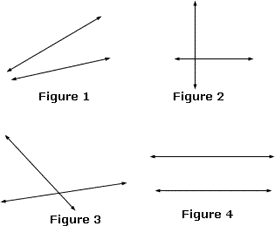
Which figure shows a set of parallel lines?
a)
Figure 1
b)
Figure 2
c)
Figure 3
d)
Figure 4
33.
Which figure shows a set of perpendicular lines?
a)
Figure 1
b)
Figure 2
c)
Figure 3
d)
Figure 4
34.
Measure to the nearest 10 degrees.
a)
80°
b)
90°
c)
100°
d)
110°
35.
Measure to the nearest 5 degrees.
a)
35°
b)
45°
c)
145°
d)
155°
36.
Measure to the nearest 10 degrees.
a)
40°
b)
50°
c)
130°
d)
140°
37.
Measure to the nearest 10 degrees.
a)
7°
b)
70°
c)
110°
d)
120°
38.
What is the number 7,432 in expanded notation?
a)
(7 x 1,000) + (4 x 100) + (3 x 10)
b)
(7 x 100) + (4 x 100) + (3 x 10) + (2 x 1)
c)
(7 x 1,000) + (4 x 100) + (3 x 10) + (2 x 1)
d)
(7 x 1,000) + (4 x 100) + (3 x 1) + (2 x 10)
39.
What is the number (5 x 10,000) + (2 x 1,000) + (8 x 100) + (5 x 1) in standard form?
a)
52,805
b)
52,850
c)
58,205
d)
52,580
40.
Suzie has (7 x 1,000) + (6 x 100) + (4 x 1)  pennies in her piggy bank.  How many pennies does Suzie have? 
a)
764 pennies
b)
7,604 pennies
c)
7,640 pennies
d)
7,064 pennies
41.

How is 61.08 written in expanded notation?

a)

(6 x 10) + (1 x 1) + (8 x 0.1)

b)

(6 x 10) + (1 x 0.1) + (8 x 0.01)

c)

(6 x 10) + (1 x 1) + (8 x 0.001)

d)

(6 x 10) + (1 x 1) + (8 x 0.01)

42.

What is (2 x 100) +(3 x 10) + (8 x 1) + (4 x 0.1) + (7 x 0.01) in standard form?

a)

23,847

b)

2,384.7

c)

238.47

d)

23.847

43.

What is (8x 100) + (3x1) + (5x 0.1) in standard form?

a)

835

b)

803.5

c)

803.05

d)

8.35

44.
Look at the shaded model.  Which number sentence is true?
a)
1/8<3/8
b)
3/8<1/8
c)
7/8<5/8
d)
5/8>1/8
45.
Place the correct symbol in the space provided:
1/2 ____ 3/8
a)
>
b)
<
c)
=
46.
3/6 ___ 8/12
a)
>
b)
<
c)
=
47.
1/3 ___ 2/7
a)
>
b)
<
c)
=
48.
5/10 ___ 2/7
a)
>
b)
<
c)
=
49.

Which comparison statement is true about these figures?

a)

2/5 > 2/3

b)

3/5 = 1/3

c)

2/5 < 2/3

d)

2/3 < 2/5

50.

Which comparison statement is true based on the image above?

a)

1/3 > 4/6

b)

2/3 > 2/6

c)

2/3 < 2/6

d)

2/3 = 2/6

51.
Which picture shows 1/2?
a)
green
b)
blue
c)
purple
d)
pink
52.
The number on the top of a fraction is called what?
a)
numerator
b)
denominator
c)
fractionator
d)
equivalent
53.
The number on the bottom of a fraction is called what?
a)
numerator
b)
denominator
c)
equivalent
d)
improper
54.
What do you call an equal fraction ?
a)
Equivalent  fraction
b)
Mixed fraction
c)
Improper fractions
d)
Denominator
55.
Which of the following is an equivalent fraction to 5/6?
a)
9/12
b)
10/12
c)
8/12
d)
14/18
56.
Which fraction is equivalent to 2/6?
a)
1/3
b)
2/3
c)
1/4
d)
2/4
57.
Which fraction is equivalent to 1/4? 
a)
1/6
b)
2/6
c)
1/8
d)
2/8
58.
The answer to a multiplication problem is called ___________
a)
Product
b)
Quotient
c)
Factor
d)
Sum
59.
A number close to an exact solution tells "about how much or how many" 
a)
Difference
b)
Sum
c)
Estimate
d)
Product
60.
The answer to an addition problem 
a)
Difference
b)
Quotient
c)
Product
d)
Sum
61.
The answer to a division problem
a)
Remainder
b)
Quotient
c)
Dividend
d)
Divisor
62.
What we can multiply to get a certain number. 5 and 2 are ____________ of 10. 
a)
multiple
b)
inverse operation
c)
factor
d)
divisor
63.
a number divided into another number 
108 divided by 12 = 108 ..... What does 12 represent. 
a)
Divisor
b)
DIvidend
c)
Remainder
d)
Quotient 
64.
A number to be divided by another number is called.. 
What 108 represents in the number sentence 108 divided by 12 equals 9
a)
Divisor
b)
Dividend
c)
Remainder
d)
inverse operation
65.
The amount left over when a number cannot be divided equally by another number. 
a)
Left overs
b)
Divisor
c)
Dividend
d)
Remainder
66.
difference
a)
the answer to a division question
b)
the answer to a subtraction question
c)
the answer to an addition question
d)
the answer to a multiplication question
67.
Perimeter
a)
L X W 
b)
The number of square units within a flat surface
c)
The amount of space something takes up
d)
The distance around an object
68.
Which number has 9 in the tenths place?
a)
16,453.87
b)
23,869.15
c)
54,823.91
d)
27,890.53
69.
Order these numbers from least to greatest:
11,111
10,101
11,110
10,001
a)
10,101
10,001
11,111
11,110
b)
11,111
11,110
10,101
10,001
c)
10,001
10,101
11,110
11,111
d)
11,110
11,111
10,001
10,101
70.
What is the value of 5 in the number below:3,654,982
a)
ten thousands
b)
50,000
c)
hundred thousand
d)
500,000
71.
There are 52 weeks in a year. If Gracie turned 9 last year, how many weeks has she been alive? 
a)
468
b)
477 weeks
c)
416 weeks
d)
468 weeks
72.
What is the area of a rectangle with a length of 6 cm and a width of 4 cm?
a)
10 square cm
b)
20 square cm
c)
24 square cm
d)
48 square cm
73.
Which lists the decimals in order from greatest to least?
a)
0.36  0.42  0.4
b)
0.4  0.36  0.42 
c)
0.42  0.4  0.36
d)
0.42  0.36  0.4
74.

Round 15,482 to the nearest thousand.

a)

20,000

b)

15,000

c)

16,000

d)

15,5000

75.

Round 83 to the nearest tens.

a)

90

b)

85

c)

100

d)

80

76.

Round 352 to the nearest tens.

a)

350

b)

400

c)

360

d)

300

77.

Which number could be rounded to 600

a)

672

b)

582

c)

534

d)

652

78.

Which number could be rounded to 4,000

a)

3,614

b)

4,624

c)

3,299

d)

4,910

79.

Which number could be rounded to 7,000

a)

6,299

b)

6,487

c)

7,512

d)

7,423

80.
Which of the following numbers will NOT round to 400 when rounding to the nearest hundred?
a)
409
b)
445
c)
345
d)
398