
 Worksheets
Functional Anatomy: Macro + Microstructure + SFT + FV + FL
Total questions: 27
Worksheet time: 15mins
In a sarcomere, what are the thick protein filaments known as?
Cross Bridges
Myosin
Light Band
Actin
In a sarcomere, which structure is attached to the Z-lines?
Mysosin
Actin
A Band
I Band
The contractile unit of a muscle is called the:
sarcomere
motor unit
fascicle
myofibril
A bundle of muscle fibres is known as a:
sarcomere
fiber
fascicle
Tendon
The thin filaments in a myofibril are:
Sarcomeres
Sarcoplasm
Actin
Myosin
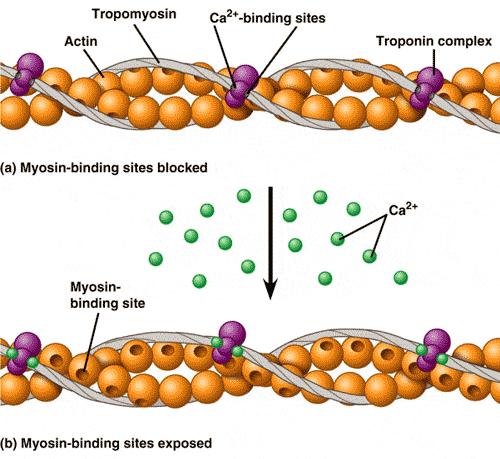
Calcium:
causes ATP to be broken down within the sarcomere
is the stimulus for a power-stroke to occur
energizes the myosin heads to be able to attach to the actine binding sites
plays a vital role exposing the binding sites on actin so that the myosin heads can attach to them
A powerstroke in the sarcomere occurs directly after:
Myosin crossbridges have binded onto actin binding sites
The calcium had crossed into the cytoplasm
The calcium has binded with troponin
A nerve impulse has stimulated the release of calcium into the sarcomere
True or False: An isometric contraction has the capability to produce more force than both concentric and eccentric contractions.
True
False
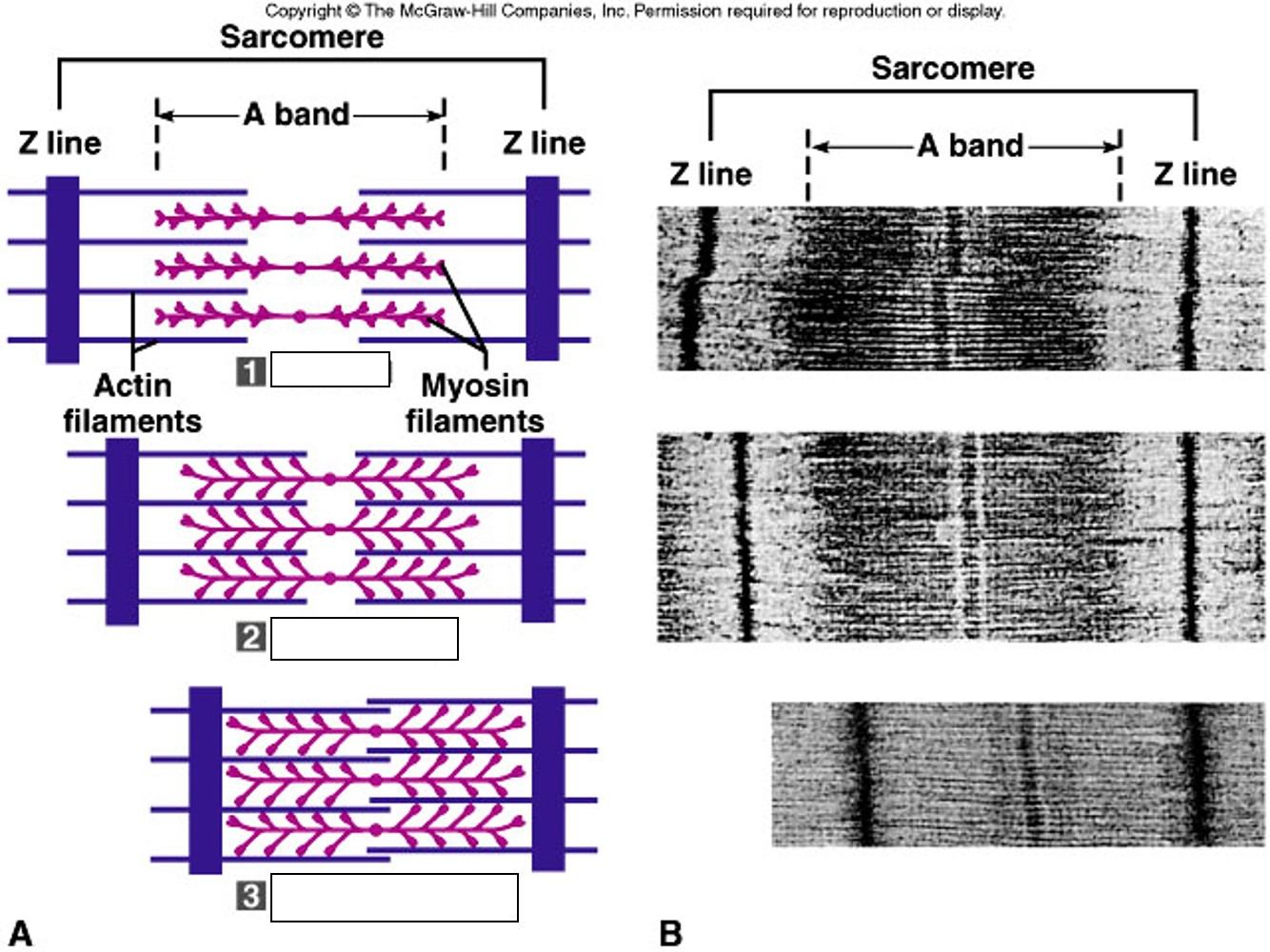
Look at the top, purple sarcomere. The sarcome is:
Relaxed
Mid-contraction
Fully Contracted
None of the above
The bottom, purple sarcomere is in which below state:
Relaxed
Contracting
Fully Contracted
None of the above

Skeletal muscles consist of numerous _____________ that contain lots of _______________ which are composed of repeating contractile units called _____________?
muscle fibers, sarcomeres, myofibrils
sarcomeres, muscle fibers, myofibrils
sarcomeres, myofibrils, muscle fibers
muscle fibers, myofibrils, sarcomeres
The force velocity relationship of a concentric contraction is best described as
Directly proportional - as velocity increases, so does force.
Directly proportional - as velocity increases, force decreases
Inverse - as velocity decreases, force increases
Inverse - as velocity decreases, so does force
A muscle can produce the most force when it is
Fully contracted
Fully lengthened
At approximately mid length
Just before it is in a fully contracted state
Paul wants to increase his overall force production. At the gym you would recommend that:
He increases the number of repetitions of the weight he is lifting
He increases the velocity of his repetitions/contractions
He increases the duration of each of his repetitions/contractions
He should lift weight that is too heavy for him to do with correct technique
The H - Zone
Is present when a sarcomere is contracted
Disappears when a sarcomere relaxes
Is the distance between the myosin filaments when a sarcomere is relaxed
Is the distance between the actin filaments when a sarcomere is relaxed
MULTIPLE ANSWERS: Select all correct statements
Actin are the thin contractile proteins connected to the Z lines
Myosin are the thick contractile proteins which have heads that stick out from it.
The I band is the the gap between the myosin and Z-lines.
The A band is the length of the actin filaments.
MULTIPLE ANSWERS: When a sarcomere moves from a relaxed to a contracted state, what occurs?
H zone disappears
I bands disappear
The actin and myosin shorten in length
There is a shortening of distance between Z lines
The final step of the sliding filament theory involves:
The nerve stimulation ceasing causing the myosin heads to release the actin.
The nerve stimulation ceasing causing the actin binding sites to release the myosin heads
The nerve stimulation ceasing whereby the actin and myosin return to their original lengths.
The "power stroke" occurring.
The force-velocity relationship for a concentric contraction is described as _____________ while the force-velocity relationship for an eccentric contraction can be described as _________________.
Directly proportional/inverse
Inverse/inverse
Inverse/directly proportional
directly proportional/directly proportional
A muscle in a fully contracted state, produces
Maximum force as an optimal amount of myosin crossbridges can attach to the actin binding sites.
Maximum force as many myosin crossbridges can easily attach to ALL actin binding sites
Comparatively less force than when a muscle is at mid length because many actin biding sites are covered due to a large amount of 'overlap' between the filaments.
Comparatively less force than when a muscle is at mid length because there is not enough overlap, meaning the myosin heads cannot reach all the actin binding sites.
MULTIPLE ANSWERS: A contraction completed at high velocity produces less force because:
ATP can not be produced quickly enough to produce large amounts of force
Nerve impulses can not be sent quickly enough to engage the sarcomere
Less total motor units (a motor neuron and all the muscle fibers it stimulates) is recruited.
There isn't sufficient time for the myosin heads to attach to the actin filaments
When completing a bicep curl, athletes typically struggle to move the weight initially (when arm is in a straight position) because within the sarcomeres:
The highest number of myosin heads are able to reach and attach to the actin binding sites in the sarcomere.
There is too much overlap within the sarcomere between the actin filaments meaning some of the binding sites are blocked.
The Actin filaments are too far apart meaning the myosin heads can not attach to all the actin binding sited.
The first step of the sliding filament theory involves a motor neuron transmitting a never impulse to the muscle fibre. However the nerve impulse can not simply jump the neuromuscular junction. As a result a neurotransmitter called _____________ is released which in turn stimulates _____________ to enter the sarcomere
acetylcholine (ACH)/sodium
acetylcholine (ACH)/calcium
calcium/acetylcholine (ACH)
sodium/calcium
Which of the following substances is NOT involved in the Sliding Filament Theory
ATP
Calcium
Acetylcholine
Phosphocreatine
Calcium is released into the sarcomere from the _________ and causes the ___________.
sarcoplasmic reticulum/actin binding sites to be revealed
sarcoplasmic reticulum/myosin heads to engage with actin
Z-Lines/actin binding sites to be revealed
Z-Lines/myosin heads to engage with actin

