Wayground logo

Free Printable Worksheets

Font size

S
M
L
XL
Worksheets

Thermal Energy and Heat

Total questions: 38

Worksheet time: 28mins

Name
Class
Date
1.
Heat transfer always goes from-
a)
Cold to Hot
b)
Hot to Cold
c)
Heat doesn't transfer
d)
Freezing to Cold
2.
Conduction is heat transfer by -
a)
Touch
b)
Circles
c)
Waves
3.
Convection is heat transfer by-
a)
Touch
b)
Circles
c)
Waves
4.
Radiation is heat transfer by-
a)
Touch
b)
Circles
c)
Waves
5.
What happens to particles as they heat up?
a)
They slow down
b)
Nothing
c)
They don't move
d)
They speed up
6.
Which is more dense?
a)
Hot Liquid
b)
Cold Liquid
7.

What type of heat transfer takes place in liquids and gasses?

a)

Conduction

b)

Convection

c)

Radiation

d)

Thermal Equilibrium

8.
What type of heat transfer takes place in solids?
a)
Conduction
b)
Convection
c)
Radiation
9.
What type of heat transfer takes place through open space?
a)
Conduction
b)
Convection
c)
Radiation
10.
This is an example of-
a)
Conduction
b)
Convection
c)
Radiation
11.
This is an example of-
a)
Conduction
b)
Convection
c)
Radiation
12.
Hot objects begin to cool as-
a)
cooler air is transferred to the hot object.
b)
thermal energy in the object is transferred to the surrounding air.
c)
atoms in the object react with the oxygen in the air.
d)
thermal energy in the object cancels out energy in the air
13.
Which sentence explains why a cold metal spoon placed in a pot of boiling water becomes hot?
a)
Thermal energy is transferred from the spoon to the water.
b)
Thermal energy is transferred from the water to the spoon.
c)
Thermal energy in the water is transformed into kinetic energy in the spoon.
d)
Thermal energy in the spoon is transformed into kinetic energy in the water.
14.
Phase change from a solid to a liquid.
a)
melting
b)
sublimation
c)
boiling
d)
condensation
15.
Phase change from a liquid to a gas that only happens at the surface.
a)
evaporation
b)
boiling
c)
sublimation
d)
melting
16.
When the temperature of matter decreases the particles ...
a)
speed up and move farther apart
b)
speed up and move closer together
c)
slow down and move farther apart
d)
slow down and move closer together
17.
The opposite phase of melting is 
a)
freezing 
b)
sublimation
c)
condensation 
d)
deposition 
18.
Change from gas to liquid...
a)
condensation
b)
evaporation
c)
expansion
d)
movement
19.
Change from Liquid to Solid is call......
a)
fusion
b)
Freezing
c)
sublimation
d)
evaporation
20.
In a solid, the particles
a)
vibrate in place
b)
slide past one another
c)
overcome the strong attraction
21.

Which section of the phase change diagram is indicated?

a)

liquid

b)

solid

c)

melting

d)

freezing

22.

Which section of the phase change diagram is indicated?

a)

Gas

b)

Liquid

c)

Vaporization

d)

Condensation

23.

Which section of the phase change diagram is indicated?

a)

Solid

b)

Liquid

c)

Melting

d)

Freezing

24.

Which section of the phase change diagram is indicated?

a)

Freezing

b)

Melting

c)

Solid

d)

Liquid

25.

Which section of the phase change diagram is indicated?

a)

Condensation

b)

Vaporization

c)

Liquid

d)

Gas

26.

Which section of the phase change diagram is indicated?

a)

Vaporization

b)

Condensation

c)

Melting

d)

Freezing

27.

Which section of the phase change diagram is indicated?

a)

Melting

b)

Freezing

c)

Vaporization

d)

Condensation

28.
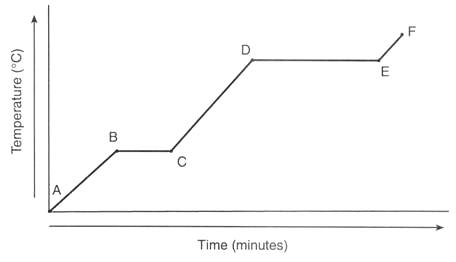
What line segment represents only the solid state?
a)
A-B
b)
B-C
c)
C-D
d)
D-E
29.
Between which points is the substance changing state?
a)
A-B only. 
b)
A-B, C-D, E-F
c)
B-C only. 
d)
B-C, D-E
30.
What can be determined by measuring the speed of molecules?
a)
volume
b)
density
c)
pressure
d)
temperature
31.
During a phase change, the temperature
a)
increases
b)
decreases
c)
fluctuates
d)
stays the same
32.
heat always travels from _____ to ______ objects
a)
hot to cold
b)
cold to hot
c)
cold to cold
d)
hot to hot
33.
An ice cube feels cold when we hold it. Which of the following best explains why?
a)
Heat moves from our hands into the ice cube.
b)
Cold moves from our hands into the ice cube.
c)
Heat moves from the ice cube into our hands.
d)
Cold moves from the ice cube into our hands.
34.
In an exothermic reaction, heat is ...
a)
taken in
b)
given out
35.

In an endothermic reaction, heat is ...

a)

taken in

b)

given out

36.

Which of the following process is exothermic?

a)

Candle was melting

b)

A puddle evaporating

c)

Dry ice (solid carbon dioxide) subliming to form gaseous carbon dioxide

d)

Water freezing to form ice

37.
Condensation
a)
Endothermic
b)
Exothermic
38.
Melting 
a)
exothermic
b)
endothermic