Wayground logo

Free Printable Worksheets

Font size

S
M
L
XL
Worksheets

P7 Radioactivity

Total questions: 56

Worksheet time: 59mins

Name
Class
Date
1.
This particle is found in the nucleus and has no charge
a)
Neutron
b)
Proton
c)
Electron
2.
The first person to ever talk about an atom was
a)
Democritus
b)
Rutherford
c)
Dalton
3.
All matter is made of what?
a)
energy 
b)
atoms 
c)
electrons 
d)
compounds 
4.
J.J. Thomson provided evidence that an atom...
a)
is the smallest particle of matter
b)
contains negatively charged particles
c)
has an overall negative charge
d)
has an overall positive charge
5.
Discovered the electron within the atom
a)
Thomson
b)
Chadwick 
c)
Schrodinger & Heisenberg
d)
Dalton
6.

In the cathode ray experiment, because the ray is deflected by a magnetic field, then the particles in the ray must be

a)

charged

b)

nucleus

c)

small

d)

droplets

7.
This particle is found in the nucleus and has a positive charge
a)
Electron
b)
Proton
c)
Neutron
8.
This is a negatively charged particle found outside the nucleus
a)
Electron
b)
Proton
c)
Neutron
9.

Neutrons were discovered by

a)

Dalton

b)

Thomson

c)

James Chawick

d)

Robert Millikan

10.
If an atom has 3 electrons, how many protons does it have?
a)
1
b)
2
c)
4
d)
3
11.
The subatomic particle with a negative charge is the
a)
electron
b)
proton
c)
neutron
d)
nucleus 
12.
How many neutrons does the isotope of lithium have?
a)
8
b)
3
c)
4
d)
5
13.
How many protons does this isotope of titanium have?
a)
48
b)
22
c)
26
d)
70
14.
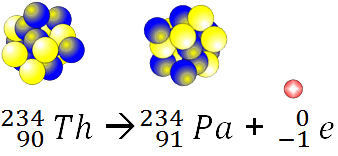
What is emitted during Beta Radiation?
a)
A high-energy Electron.
b)
Protons.
c)
Neutrons.
d)
Nuclei
15.
Which of these is associated with Alpha Radiation?
a)
4/2 
b)
0/0
c)
0/-1
d)
0/1
16.
What is emitted during Gamma Radiation?
a)
Particles.
b)
Protons
c)
Beta Rays.
d)
Gamma Rays.
17.
Which of these is associated with Beta Radiation?
a)
0/0
b)
4/2
c)
0/1
d)
0/-1
18.
What is the most penetrating radiation?
a)
gamma
b)
alpha
c)
beta
d)
positron
19.
What is NOT a characteristic of a Beta particle?
a)
Stopped by thin metal
b)
The most dangerous type of radiation
c)
High speed, High energy electrons or positrons
d)
can penetrate skin
20.

Which type of nuclear radiation is seen here?

a)

Alpha

b)

beta

c)

gamma

d)

none

21.
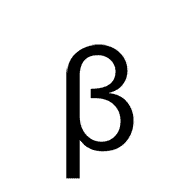
Has the symbol
a)
Alpha
b)
Beta
c)
Gamma
22.
Balance the following equation:
146C --> 0-1e + ________
a)
145B
b)
146C
c)
147N
d)
42He
23.

Solve this equation for alpha decay.

88226Ra --> ___ + 24He

a)

86222Rn

b)

89226Ac

c)

84224Po

d)

88225Ra

24.

Solve this equation for alpha decay.

85209At --> ___ + 24He

a)

83205Bi

b)

86209Rn

c)

81207Tl

d)

85208At

25.

Solve this equation for beta decay.

614C --> ___ + -10e

a)

410Be

b)

714N

c)

210He

d)

613C

26.

Solve this equation for beta decay.

2760Co --> ___ + -10e

a)

2556Mn

b)

2860Ni

c)

2358V

d)

2759Co

27.
Balance the following equation:
146C --> 0-1e + ________
a)
145B
b)
146C
c)
147N
d)
42He
28.

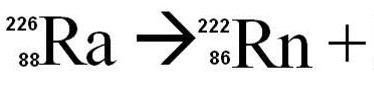
Complete the nuclear equation and determine the type of decay.

a)

4 He alpha

2

b)

0 e beta

-1

c)

0 y gamma

0

d)

none

29.
What makes something radioactive?
a)
elements with an atomic number above 81
b)
an unstable nucleus
c)
contaminated sewage
d)
It decays over time
30.

_______________ is when an unstable atoms breaks down emit radiation until they become stable.

a)

Radiation

b)

Chemical Reaction

c)

Radioactive Decay

d)

Isotopes

31.
What type of radioactive decay is shown here?
a)
Alpha decay
b)
Beta decay
c)
Gamma decay
32.
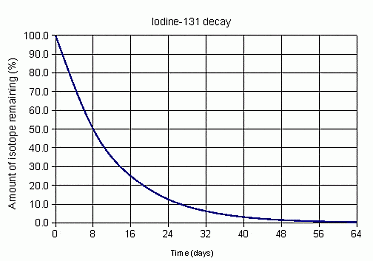
What is the half-life of iodine-131?
a)
32 days
b)
8 days
c)
16 days
d)
24 days
33.
What percent of carbon-14 would be left after 5730 years?
a)
100%
b)
75%
c)
50%
d)
25%
34.
What percent of carbon-14 would be left after 11,460 years?
a)
100%
b)
75%
c)
50%
d)
25%
35.
If one-fourth of the carbon-14 is remaining then how many half-lives have passed?
a)
1
b)
2
c)
3
d)
4
36.
Barium-122 has a half-life of 2 minutes. A fresh sample weighing 80 g was obtained. If it takes 10 minutes to set up an experiment using barium-122, how much barium-122 will be left when the experiment begins?
a)
0.25g
b)
2.5g
c)
25g
d)
80g
37.
The half-life of strontium-90 is 25 years. How much strontium-90 will remain after 100 years if the initial amount is 4.0 g?
a)
3.0g
b)
0.25mg
c)
0.3g
d)
0.25g
38.
When nuclei decay, massive amounts of __________ is released.
a)
energy
b)
jello
c)
protons
d)
neutrons
39.
The half life of iodine-131 is 8.040 days. What percentage of an iodine-131 sample will remain after 40.20 days?
a)
312.5%
b)
31.25%
c)
.3125%
d)
3.125%
40.
After 4 half-lives, 1g of a sample of Krypton-85 remains unchanged.  What was the original mass of the sample?
a)
16g
b)
32g
c)
0.0625g
d)
4g
41.
Nuclear power uses ____ for fuel.
a)
steel
b)
coal
c)
uranium
d)
hydrogen
42.
The splitting of a nucleus into smaller nuclei is
a)
fusion
b)
fission
c)
decay
d)
gamma radiation
43.
An example of an uncontrolled fission reaction is _______________
a)
Nuclear power plants
b)
Radio active decay
c)
Atomic Bomb
d)
On the surface of the sun
44.
Nuclear energy uses _____ to turn turbines to power a generator.
a)
wind
b)
water
c)
steam
d)
solar
45.
One disadvantage of nuclear energy is ___.
a)
it is a fossil fuel
b)
it leaves behind radioactive waste
c)
it emits large amounts of pollution into the atmosphere
d)
there are no disadvantages
46.
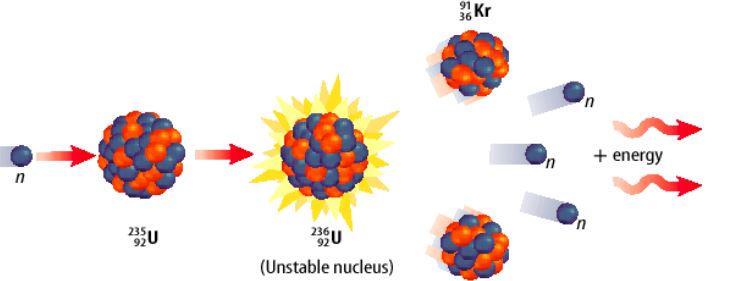
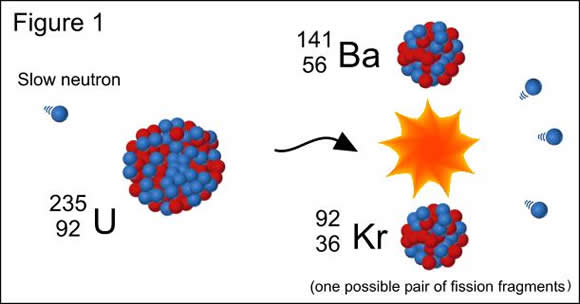
This is an example of...
a)
Fission  reaction
b)
Fusion reaction
c)
Decomposition reaction
d)
Decay
47.
_________ happens naturally due to an unstable nucleus.
a)
fission
b)
fusion
c)
radioactive decay
d)
K-capture
48.
The splitting of a nucleus into smaller nuclei is
a)
fusion
b)
fission
c)
decay
d)
gamma radiation
49.
Half life is 
a)
Fission
b)
Fusion
c)
Radioactive Decay
50.

This is an example of...

a)

Chain reaction

b)

Fusion reaction

c)

Decomposition reaction

d)

Decay

51.
What is emitted during  Alpha Radiation?
a)
A helium nuclei
b)
 An electron
c)
Gamma Rays
d)
A neutron
52.

Solve the nuclear fusion reaction 42He+21H→

a)

63Li

b)

63C

c)

103Li

d)

103Ne

53.

Solve the nuclear fusion reaction 105B+126C→

a)

3211Na

b)

2211Na

c)

2211Ca

d)

3211Ge

54.
This type of reaction occurs on the sun and in stars.
a)
Fission
b)
Fusion
c)
synthesis
d)
decomposition
55.
This type of reaction occurs when light nuclei combine to form a larger, single nucleus.
a)
Fission
b)
Fusion
c)
single displacement
d)
double displacement
56.
Which nuclear process is shown in the picture?
a)
fission
b)
fusion
c)
alpha decay
d)
beta decay