wayground logo

Free Printable Worksheets

Font size

S
M
L
XL
Worksheets

Photosynthesis

Total questions: 56

Worksheet time: 42mins

Name
Class
Date
1.
What is the source of energy for photosynthesis?
a)
carbohydrates-chemical
b)
sunlight-radiant
c)
heat-thermal
d)
television-electrical
2.
What are the reactants (what's needed) for photosynthesis?
a)
glucose and oxygen
b)
light, water, and carbon dioxide
3.
What gas is released by plants during photosynthesis?
a)
sulfur
b)
carbon dioxide
c)
oxygen
d)
hydrogen
4.
What is the purpose of photosynthesis?
a)
make glucose
b)
make ATP
c)
make light
d)
release carbon dioxide
5.
What are the products (what's made) during photosynthesis?
a)
glucose and oxygen
b)
water, light, and carbon dioxide
6.
What type of organism uses photosynthesis?
a)
plants
b)
bacteria
c)
animals
d)
both plants and bacteria
7.
What is the energy conversion during photosynthesis?
a)
chemical --> chemical
b)
thermal --> electrical
c)
chemical --> electrical 
d)
radiant --> chemical
8.
In which organelle (part of the cell) does photosynthesis take place?
a)
mitochondria
b)
chloroplast
c)
nucleus
d)
cell membrane
9.
How can photosynthesis be related to cellular respiration?
a)
What's produced (made) by one is needed (the reactants) for the other
b)
They both produce the same products
c)
They both have the same reactants (need the same things)
d)
These 2 processes have nothing in common
10.
What is the equation for photosynthesis?
a)
6CO + 6H20 -----> C6H12O6 + 6O2
b)
6CO + 6H20 + Light -----> C6H12O6 + 6O2
c)
sin(x)
d)
a squared plus b squared equals c squared
11.
What are light dependent reations
a)
They require no light
b)
They take place under the light of FBI investigations
c)
They require light
d)
They require only moonlight
12.
What are light independent reactions?
a)
They require no light
b)
They require light
13.
What are C3 plants?
a)
These plants are the best when it comes to storing water due to their extremely dry environments
b)
These plants mostly just reduce the rate of photorespiration
c)
What most plants who don't specifically have to adapt for harsh environments
14.
What are C4 plants?
a)
These plants are the best when it comes to storing water due to their extremely dry environments
b)
These plants mostly just reduce the rate of photorespiration
c)
What most plants who don't specifically have to adapt for harsh environments
15.
What are CAM plants?
a)
What most plants who don't specifically have to adapt for harsh environments
b)
These plants mostly just reduce the rate of photorespiration
c)
These plants are the best when it comes to storing water due to their extremely dry environments
16.
What is the formula for glucose?
a)
C6H12O7
b)
CHO6126
c)
C6H12O6
d)
C5H5O5
17.
Glucose is formed in the _______ of a plant
a)
The stem
b)
The buds
c)
The leaves
d)
The roots
18.

Plants use the following reactants for the light reaction

a)

Water and CO2

b)

Water and NADPH

c)

Water and NADP+

d)

NADPH and ATP

19.

Photosynthesis goal is to

a)

convert light energy into glucose energy

b)

use light energy to make oxygen gas

c)

convert sugar energy into ATP

d)

convert sugar energy into oxygen gas

20.

Rubisco is important in which step of photosynthesis

a)

energizing the electrons in chlorophyll

b)

carbon fixation when CO2 is connected to RUBP during calvin cycle

c)

regeneration phase as RUBP is made during calvin cycle

d)

reduction of the carbon chain during the calvin cycle

21.

If the proton (H+) pump in the thylakoid was not working which molecule could not be made during the light reaction?

a)

NADPH

b)

ATP

c)

Water

d)

Oxygen gas

22.

The NADP+ is

a)

oxidized during the light reaction

b)

reduced during the light reaction

c)

oxidized during the Calvin cycle

d)

reduced during the Calvin cycle

23.

Which of the following would have the least affect on photosynthetic rate?

a)

increase the temp from 20 C to 30 C

b)

increasing the CO2 from 400 ppm to 600ppm

c)

increasing the light intesity from 40 Watts to 60 Watts

d)

increasing the amount of O2 from 20% to 30% in the air

24.

Plants obtain CO2 into the chloroplast by

a)

active transport

b)

diffusion

c)

facilitated diffusion

d)

endocytosis

25.

Photosystems are made of

a)

chloroplasts

b)

chromosomes

c)

chlorophyll

d)

cytoplasm

26.

Photorespiration involves

a)

the production of oxygen gas during the break down of sugar

b)

the breakdown of sugar when CO2 levels are low.

c)

the production of massive amounts of ATP in the thylakoid

d)

water being pulled out of the plant

27.

Why does photorespiration occur?

a)

stomata are closed and CO2 levels are too low.

b)

stomata are closed and O2 levels are too low.

c)

stomata are open and too much water is leaving the plant

d)

stomata are open and the plant receives too much CO2

28.

What does a C4 plant do?

a)

stores CO2 in a separate cell from its photosynthetic cell during the day

b)

stores CO2 in a vacuole during the night.

c)

can't store CO2 so it sufferes photorespiration

d)

can't store CO2 so it speeds up cellular respiration in order to make more CO2

29.

Plants that store CO2 at night are called

a)

C3 plants

b)

C4 plants

c)

CAM plants

30.

Which plant LACKS CO2 storage method

a)

C3

b)

C4

c)

CAM

31.
What is one function of the other pigments  besides chlorophyll, in the chloroplast?
a)
to block damaging wavelengths of light
b)
to absorb different wavelengths than the chloroplasts
c)
to provide different colors to the leaves
d)
to transfer energy to a separate photosystem beside the one using chlorophyll a and b.
32.
What is the primary function of the light reactions of photosynthesis?
a)
To produce glucose
b)
To produce NADPH and ATP
c)
To use ATP
d)
To produce RuBP
33.
What is the function of NADP+?
a)
It absorbs light
b)
It is an electron carrier
c)
It is a light-reflecting pigment
d)
It acts as long-term energy storage
34.
Which of the following molecules is not needed for the Calvin Cycle?
a)
CO2
b)
ATP
c)
NADPH
d)
H2O
35.
Green plants reflect ________ light.
a)
Red
b)
Green
c)
All
d)
Red and Violet
36.
The light reactions occur in the ________ and the dark reactions take place in the ________.
a)
Chloroplast / thylakoid membrane
b)
stroma / thylakoid
c)
mesophyl / stomata
d)
thylakoid membrane / stroma
37.
Where does the carbon come from that is used to form glucose?
a)
The soil
b)
CO2 in the air
c)
From other carbohydrates
d)
Calvin Cycle
38.
Where is glucose synthesized
a)
Photosystem II
b)
Photosystem I
c)
Calvin Cycle
d)
Glycolysis
39.
Where does the Calvin cycle take place?
a)
stroma of the chloroplast
b)
thylakoid membrane
c)
outer membrane of the chloroplast
d)
interior of the thylakoid membrane
40.
When oxygen is released as a result of photosynthesis, it is a direct by-product of
a)
reducing NADP+
b)
splitting water molecules
c)
chemiosmosis
d)
electron transfer in photosystem II and I
41.
What is the primary function of the Calvin cycle?
a)
regenerate ATP for use in the light reactions of photosynthesis
b)
produce carbon dioxide for use in the light reactions of photosynthesis
c)
produce oxygen by oxidizing water
d)
produce simple sugars from carbon dioxide
42.
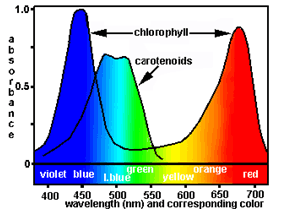
Plants with the largest amount of which pigment will be best suited for growing conditions where light has a green hue.
a)
Chlorophyll A
b)
Chlorophyll B
c)
Carotenoids
d)
A combination of all 3
43.
How many sugar molecules are produced from every six molecules of carbon dioxide that enter the Calvin cycle?
a)
1
b)
3
c)
6
d)
12
44.

The H+ concentration gradient used in chemiosmosis is used to

a)

make NADPH

b)

split a water molecule

c)

generate ATP

d)

form water

45.

The enzyme is this picture is primarily responsible for

a)

making ADP

b)

making ATP

c)

making FADH2

d)

making NADPH

46.

What source of energy powers the proton pumps in the electron transport chain?

a)

NADPH

b)

FADH2

c)

O2

d)

electrons from the H in water (e-)

47.

What is reduced in the electron transport chain of photosynthesis?

a)

FADH+

b)

NAD+

c)

NADP+

d)

H2O

48.

What are the products of the electron transport chain in photosynthesis?

a)

NADH, ATP

b)

NAD+, ADP

c)

NADPH, ATP

d)

H2O, NADP+, ADP

49.

Chemiosmosis is a process of building a difference in charge on each side of the membrane to power which enzyme?

a)

ATP synthase

b)

RuBisCo

c)

Hydrolase

d)

Chlorophyll

50.

In photosynthesis, ___________ starts the light reactions (aka. electron transport chain) of photosynthesis. Choose all that apply.

a)

oxidation of water

b)

light energy

c)

oxygen

d)

carbon dioxide

51.

The products of the light reactions (electron transport chain) of photosynthesis are ___________. (Check all that apply.)

a)

ATP

b)

NADPH

c)

NADH

d)

O2

52.

What reactants are needed to start the light independent reactions (Calvin Cycle) of photosynthesis? Check all that apply.

a)

RuBP

b)

RuBisCo

c)

CO2

d)

ATP

e)

NADPH

53.

What are the products of the light independent reactions (Calvin Cycle) of photosynthesis? Check all that apply.

a)

ADP

b)

NADP+

c)

C6H12O6

d)

NAD+

54.

CAM plants typically live in what type of environment?

a)

mild to moderate temperature

b)

hot, arid (dry) environments

c)

hot and humid environments

d)

extremely cold, dry environments

55.

Which plant has evolved to keep its stoma closed during the day and stores CO2 so that it can complete photosynthesis at night?

a)

CAM plants

b)

C3 plants

c)

C4 plants

d)

corn

56.

Which plant has evolved to do less photorespiration by having less stoma on the underside of its leaves and lives in hot humid environments? Check all that apply.

a)

C4 plants

b)

CAM plants

c)

C3 plants

d)

Sugar cane