
 Worksheets
Tectonic Plates Review
Total questions: 52
Worksheet time: 43mins
Name
Class
Date
1.
The type of plate boundary where two plates come together is a .....
a)
Convergent Boundary
b)
Divergent Boundary
c)
Transform Boundary
d)
Plate Boundary
2.
Which of the following causes Earth's tectonic plates to move?
a)
Energy from the Sun
b)
Magnetic Pole Reversal
c)
Convection currents in the mantle
d)
Faults in Mountain Ranges
3.
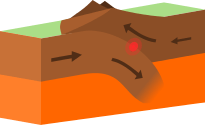
What type of plate boundary is this?
a)
Plate
b)
Divergent
c)
Convergent
d)
Transform
4.

What type of event will occur at this boundary?
a)
Earthquake
b)
Volcano Eruption
c)
Tornado
d)
Mountain Building
5.
A divergent boundary occurs when plates ....
a)
Pull apart
b)
Come together
c)
Slide past each other
d)
subducting
6.
Which of the following is the name of the ancient supercontinent formed 28 Million Years ago.
a)
Pangea
b)
Gondwanda
c)
Laurasia
d)
Neverland
7.
Which of the following is NOT evidence to support the theory of plate tectonics?
a)
Fossils
b)
Mountains
c)
Glaciers
d)
Sand Erosion
8.
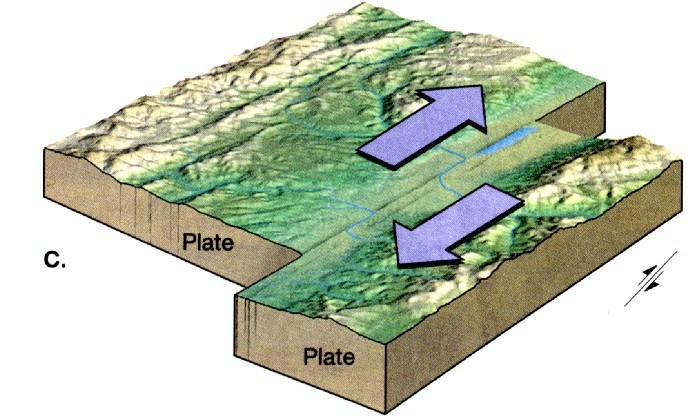
What type of plate boundary is this?
a)
Transform
b)
Convergent
c)
Divergent
d)
Plate
9.
The theory that says Earth's continents once made up an ancient supercontinent, and have been drifting apart ever since, is called the theory of...
a)
Pangea
b)
Plate Tectonics
c)
Natural Selection
d)
Gravity
10.
Oceanic Trenches are formed by _______ plate boundaries
a)
Convergent
b)
Transform
c)
Plate
d)
Divergent
11.
A fault is formed by the movement of a __________ plate boundary
a)
Transform
b)
Convergent
c)
Divergent
12.
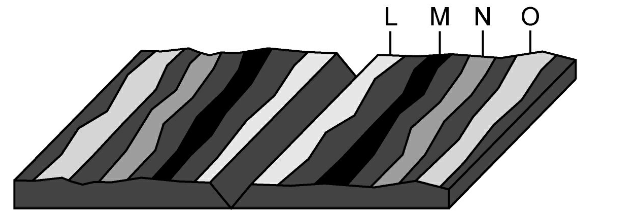
Where would the oldest rock be found?
a)
L
b)
M
c)
N
d)
O
13.
How is it possible for new crust to be formed without increasing the surface area of the Earth?
a)
Crust is destroyed at the same time it is created
b)
New crust is underwater where it sinks
c)
New crust breaks more easily than old crust
14.
Mountains are created when....
a)
Two continental plates collide
b)
Two oceanic plates pull apart
c)
An Oceanic plate subducts under a Continental Plate
d)
Two continental plates pull apart
15.
Which of the following occurs because of convection currents?
a)
Tectonic plates on the crust move.
b)
The mantle increases in size.
c)
Pressure in the crust increases.
d)
Pressure in the crust decreases.
16.
The area around the pacific plate where boundaries form is called...
a)
death ring
b)
fire zone
c)
ring of fire
d)
zone of fire
17.
Mountains form from ...
a)
plates sliding past one another
b)
collision of plates
c)
plates moving away from each other
18.
During sea floor spreading, molten material rises up from the mantle...
a)
along the continents
b)
at the mid ocean ridges
c)
deep ocean trenches
d)
at north and south poles
19.
Which of the following is where one plate slides under another plate?
a)
submarine zone
b)
divergence zone
c)
subduction zone
d)
lower zone
20.
Associated with transform boundaries.
a)
Volcanoes
b)
mountains
c)
trenches
d)
earthquakes
21.
This land formation occurs at a divergent boundary.
a)
mid ocean ridge
b)
deep ocean trench
c)
pacific hot spot
d)
rift valley
22.
Which type of plate boundary would cause mountains to form?
a)
Transform
b)
Convergent
c)
Divergent
d)
Reform
23.
The Great Rift Valley in Africa and the Mid-Ocean Ridge were all created by this boundary
a)
Divergent
b)
Convergent
c)
Reform
d)
Transform
24.
What are the two types of crust
a)
continental and oceanic
b)
ocean and upper
c)
lower and upper
d)
pizza and subway
25.
subduction zones in the ocean can create which features?
a)
islands
b)
volcanoes
c)
earthquakes
d)
all of the above
26.
Earthquakes and volcanoes are most likely found in which locations?
a)
At plate boundaries
b)
in oceans
c)
in the middle of continents
d)
in the middle of plates
27.
The Himalayas in Asia are an example of what type of plate boundary?
a)
divergent
b)
continent-to-continent convergent
c)
ocean-to-continent convergent
d)
transform
28.
When an oceanic plate and a continental plate collide, which one will subduct?
a)
oceanic
b)
continental
c)
neither
29.
Which of the following is NOT a tectonic boundary?
a)
Convergent
b)
Divergent
c)
Sedergent
d)
Transform
30.
The area where two tectonic plates meet.
a)
mantle
b)
focus
c)
plate boundary
d)
convection
31.
This landform can occur at a divergent plate boundary.
a)
ocean trench
b)
mid-ocean ridge
c)
tall mountains
d)
transform fault
32.
A continental rift valley can be formed from stretching continental crust at...
a)
transform plate boundaries
b)
convergent plate boundaries
c)
divergent plate boundaries
d)
all plate boundaries
33.
A mid-ocean ridge occurs at a ________ plate boundary.
a)
transform
b)
convergent
c)
divergent
34.

What type of boundary is the SAN ANDREAS FAULT on?
a)
Covergent
b)
Transformers
c)
Divergent
d)
Transform
35.

Which of these events can ONLY happen on a DIVERGENT BOUNDARY?
a)
Rift Valley
b)
Mountain
c)
A peninsula
d)
An Insanely complex, long answer that you will click out of instinct.
36.
What is Pangaea?
a)
The name of a German Scientist
b)
the name of the supercontinent that existed millions of years ago
c)
another name for continental drift
d)
the name of an ancient fossil
37.
What geologic feature/event you be most likely to find at a transform boundary?
a)
Earthquakes
b)
Volcanoes
c)
Mountains
d)
Rift Valleys
38.
What geologic feature/event would you most likely to find at a divergent boundary between two pieces of oceanic crust?
a)
Rift Valley
b)
Mid-Ocean Ridge
c)
Island Arc
d)
Flat land
39.
What geologic feature/event would you most likely to find at a convergent boundary between two pieces of continental crust?
a)
Volcano
b)
Mountain
c)
Rift
d)
Island Arc
40.
A subduction zone is formed...
a)
when one tectonic plate sinks below another
b)
at every type of convergent plate boundary
c)
at every type of divergent plate boundary
d)
at transform boundaries
41.
In which type of boundary do the plates move away from each other?
a)
convergent
b)
normal
c)
divergent
d)
transform
42.
Plates slide past one another at ____________ boundaries.
a)
divergent
b)
convergent
c)
transform
d)
submergent
43.
Plates move towards one another at ______________ boundaries.
a)
divergent
b)
convergent
c)
transform
d)
detergent
44.

Name the boundary
a)
convergent boundary
b)
divergent boundary
c)
transform boundary
d)
sergent boundary
45.

Name the boundary
a)
convergent boundary
b)
divergent boundary
c)
transform boundary
d)
sergent boundary
46.

Name the boundary
a)
convergent boundary
b)
divergent boundary
c)
transform boundary
d)
sergent boundary
47.
The cycle that powers the ocean currents, weather, and tectonic plates it called
a)
conduction current
b)
radiation
c)
condition current
d)
convection current
48.
In convection, COOL air
a)
Rises
b)
Sinks
49.
In convection, WARM air
a)
Rises
b)
Sinks
50.
In convection, WARM air
a)
Rises
b)
Sinks
51.
Convection currents occur in
a)
Fluids
b)
Solids
52.
How does a convection cell affect the crust material above it?
a)
It doesn't affect the crust material.
b)
It moves the crust material in the opposite direction.
c)
It moves the crust material in the same direction.
d)
I have no idea.
100 %

