
 Worksheets
DCA #3 Review
Total questions: 46
Worksheet time: 52mins
How long does it take the Earth to rotate on its axis?
365 days
24 hours
30 days
12 hours
What effect does the Earth rotating on its axis have on the Earth?
Earth's rotation causes the seasons.
Earth's rotation causes the day/night cycle.
Earth's rotation causes the tides to rise.
Earth's rotation causes the Earth to tilt.
What effect does the Earth revolving around the sun have on the Earth?
Earth's orbit around the Sun causes day/night.
Earth's orbit around the Sun causes gravity.
Earth's orbit around the Sun causes the seasons.
Earth's orbit around the Sun causes its rotation.
Does the Sun move across the sky?
Yes, every 24 hours.
Yes, every 12 hours.
No, the Earth rotates causing the Sun to appear to move.
No, the Moon moves across the sky.
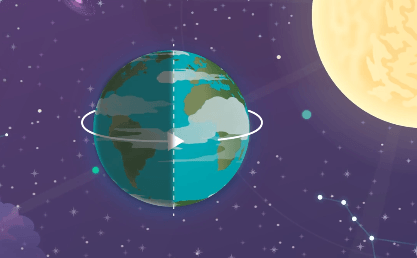
The Earth completes one of these every 365.25 days
rotation
revolution

Scientists studying climate collect data that is slightly different from the data collected by those interested in weather. What is different about the data collected about climate? Climate data -
requires more specialized equipment than weather data.
focuses on conditions only in the upper atmosphere
refers to longer times and wider areas than weather data.
does not include information about air temperature.

The two weather maps show a front moving across Texas. In which of the following cities would a decrease in temperature be predicted between Day 1 and Day 2?
Amarillo
Austin
El Paso
Sweetwater
A study of climate includes the use of maps that are different from simple weather maps. A map of which of the following is one that would be used in the study of climate?
Number of sunny days per year in Northern Africa.
Location of current rains in Southeast Nebraska.
Path of a hurricane in the Gulf over a week.
Position of a cold front yesterday outside Detroit, Michigan.
Weather data is different from climate data. Which of these is an example of weather data?
Skies are mostly cloudy at 5:00 pm in Las Vegas on May 3rd , 2012.
New England has an average of more than 100 rainy days each year.
Northern Europe has much colder winters than South America.
The high plateau region of Antarctica has constant light winds from the south.
The kinds of data that reflect climate are different from the conditions described in weather data. Which of the following is a description of climate?
Today it is hot and sunny in Phoenix, Arizona.
Summers are usually mild in Lansing, Michigan.
Last week it rained every day in San Antonio, Texas.
Yesterday was cold and windy in Anchorage, Alaska.
Weather and climate data are different. Which of the following is a description of weather data?
The Sahara desert gets very little rainfall.
The average daytime high in the Amazon is 25°C.
Temperatures in the Arctic are usually below freezing
It rained two inches in Miami, Florida on May 5th
Some scientists measured and recorded local rainfall amounts and water levels at several local lakes over the summer. They compared their measurements with data from the past 30 years. The scientists concluded that the area was drier this summer than in previous years. They plan to continue recording these measurements each summer for the next decade. What characteristic of the area are the scientists studying?
Climate, because they are making more than one type of measurement.
Climate, because they are comparing rainfall amounts over a long period of time.
Weather, because they are tracking changes only to their local environment.
Weather, because they expect rainfall amounts and water levels to continue to decrease.
Precipitation is defined as:
the set of weather conditions that prevail in a region year after year
rain, snow, sleet, or hail that falls from clouds in the sky
how hot or cold something is
the amount of water vapor in the air

The labeled diagram shows the water cycle over the ocean. At which point is condensation occuring?
A
B
C
D

Students built a model of the water cycle by putting water in the bottom of a plastic bottle and then shining a lamp on it. They observed tiny droplets appearing near the top of the bottle and larger drops sliding down the sides of the bottle. What part of the model demonstrates precipitation?
lamp shining on bottle
tiny droplets forming at top of bottle
drops running down the side of the bottle
water sitting in the bottom of bottle

This picture shows the water cycle. Which of the processes is driven by the Sun’s heat?
A
B
C
D
The Sun drives the water cycle by doing which of the following?
Rotating on its axis
Giving off light for plants
Keeping Earth in orbit
Providing heat for evaporation
The constant movement of water through the land, air, oceans, and living things --
water cycle
air cycle
atmosphere movement
ocean cycle
What is the physical change in matter from a liquid to a gas?
condensation
precipitation
evaporation
convection
What is the physical change in matter from a gas to a liquid?
condensation
evaporation
conduction
precipitation
Rain, snow, sleet, and hail that falls from clouds in the sky --
evaporation
precipitation
condensation
deposition
A buildup or gathering of something that occurs over time --
precipitation
deposition
accumulation
evaporation

This photograph shows a beach on a partly sunny day. Which of the following is an interaction between the sun and the ocean that results in clouds forming near the beach?
Energy from the sun causes precipitation over the ocean.
Energy from the sun causes water to evaporate from the ocean.
Light from the sun reflects off the surface of the ocean.
Light from the sun decreases the amount of water vapor in the air over the ocean.

The pictures show a sidewalk at three different times on the same day. The changes were caused by the weather. Which table best describes the changes that most likely occurred between 6:00 A.M. and noon?


This is a diagram of the stages of the water cycle. Which of these observations would most likely be seen at Stage N?
Water flowing downhill
Fog forming along a highway
The water level of a lake decreasing
Dark clouds forming in the sky

The picture shows a Cumulonimbus cloud forming over an ocean. Which statement best explains how the Sun and the ocean interact to form a cumulonimbus cloud?
Heat from the Sun warms the ocean, causing water to evaporate. The water vapor then condenses to form a cumulonimbus cloud.
Heat from the Sun causes clouds in the area to gather over the ocean and form one large cumulonimbus cloud.
Light from the Sun shines on the ocean, causing water vapor to condense. The water then evaporates to form a cumulonimbus cloud.
Light from the Sun causes ocean water to reflect water vapor into the air and gather over the ocean in a cumulonimbus cloud.
Water ______ in the atmosphere condenses to form clouds.
cycles
vapor
droplets
accumulation
The Sun is an essential energy source of light and heat for life on Earth. It provides _________ to the surface of Earth, causing water to evaporate. The process of ___________ causes water to change from a liquid to a gas. No matter where water is accumulated, the sun plays a major role in its evaporation as part of the water cycle.
evaporation, heat
light, condensation
heat, evaporation
light, evaporation
Earth’s oceans cover the largest portion of its surface. With _____ of Earth covered with water, much of it becomes heated with the Sun’s energy. This warmth causes water to _________ from the ocean. When water becomes a gas, it rises into the _________ , continuing the water cycle. Without the Sun’s energy, freshwater on Earth could not be replenished.
30%, evaporate, atmosphere
71%, accumulate, atmosphere
71%, evaporate, atmosphere
50%, evaporate, sky

What weather tool is this?
temperate measurement
anemometer
thermometer
rain gauge

This is a tool a meteorologist would use. What is it called?
anemometer
traffic cone
wind sock
wind vane

What is this weather instrument called?
wind vane
anemometer
barometer
thermometer

Four students have drawn and labeled pictures on the chalkboard. Which drawing and description best shows the cause of day and night on Earth?
Student 1
Student 2
Student 3
Student 4

A teacher demonstrates the day and night cycle to a group of students using a globe and a lamp. Students are asked to write a valid conclusion about how the day and night cycle occurs naturally on Earth.
The sun rotates on its axis once approximately every 30 days.
The sun revolves around the Earth approximately every 365
days.
The Earth rotates on its axis once approximately every 24 hours.
The moon revolves around the Earth once approximately every
28 days.

All of the following picture are like Earth’s rotation EXCEPT-
A
B
C
D
Which one thing would NOT cause water to be on your sidewalk in the morning?
evaporation
precipitation
condensation
Why does the sun appear to move across the sky each day?
Earth orbiting the Sun
The moon reflecting light from the Sun
Earth rotating on its axis
The phases of the moon
How long does it take the Earth to make a complete revolution around the Sun?
24 hours/1 day
365 days/1 year
About 3 months/1 season
1 month
Earth's rotation makes the ______ and _______ appear to change positions.
clouds and planets
sun and clouds
sun and stars
The Earth and Moon both have the same gases in their atmospheres --
TRUE
FALSE
The surface gravity on the Moon and the Earth are the same because they are about the same size --
TRUE
FALSE
What keeps all planets and their moons in orbit?
The force of gravity
The ability to rotate on an axis
The Stars
Which tool would a meteorologist use?
Scale
Triple Beam Balance
Rain Gauge/Graduated Cylinder
Microscope

