wayground logo

Free Printable Worksheets

NEW

Font size

S
M
L
XL
Worksheets

Foss Weather on Earth Investigation 1-2 Review

Total questions: 49

Worksheet time: 29mins

Name
Class
Date
1.

What happens to air pressure as you move upward into the atmosphere?

a)

increases

b)

decreases

c)

stays the same

2.

A device that is used to measure atmospheric pressure is a ___________.

a)

barometer

b)

kilometer

c)

thermometer

d)

micrometer

3.

Air pressure is greater _______.

a)

at the top of the mountain

b)

at the center of the mountain

c)

at the bottom of the mountain

4.

___________is the result of the weight of a column of air pushing on an area.

a)

air pressure

b)

density

c)

volume

d)

none of the above

5.

If you burn your tongue while eating hot food, you are experiencing:

a)

heat transfer by convection.

b)

heat transfer by radiation

c)

heat transfer by conduction.

6.

On a hot summer day, you jump into a lake to cool off. Why does this cause you to feel cool?

a)

Kinetic engergy is transferring from the water in the lake to my body.

b)

Kinetic energy is transferring from my body to the water in the lake.

7.

When you feel heat from a bonfire, you are experiencing what type of energy transfer?

a)

Kinetic

b)

Radiant

c)

Convective

8.

What occurs when air is forced into a smaller space?

a)

compression

b)

force

c)

weight

d)

expansion

9.
What occurs when air particles spread out because of less pressure?
a)
force 
b)
expansion
c)
compression
d)
weight
10.
When particles are compressed, they move how?
a)
slower
b)
no change
c)
faster
11.
What do we call the prediction of what the weather will be?
a)
inference
b)
guess
c)
forecast
d)
prediction
12.
What is the measure of the amount of matter? 
a)
gravity
b)
mass
c)
force
d)
weight
13.
What do we call anything that takes up space and has weight?
a)
atoms
b)
mass
c)
gravity
d)
matter
14.
Who is the person that studies the causes of weather and tries to make predictions? 
a)
meteorologist
b)
weatherologist
c)
precipologist
d)
deanerologist
15.
What is the study of the Earth's lower atmosphere where weather occurs?
a)
deanerology
b)
meteorology
c)
weatherology
d)
precipology
16.
What are the two most prevalent gases in our atmosphere?
a)
oxygen and carbon dioxide
b)
carbon dioxide and nitrogen
c)
nitrogen and oxygen
d)
ozone and oxygen
17.
Matter is made up of what?
a)
pieces
b)
dust
c)
particles
d)
cells
18.
The push on an object is called what?
a)
gravity
b)
expansion
c)
mass
d)
pressure
19.
What layer of the atmosphere do we live in?
a)
startosphere
b)
troposphere
c)
mesopshere
d)
thermosphere
20.
We measure air pressure with a...
a)
thermometer
b)
compass
c)
hygrometer
d)
barometer
21.
We measure air temperature with a...
a)
hygrometer
b)
barometer
c)
wind meter
d)
thermometer
22.
Which units do we use to measure temperature?
a)
%
b)
inches
c)
miles per hour
d)
degrees F or C
23.
What weather concept are we talking about when we say it is "foggy" or "clear?"
a)
visibility
b)
wind direction
c)
temperature
d)
air pressure
24.
What happens to air pressure as you rise farther in the atmosphere?
a)
Increases
b)
Decreases
c)
Does not change
d)
first increases, then decreases
25.
What are the main layers of the atmosphere in order from Earth to Space?
a)
troposphere, stratosphere, mesosphere,thermosphere
b)
stratosphere, troposphere, mesosphere, thermosphere
c)
mesosphere, troposphere, stratosphere, thermosphere
d)
thermosphere, troposphere, stratosphere, mesosphere
26.
What is the atmosphere?
a)
The layer in which all weather occurs
b)
The layer that contains the ozone layer
c)
the layer of water in the ocean
d)
the layer of gases that surround the Earth
27.
What is the study of the atmosphere?
a)
weather 
b)
nitrogen
c)
forecast
d)
meteorology
28.
What is the best evidence that air has mass?
a)
It can be compressed
b)
It can be weighed
c)
It can be in a syringe
d)
It can be expanded
29.
Weather occurs in which layer of the atmosphere?
a)
entire atmosphere
b)
the stratosphere
c)
the troposphere
d)
the exosphere
30.
Compression occurs when air particles... 
a)
are forced together
b)
are forced apart
c)
bounce off a surface
d)
heat up
31.
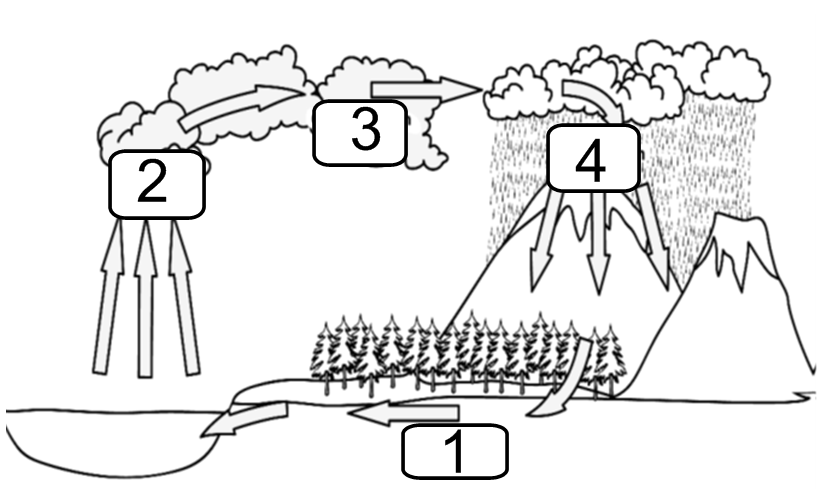
Which stage does the #2 show in the diagram?
a)
condensation
b)
evaporation
c)
precipitation
d)
run off
32.
During which stage do clouds form?
a)
condensation
b)
evaporation
c)
precipitation
33.
where does water go when it evaporates 
a)
it turns into water vapor and goes high in the air.
b)
goes under ground and gives plants water
34.
Does this image show a land breeze or a sea breeze?
a)
land breeze
b)
sea breeze
35.
Does this diagram show a land breeze or a sea breeze?
a)
land breeze
b)
sea breeze
36.
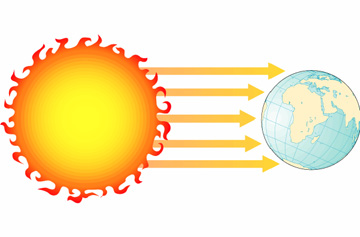
Which method of heat transfer is shown in this image?
a)
conduction
b)
convection
c)
radiation
37.
Warm air rises because it is _____ dense.
a)
more
b)
less
38.
Which method of heat transfer is shown in the image?
a)
convection
b)
conduction
c)
radiation
39.

Local winds are caused by the uneven heating of earth's surface.

a)

True

b)

False

40.
How much of Earth's water is fresh water? 
a)
About 3%
b)
About 10%
c)
About 25% 
d)
About 70%
41.
How  much of Earth's surface is covered by water? 
a)
About 3%
b)
About 10%
c)
About 25%
d)
About 70%
42.
Which color is going to heat up the most?
a)
White
b)
Pink
c)
Dark Blue
d)
Red
43.
A girl is trying to heat up his mother's pool.  Using your knowledge about heat and color what would you recommend?
a)
Put a thin dark cover overtop
b)
Line the pool with a white lining
c)
Line the pool with a white lining and a thick cover on top
d)
Line the pool with a dark blue lining and a clear top
44.
What word describes why objects heat up at different rates?
a)
Conduction
b)
Uneven Heating
c)
Waves and Rays
d)
Wind
45.
Convection currents cause what weather phenomena?
a)
Wind
b)
Rain
c)
Lightning
d)
Water Spouts
46.
A pan sitting on top of a lit oven top is an example of...
a)
Radiation
b)
Cooking
c)
Convection
d)
Conduction
47.
The sun uses rays to transport its heat across space.  This is called...
a)
Radiation
b)
Wind
c)
Convection
d)
Space Travel
48.
The idea of warm air rising and cold air sinking is called...
a)
Conduction
b)
Convection Current
c)
Flow
d)
Radiation
49.
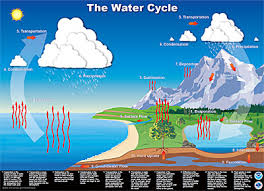
What is the correct order of the water cycle.
a)
Evaporation, Condensation, Precipitation, Runoff
b)
Condensation, Runoff, Precipitation, Evaporation 
c)
Evaporation, Precipitation, Runoff, Condensation
d)
Percipitation, Condensation, Runoff, Evaporation