
NEW
Font size
S
M
L
XL
 Worksheets
CFA 5 Review - Earth Science Grade 6
Total questions: 63
Worksheet time: 48mins
Name
Class
Date
1.
What layer is a semisolid and acts like a plastic?
a)
Lithosphere
b)
Mantle
c)
Asthenosphere
2.
The thinnest layer of the Earth is?
a)
Mantle
b)
Lithosphere
c)
Athenosphere
d)
Crust
3.
The lithosphere combines what two layers?
a)
Athenosphere & Crust
b)
Crust & Upper Mantel
c)
Mantel & Athenosphere
4.
The asthenosphere makes up the?
a)
Upper portion of the mantel
b)
The lower portion of the crust
c)
Just the Athenosphere
5.
This layer of Earth is solid Iron and Nickel
a)
Outer Core
b)
Mantle
c)
Inner Core
d)
Crust
6.
What is the name of the layer that contains the uppermost mantle and crust
a)
Asthenosphere
b)
Mesosphere
c)
Lithosphere
d)
Transosphere
7.
This layer of Earth is the thickest part
a)
crust
b)
outer core
c)
mantle
d)
inner core
8.

Identify layer #20.
a)
mantle
b)
asthenosphere
c)
inner core
d)
outer core
9.
Less dense materials rise to the top.
a)
True
b)
False
10.
Oceanic crust is thicker than continental crust.
a)
True
b)
False
11.
What is the correct order (starting from the surface) of Earth's layers?
a)
crust, outer core, inner core, mantle
b)
mantle, outer core, inner core, crust
c)
crust, mantle, outer core, inner core
d)
outer core, inner core, crust, mantle
12.
Heat transfer within a fluid takes place by...
a)
convection currents
b)
radiation
c)
conduction
d)
density
13.
Which layer of Earth is LIQUID?
a)
upper mantle
b)
lower mantle
c)
outer core
d)
inner core
14.
How light reflects off of a mineral is called the mineral's
a)
luster
b)
streak
c)
cleavage
d)
fracture
15.
Why is coal not a mineral?
a)
It's not a solid
b)
It is man-made
c)
It is not inorganic
d)
It is made of carbon
16.

The following image shows what mineral property?
a)
Hardness
b)
Streak
c)
Cleavage
d)
Density
17.
Diamond has a hardness of ___ on Mohs Hardness Scale.
a)
1
b)
5
c)
8
d)
10
18.
Dull, silky, waxy, pearly, and earthy are terms that best describe which property of minerals?
a)
luster
b)
color
c)
streak
d)
cleavage
19.

By definition, a mineral has which of the following characteristic(s)?
a)
definite chemical composition
b)
crystal structure
c)
naturally occuring
d)
all of the above
20.
How do you test the hardness of a mineral?
a)
Throw it against a wall
b)
Step on it
c)
Scratch Test
d)
Kick it until it breaks
21.
A naturally occurring, inorganic solid with a crystal structure and a definite chemical composition is referring to
a)
density
b)
streak
c)
mineral
d)
non silicate mineral
22.
The solid, geometric form of a mineral produced by a repeating pattern of atoms
a)
crystal
b)
density
c)
element
d)
fracture
23.
What mineral is the softest mineral on Moh's Hardness Scale and the main ingredient in baby powder?
a)
feldspar
b)
talc
c)
gypsum
d)
kaolinite
24.
A mineral's resistance to being scratched is called?
a)
streak
b)
luster
c)
hardness
d)
heft
25.
Large crystals are going to form
a)
when lava erupts from a volcano
b)
when a shallow sea evaporates
c)
when magma underground cools off
d)
all of the above
26.
Which type of rock results from melting and cooling of magma?
a)
Igneous
b)
Metamorphic
c)
Sedimentary
d)
Extrusive
27.
Which type of rock forms from extreme heat and pressure?
a)
Igneous
b)
Sedimentary
c)
Organic
d)
Metamorphic
28.
A metamorphic rock changes into an igneous rock by what two processes?
a)
Melting and cooling
b)
Extreme heat and pressure
c)
Compaction and cementation
d)
Weathering and erosion
29.
Wind, water, and ice breaking down rock is called
a)
Erosion
b)
Deposition
c)
Compaction
d)
Weathering
30.
What is the MAIN way rocks are classified?
a)
Their color and shapes
b)
How they form
c)
Mineral bands
d)
Where they form
31.
True/False: Igneous rocks can only turn into metamorphic rocks.
a)
True
b)
False
32.
The process in which dissolved minerals crystallize and glue sediment together.
a)
compaction
b)
deposition
c)
organic rock
d)
cementation
33.

When sediments are pressed together tightly, this is called ____________.
a)
Compaction
b)
Cementation
c)
Weathering
d)
Erosion
34.
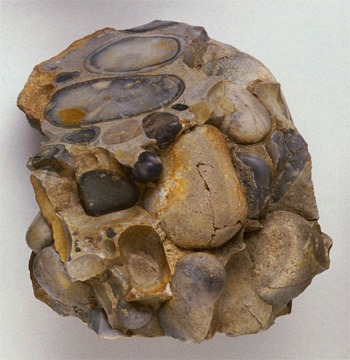
This rock was formed by smaller pieces of rock that settled at the bottom of a lake millions of years ago. What type of rock is this?
a)
Sedimentary
b)
Igneous
c)
Metamorphic
35.
What are the 3 major types of rocks?
a)
Igneous, Metamorphic, Sedimentary
b)
Metamorphic, Igneous, Cementation
c)
Brown, Red, Gray
d)
Streak, Hardness, Breakage
36.

This rock started as lava that cooled and then was heated and put under pressure over time. What type of rock is this?
a)
Sedimentar
b)
Igneous
c)
Metamorphic
37.

This rock started as molten magma. What type of rock is this?
a)
Sedimentary
b)
Igneous
c)
Metamorphic
38.

This rock is made from tiny pieces of other rocks that settled to the bottom of a valley millions of years ago. What type of rock is this?
a)
Sedimentary
b)
Igneous
c)
Metamorphic
39.

After lots of time, pressure, and heat, you get this kind of rock. What type of rock is this?
a)
Sedimentary
b)
Igneous
c)
Metamorphic
40.

Each rock type can follow only one pathway of the rock cycle.
a)
True
b)
False
41.
Fossils are often found in ____________ because it is formed from the remains of once living things.
a)
metamorphic
b)
magma
c)
igneous
d)
sedimentary
42.

Name this boundary
a)
Convergent
b)
Divergent
c)
Transform
d)
Sergent
43.

Name the boundary
a)
divergent
b)
convergent
c)
transform
d)
sergent
44.

Name the boundary
a)
convergent
b)
transform
c)
divergent
d)
sergent
45.
Which of the following is where one plate slides under another plate?
a)
submarine zone
b)
divergence zone
c)
subduction zone
d)
lower zone
46.
Which of the following land formation occurs at a divergent continental/continental boundary?
a)
mid-ocean ridge
b)
deep ocean trench
c)
Pacific hot spot
d)
rift valley
47.
Which of the following land formation occurs at a divergent continental/continental boundary?
a)
mid-ocean ridge
b)
deep ocean trench
c)
Pacific hot spot
d)
rift valley
48.
Mountains form from....
a)
Plates sliding past one another
b)
collision of plates
c)
plates moving away from each other
d)
none of these
49.
Which of the following is associated with transform boundary?
a)
volcanoes
b)
mountains
c)
trenches
d)
earthquakes and fault line
50.
Oceanic crust is.....
a)
Younger and less dense than continental crust
b)
Thinner, younger, and more dense than continental crust
c)
older, thicker, and less dense than continental crust
d)
Bigger and younger than continental crust
51.
Earth's plates are....
a)
Constantly moving and changing the face of the Earth
b)
Never moved
c)
Move seldom and very fast
d)
move when they feel like it
52.
What was the name given to all the continents when they were joined as one super continent?
a)
Supreme Continent
b)
Eurasia
c)
Plate tectonics
d)
Pangea
53.
Whenever a subduction zone is formed a ____ is formed.
a)
mountains
b)
Island arc
c)
rift valley
d)
volcanoes
54.
Plate movement is caused by _____
a)
The rotation of the Earth
b)
Ocean tides
c)
Convection current in the mantle
d)
The moon's gravity
55.
What are mid-ocean ridges?
a)
A chain of underwater falls
b)
A chain of underwater volcanoes
c)
A chain of underwater mountains
d)
A chain of underwater rocks
56.
Created by a divergent boundary
a)
rocky mountain
b)
Mariana's Trench
c)
mid-Atlantic ridge
d)
volano
57.
Plates moving apart would be...
a)
convergent
b)
divergent
c)
transform
58.

Which is subducted in an ocean-continental convergent boundary?
a)
continental plate
b)
oceanic plate
59.
What type of boundary creates a new seafloor?
a)
convergent continental to continental
b)
convergent ocean to continental
c)
convergent ocean to ocean
d)
divergent
60.
A subduction zone is formed....
a)
when one tectonic plate sinks below another
b)
at all plate boundaries
c)
when plates diverge
d)
at transform boundaries
61.
Which of the following is the softer moving area of the mantle that contains convection current?
a)
asthenosphere
b)
lithosphere
c)
outer core
d)
oceanic crust
62.
This area contains over 70 percent of volcanoes and 90 percent of earthquakes in the world.
a)
North American plate
b)
Ring of Fire
c)
Fiery rings
d)
African plate
63.
Which of the following did not support the Continental Drift Theory?
a)
Magnetic striping in the ocean floor
b)
identical fossils found in different continents
c)
Mountains that extend over continents
d)
Coastlines of continents such as South America and Africa fit like a puzzle
Reset

