Wayground logo

Free Printable Worksheets

Font size

S
M
L
XL
Worksheets

Natural Selection Quiz

Total questions: 28

Worksheet time: 34mins

Name
Class
Date
1.
Why are advantageous traits more likely to be passed onto offspring?
a)
Because they are more likely to survive and reproduce.
b)
Because they come from dominant alleles.
c)
Because they come from recessive alleles.
d)
Because the trait is an acquired phenotype.
2.
What is the advantage of having different shaped beaks?
a)
To look different from other species.
b)
To be able to eat the food readily available in the environment.
c)
To protect itself against predators.
d)
To protect itself against prey.
3.
A fossil of an extinct dinosaur is found and the anatomy of the fossil shows similarities to that of a bird. What could this mean?
a)
This is purely by chance and isn't significant
b)
The extinct dinosaur and modern bird share a common ancestor
c)
All dinosaurs evolved into birds and that's why there aren't any dinosaurs alive today
d)
Dinosaurs choose to fly, and evolved into birds to escape predation and capture food
4.

Any change in an organism that allows it to survive and reproduce more effectively in its environment

a)

natural selection

b)

adaptation

c)

evolution

d)

population

5.

What is natural selection?

a)

Sharp reduction in population size due to an environmental disaster, often results in loss of variation

b)

When individuals survive and reproduce at a higher rate than others in the same population due to some environmental pressure

c)

Process by which populations have become adapted to their environment over time

d)

Specialized structures and behaviors that aid in survival

6.

What are adaptations?

a)

Sharp reduction in population size due to an environmental disaster, often results in loss of variation

b)

When individuals survive and reproduce at a higher rate than others in the same population

c)

Process by which populations have become adapted to their environment over time

d)

Specialized structures and behaviors that benefit the organism and aid in survival

7.
If an organism has a vestigial structure, that structure likely once had a function in a(n)
a)
close relative
b)
early ancestor
c)
unrelated organism
d)
embryological stage
8.
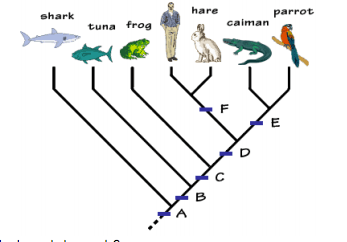
On the cladogram, which organism is the closest relative of the human?
a)
Frog
b)
Hare
c)
Caiman
d)
Parrot
9.
Individuals that are well adapted to their environment will survive and produce:
a)
Fewer mutations
b)
Stronger genes
c)
More offspring
d)
Better traits
10.
On this map there are many different geographical barriers, which could be mountains, rivers, or oceans. Animals that do not have a barrier between them have more similarities, which set shows that common ancestry existed?
a)
1 and 2
b)
3 and 4
c)
7 and 8
11.
What type of evolution do homologous structures show?
a)
convergent
b)
divergent
c)
artificial selection
d)
disruptive selection
12.

There are species of lizards that burrow underground. Gophers and moles are mammals that also burrow underground.

a)

allopatric speciation

b)

divergent evolution

c)

convergent evolution

d)

coevolution

e)

sympatric speciation

13.
a measure of how commonly a particular allele occurs in a population is known as the 
a)
gene pool
b)
allele frequency
c)
mutation rate
d)
phenotype
14.
Mutations are important because they bring about
a)
death of the organism in which they develop
b)
genetic variation needed for a population to evolve
c)
benefits for the individual, not for the population
d)
Hardey-Weinberg equilibrium within a population
15.
The table shows the survival rate of two types of beetles in the same environment over a period of three years.  

Which statement about the beetles in this environment is best supported by the data?
a)
Brown beetles have a shorter life cycle than green beetles have
b)
Green beetles are more fit for their environment than brown beetles
c)
 brown beetles are undergo more unfavorable mutations than green beetles
16.
Some animals are able to see in ultraviolet (UV) light. Bees for instance can see Green and Blue and UV, but no Red, but butterflies and birds can see Red, Green, Blue and UV. Why would a plant need these special ultra violet markings? 
a)
to show insects they are poisonous 
b)
Attract insects to help it pollinate 
c)
avoid sunlight
d)
visibility at night
17.
Dogs are closely related to wolves. To prove this, what type of testing or experiment would a scientist most likely carry out?
a)
compare wolf and dog DNA
b)
examine their social habits and record similarities
c)
feed them similar foods and see if they have similar diets 
d)
determine whether a female dog will care for a wolf pup
18.
The Asian shore crab invaded parts of the eastern coast of the United States about 15 years ago. The Asian shore crab preys on blue mussels. In the time since the Asian shore crab arrived, the average shell thickness of the blue mussel population has increased. Which of the following is the most likely reason that this increase in shell thickness has occurred? 
a)
Blue mussels with thick shells attract more crabs that mussels without thick shells.
b)
Blue mussels with thick shells grow in larger colonies than mussels without thick shells.
c)
Blue mussels with thick shells catch more food per day than mussels without thick shells.
d)
Blue mussels with thick shells survive and reproduce more successfully than mussels without thick shells.
19.
In recent years "SuperBugs" (bacteria that aren't effected by antibiotics) are becoming more and more common. How could natural selection explain this?
a)
Superbugs survive antibiotics and reproduce
b)
Antibiotics cause bacteria to become superbugs
c)
We have always had the same amount of superbugs; modern media just discusses them more.
d)
There is no reliable data on the origin of super bugs.
20.
Why would a population with a large amount of genetic variation be more likely to survive a severe climate change in its environment?
a)
Individuals will only create offspring well-suited to the climate change
b)
The individuals would produce more offspring
c)
Individuals better suited to the new climate will help less-suited individuals survive
d)
Some individuals will posses traits better suited to the new climate and be more likely to pass them on
21.
Crossing over is important because....
a)
It prevents mutations from entering the gametes. 
b)
It allows for even distribution of chromosomes in the gametes.
c)
It allows for more genetic diversity of gametes.
d)
It allows for genetic uniformity of gametes. 
22.
Since the 1800s humans have stopped burning coal, and the trees have returned to their original color. Which moth will be more successful in this environment?
a)
Dark moth
b)
Light moth
c)
Both will be equally successful
d)
Neither will be successful
23.
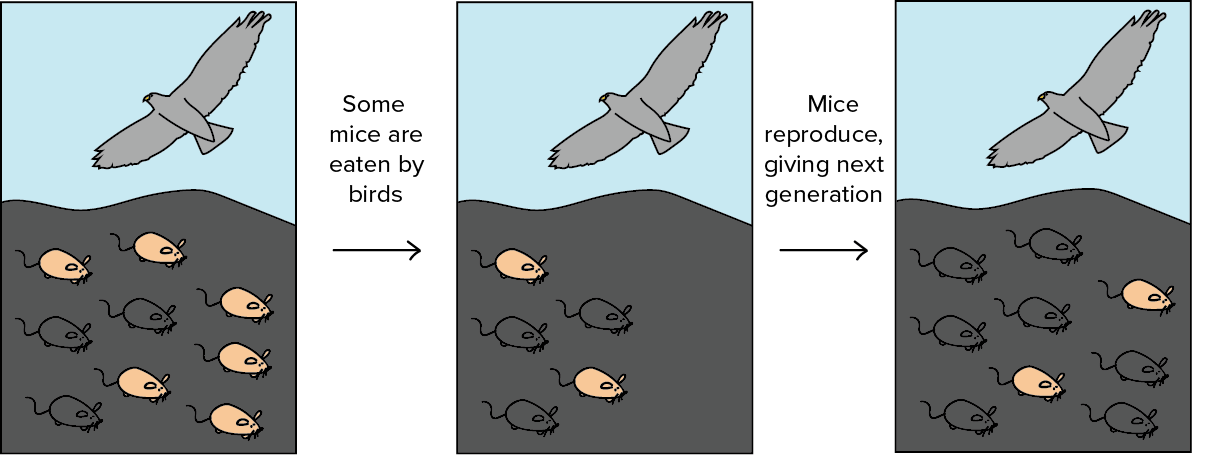
Why is the mouse population changing over time?
a)
The light mice can reproduce more successfully than the dark mice
b)
The hawks eat more dark mice than light mice because the dark mice taste better
c)
The hawks eat more light mice than dark mice because they can see the light mice more easily
d)
The hawks eat more dark mice than light mice because they can see the dark mice more easily
24.
Darwin determined that the 13 species of finch found in the Galapagos Islands
a)
probably all came from the same ancestral species 
b)
had all adapted to the same food source
c)
were identical to species 600 miles away
d)
were the result of careful breeding by humans
25.

Variety of beak size and shapes of finches in Galapagos Island is an example of __________________

a)

Artificial selection

b)

Disruptive selection

c)

Directional selection

d)

Adaptive Radiation

26.

Occurs when changing environment favours one extreme phenotype

a)

stabilizing selection

b)

Directional selection

c)

Disruptive selection

d)

Outbreeding

27.
Which of the three graphs shows stabilizing selection?
a)
A
b)
B
c)
C
28.
What is the correct explanation for what is happening in this graph?
a)
There are a lot of average-sized beaks
b)
There are no beaks
c)
There are a lot of small beaks only
d)
There are a lot of small and large beaks, but not average-sized ones