
 Worksheets
Evolution - 8th
Total questions: 16
Worksheet time: 5mins
Name
Class
Date
1.

Who was the naturalist that traveled the world to study plants and animals?
a)
Albert Einstein
b)
Charles Darwin
c)
Charles Barkley
d)
Isaac Newton
2.

The gradual change in species over time is...
a)
Evolution
b)
Nucleotide
c)
Adaptation
d)
Natural Selection
3.
What characteristic did Darwin observe about the finches on the Galapagos Islands?
a)
Their feathers
b)
Genotypes
c)
Their beaks
d)
Their body sizes
4.
Which term refers to the process by which individuals that are better suited to the environment survive and reproduce therefore passing down their genes to their offspring?
a)
Evolution
b)
Variation
c)
Adaptation
d)
Natural Selection
5.
When an organism completely dies out, it is called.....
a)
Adaption
b)
Extinction
c)
Fossilization
d)
Mutation
6.
Genetic differences between organisms of the same species
a)
Variation
b)
Adaptation
c)
Behavior
d)
Environment
7.
A well-tested concept that explains a wide range of observations is called a(an):
a)
hypothesis
b)
experiment
c)
cause and effect
d)
scientific theory
8.
What is the study of organisms at the early stages of development?
a)
DNA studies
b)
embryology
c)
extinction
d)
fossil record
9.
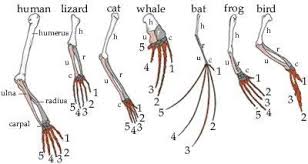
What is this an example of?
a)
vestigial structures
b)
embryology
c)
homologous structures
d)
fossil record
10.
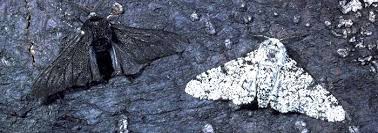
Predict which moth would increase in population
a)
light
b)
dark
11.
Which of the following is NOT an example of natural selection?
a)
People selectively breeding hamsters.
b)
Insect populations developing resistance to certain pesticides.
c)
Bacteria becoming resistant to antibiotics.
d)
Male birds of certain species developing colorful feathers to attract female mates.
12.

Which species’ DNA is most similar to the DNA of the toothed whale?
a)
Hippopotamus
b)
Baleen Whale
c)
Grazing Mammals
d)
Camels
13.

Which of the following is a term for a group of similar organisms that can reproduce fertile offspring?
a)
individual
b)
population
c)
species
d)
fossil
14.
Why are advantageous traits more likely to be passed onto offspring?
a)
Because they are more likely to survive and reproduce.
b)
Because they come from dominant alleles.
c)
Because they come from recessive alleles.
d)
Because the trait is an acquired phenotype.
15.
The ability of an organism to survive and reproduce in its specific environment
a)
diversity.
b)
evolution
c)
adaptation
d)
fitness
16.
In natural selection, what drives organisms to change?
a)
humans
b)
mutations
c)
breeders
d)
environment
100 %

