wayground logo

Free Printable Worksheets

Font size

S
M
L
XL
Worksheets

Waves

Total questions: 34

Worksheet time: 19mins
Name
Class
Date
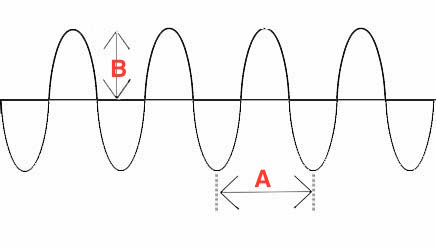
1.

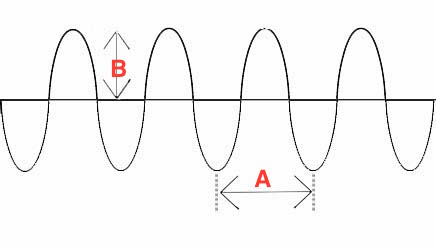
What property of this wave is represented by the letter "A"

a)

amplitude

b)

crest

c)

trough

d)

wavelength

2.
What property of the wave is represented by the letter "B"?
a)
amplitude
b)
crest
c)
trough
d)
wavelength
3.
The highest point on a wave is:
a)
the crest
b)
the trough
c)
the top
d)
the coast 
4.
The lowest point on a wave is the:
a)
Amplitude
b)
Crest
c)
Trough
d)
Wavelength
5.
The number of wavelengths that pass a point each per second is:
a)
frequency
b)
period
c)
longitudinal 
d)
transverse wave 
6.
The type of waves that require medium to pass:
a)
Mechanical Waves
b)
Electromagnetic Waves
7.
Which vocabulary term is used to identify the distance between points C & G?
a)
Amplitude
b)
Crest
c)
Frequency
d)
Wavelength
8.
When the frequency of a wave increases, what happens to the wavelength?
a)
The wavelength is not directly affected by the frequency of a wave.
b)
The wavelength increases.
c)
The wavelength decreases.
d)
More specific information is needed to form a conclusion about the wavelength.
9.

A mechanical wave cannot travel through...

a)

a vacuum (empty space).

b)

water.

c)

air.

d)

glass.

10.

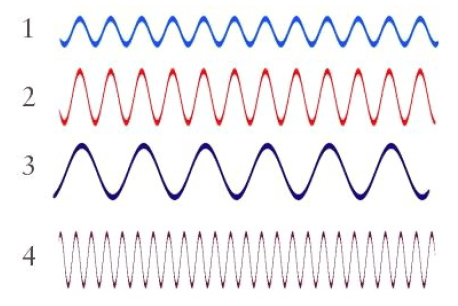
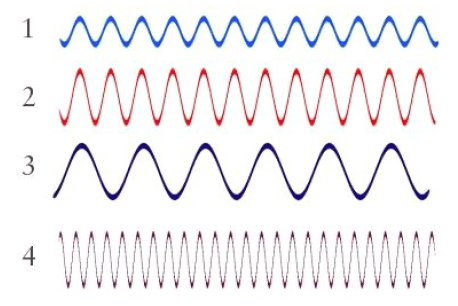
Which wave in the diagram has the highest frequency?

a)

1

b)

2

c)

3

d)

4

11.
Which wave in the diagram has the greatest wavelength?
a)
1
b)
2
c)
3
d)
4
12.

When a wave bends as it passes through at an angle from one medium to another. (example: pencil in a glass of water)

a)

medium

b)

refraction

c)

reflection

d)

interference

13.
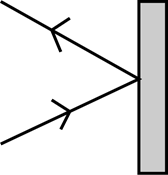
When a wave strikes and object and bounces off. (example echo)
a)
medium
b)
refraction
c)
reflection
d)
interference
14.
A wave carries...?
a)
energy only
b)
matter only
c)
energy and matter
d)
neither
15.
What kind of waves can travel through space?
a)
electromagnetic waves
b)
compressional waves
c)
longitudinal waves
d)
sound waves
16.
Amplitude is a measure of how much _________ the wave is carrying
a)
energy
b)
matter
c)
medium
d)
frequency
17.
The longer the _____________  the ______________ the frequency.
a)
wavelength, lower
b)
wavelength, higher
c)
amplitude, lower
d)
amplitude, higher
18.

Which wave has a greater frequency?

a)

A

b)

B

c)

both A & B

19.

The units for frequency are measured in _____________.

a)

Hertz

b)

Joules

c)

Watts

d)

Newtons

20.
When a wave's amplitude increases it means
a)
it's carrying more energy
b)
its wavelength gets longer
c)
its frequency increases
d)
its wavelength decreases
21.
Which is an example of a longitudinal wave?
a)
light wave
b)
sound wave
c)
visible wave
d)
radio wave
22.

Interference of waves involves...

a)

combination of light and dark bands on a screen

b)

polarisation of sound or light waves

c)

diffraction of waves of the same frequency

d)

superposition of two or more waves

23.
Constructive interference will cause the wave to 
a)
Increase its displacement
b)
Decrease its displacement 
c)
Make its displacement stay the same
24.

What type of interference is represented in this diagram?

a)

Constructive

b)

Destructive

c)

Pass

25.

What type of interference is represented in the diagram?

a)

Constructive

b)

Destructive

c)

Pass

26.

What type of interference do noise cancelling headphones use?

a)

Constructive Interference

b)

Destructive Interference

c)

Pass Interference

27.

In the diagram which letters represent the nodes

a)

A B C

b)

A C E

c)

B D

d)

B D E

e)

A C D

28.

the apparent change in frequency of a wave due to the motion of the source or the receiver

a)

Doppler effect

b)

sonic effect

c)

ultasonic effect

d)

infrasonic effect

29.
What kind of wave is pictured?
a)
Transverse
b)
Longitudinal
c)
surface
d)
none of the above
30.

How many nodes does this standing wave have?

a)

1

b)

2

c)

3

d)

4

31.

How many antinodes does this standing wave have?

a)

5

b)

6

c)

7

d)

8

32.
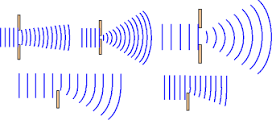
a)

reflection

b)

refraction

c)

diffraction

d)

interference

33.
a)

reflection

b)

refraction

c)

diffraction

d)

interference

34.
a)

reflection

b)

refraction

c)

diffraction

d)

interference