wayground logo

Free Printable Worksheets

Font size

S
M
L
XL
Worksheets

Final Exam

Total questions: 219

Worksheet time: 3hrs 9mins

Name
Class
Date
1.

What is an example of Conduction?

a)

A beaker touching a hot plate

b)

Air flowing from land to sea

c)

Sun radiating down on sand

2.

If you were investigating the different rates of heating between the sand and ocean water? What tool would you use?

a)

Lamp

b)

Thermometer

c)

Saltwater

d)

Wet Sand

3.

In order to get the most accurate reading of sand temperature over 10 minutes. Should the scientist place a thermometer in muddy sand or dry sand?

a)

Muddy Sand

b)

Dry Sand

4.

High Pressure on a barometer indicates what type of temperature?

a)

Hot air and clear skies

b)

Cold Air and rain

5.

Low pressure on a barometer indicates what type of air?

a)

Hot air

b)

Cold air

6.

During a Sea Breeze; Which has warmer temperature?

a)

Sand

b)

Land

7.

During a Sea Breeze, which area has cooler temperature?

a)

Land

b)

Sea

8.

During a Sea Breeze; which area is experiencing high pressure?

a)

Sea because the air is cold

b)

Land because the air is hot

9.

During a Sea Breeze, which area is experiencing low pressure?

a)

sea because the air is cold

b)

land because the air is hot

10.

How can you use a balloon to illustrate the Coriolis effect?

a)

Throwing the balloon in the air shows Earth Rotation

b)

Turning the balloon illustrates Earth Rotation that causes the Coriolis Effect

11.

What direction does wind blow?

a)

High pressure to Low Pressure

b)

Low Pressure to High Pressure

12.

During a Land Breeze, cool air blows in what direction?

a)

Sea to Land

b)

Land to Sea

13.

During a land breeze, which area experiences warmer temperature?

a)

Sea because water holds on to its heat longer

b)

Land because land holds on to its heat longer

14.

During a Land Breeze, which has cooler temperature?

a)

The Sea because it cools down quicker than land

b)

The land because it cools down quicker than water
15.
Do sea breezes typically happen during the day or night?
a)
Day
b)
Night
16.
Do land breezes typically happen during the day or night?
a)
Day
b)
Night
17.
During a land breeze which way does the wind blow?
a)
from the sea to the land
b)
from the land to the sea
18.
During a sea breeze which way does the wind blow?
a)
from the land to the sea
b)
from the sea to the land
19.
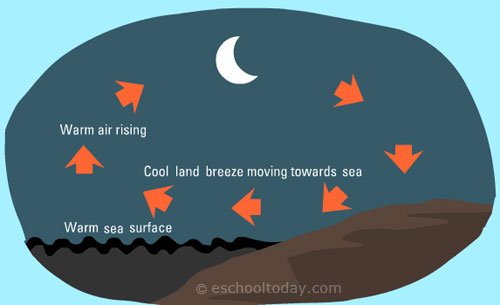
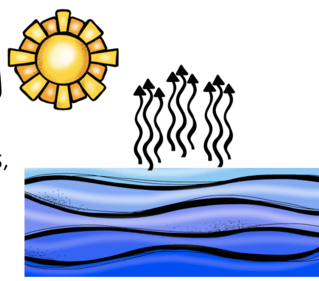
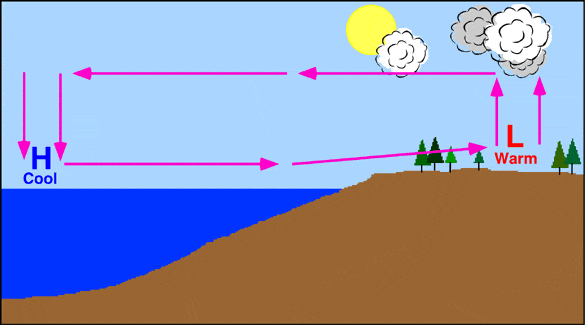
Is this a land or a sea breeze?
a)
land breeze
b)
sea breeze
20.
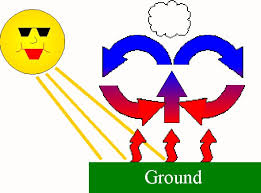
Is this a land or a sea breeze?
a)
land breeze
b)
sea breeze
21.
When warm air rises, ______ pressure forms at the surface of the land or sea.
a)
high
b)
some
c)
low
d)
none
22.
Where does the initial source of energy come from that creates winds?
a)
the moon
b)
the sun
c)
the Earth's surface
d)
the rotation of the Earth
23.
Why does warm air rise?
a)
Warm air is more dense than cooler air.
b)
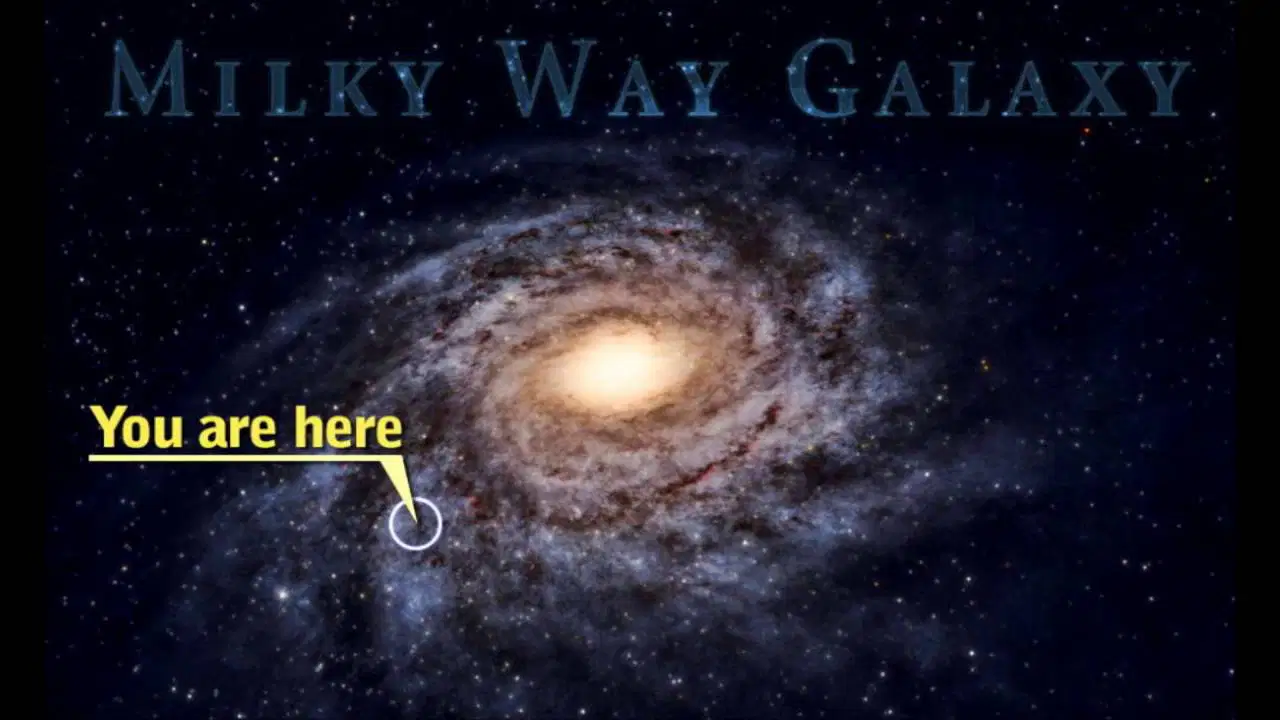
Warm air has more pressure than cooler air.
c)
Warm air is less dense than cooler air.
d)
Warm air has a higher dew point than cooler air.
24.

Global Winds travel

a)

short distances

b)

far distances

25.

Local Winds travel

a)

short distances

b)

long distances

26.

When is the ocean the coolest during the day or night?

a)

daytime

b)

nighttime

27.

when is the ocean the warmest?

a)

daytime

b)

nighttime

28.
The Coriolis effect deflects wind direction. How does this process impact ocean surface currents?
a)
The wind deflects the currents to the right in the Northern Hemisphere and to the left in the Southern Hemisphere.
b)
The wind deflects the currents to the left in the Northern Hemisphere and to the right in the Southern Hemisphere.
c)
The wind deflects the currents to the left in both hemispheres.
d)
The wind deflects the currents to the right in both hemispheres.
29.
Which of these MOST likely causes winds to blow on Earth?
a)
Earth spins quickly, causing air to blow around.
b)
The gravity of Earth and the Moon push and pull the air.
c)
Warm air rises and cool air falls toward Earth's surface.
d)
Ocean waves push air onto the shore and across Earth's surface.
30.
Which factor causes the motion of surface ocean currents?
a)
the sun
b)
the wind
c)
the moon
d)
hurricanes
31.
Hurricanes are large, powerful storms that form as they travel over warm ocean waters. What do oceans add to make hurricanes so strong?
a)
salt and water
b)
wind and tides
c)
heat and moisture
d)
waves and flooding
32.
Which of these BEST explains the cause of convection currents in Earth's atmosphere?
a)
Heat from Earth's core heats the land only at the equator.
b)
Glaciers moving away from the poles cool Earth unevenly.
c)
Sunlight is more concentrated in some places on Earth than others.
d)
The light and heat reflected from the moon varies as the moon changes phases.
33.
When visiting the beach, Felicity observed that a breeze blew in from the ocean during day and out toward the ocean at night. Which factor is MOST responsible for the direction of land and sea breezes in coastal regions?
a)
the revolution of Earth around the Sun
b)
the uneven heating between the land and water
c)
the gravitational pull of Earth on the atmosphere
d)
the daily rise and fall of tides in a regular pattern
34.
How do differences in air pressure affect the movement of air?
a)
Air always moves from areas of high pressure to areas of low pressure.
b)
Air always moves from areas of low altitudes to high altitudes.
c)
Air always moves from areas of low pressure to areas of high pressure.
d)
Air always moves from east to west.
35.
Which statement correctly describes the properties of cold air?
a)
less dense and less pressure than warm air
b)
more dense and more pressure than warm air
c)
more dense and less pressure than warm air
d)
less dense and more pressure than warm air
36.
The curving of air to the right in the Northern hemisphere is caused by ___________ and is called the _________ effect.
a)
Earth's rotation...Coriolis
b)
Earth's revolution...Coriolis
c)
Earth's rotation...Doppler
d)
Earth's revolution...Doppler
37.
Which air mass means wet and warm?
a)
Continental tropical 
b)
Continental polar
c)
Maritime tropical 
d)
Maritime polar
38.
What is a body of air that has consistent temperature and moisture and moisture content?
a)
climate 
b)
air mass
c)
cold front 
d)
tropical
39.
A cold front is an air mass that
a)
pushes a warmer front 
b)
pushes a cloud
c)
pushes the Earth 
d)
pushes another cold front
40.
A measure of the amount of water vapor in the air is called what?
a)
Air Pockets
b)
Air Fronts
c)
Cold Fronts
d)
Humidity
41.
What type of pressure is associated with cold air masses?
a)
Low
b)
Middle
c)
High
42.
Which air mass means dry and cold?
a)
Maritime polar
b)
Maritime continental
c)
Continental tropical 
d)
Continental polar
43.
Which front is this symbol? 
a)
Warm
b)
Cold
44.
Which gas in our atmosphere is most abundant?
a)
Argon
b)
Oxygen
c)
Nitrogen
d)
Carbon Dioxide
45.
What is the percentage of oxygen in Earth's atmosphere?
a)
1%
b)
21%
c)
78%
d)
90%
46.
What is the percentage of nitrogen in Earth's atmosphere?
a)
1%
b)
21%
c)
78%
d)
90%
47.
In which layer of the atmosphere does weather occur?
a)
Mesosphere
b)
Thermosphere
c)
Stratosphere
d)
Troposphere
48.
What causes the temperature to increase in the stratosphere?
a)
Nitrogen
b)
Ozone
c)
Water Vapor
d)
carbon dioxide
49.
What decreases as you go up in the atmosphere?
a)
Altitude
b)
Atmosphere
c)
Meteors
d)
Air Pressure
50.
The layers of the atmosphere are classified according to changes in _________.
a)
altitude
b)
density
c)
composition
d)
temperature
51.
Which of the following is the correct order of the atmosphere layers from Earth to space?
a)
troposphere, stratosphere, mesosphere, thermosphere, exosphere
b)
troposphere, mesosphere, thermosphere, exosphere, stratosphere
c)
thermosphere, stratosphere, mesosphere, troposphere, exosphere
d)
troposphere, stratosphere, mesosphere, exosphere, thermosphere
52.

The greenhouse gas having the greatest role in human-caused global warming is ...

a)

Methane.

b)

Carbon dioxide.

c)

CFCs (chlorofluorocarbons).

d)

Ozone.

53.
1.  Which of these could increase average global temperatures? 
a)
A.  increased use of fossil fuels 
b)
A.  increased ocean plants 
c)
A.  decreased carbon dioxide emissions 
d)
A.  increased numbers of animal species
54.
Where you will find the ozone layer.
a)
stratosphere
b)
thermosphere
c)
exosphere
d)
mesosphere
55.
The hottest layer.
a)
troposphere
b)
thermosphere
c)
exosphere
d)
mesosphere
56.
What is the function of the ozone layer?
a)
to allow UV rays to get to Earth
b)
to block UV rays from getting to Earth
c)
To keep oxygen in
d)
to allow meteors to get to Earth
57.
Where is the air pressure the greatest?
a)
1
b)
2
c)
3
d)
4
58.

What happens to air pressure the higher in the atmosphere?

a)

increase

b)

decrease

59.

What happens to the air density (amount of air) with the increase in altitude?

a)

density increases

b)

density decreases

c)

density stays the same

d)

density disappears

60.
The higher you go, the air becomes.......
a)
More dense
b)
Less dense 
61.
What is the definition of CONVECTION
a)
When heat transfers through waves.
b)
When heat transfers from objects that are touching.
c)
a  hot liquid or air that  expands, becomes less dense, and rises or becomes more dense, and sinks.
d)
Heat traveling from the sun
62.
What is the definition of CONDUCTION?
a)
When heat is transferred from objects like rays of light or electromagnetically.
b)
a  hot liquid or air that  expands, becomes less dense, and rises or becomes more dense, and sinks.
c)
When heat transfers from objects that are touching.
d)
When heat transfers through the heater or AC in your house.
63.
What kind of heat transfer happens when the sun is heating your body?
a)
Conduction
b)
Radiation
c)
Convection
d)
Density
64.
Warm air rises and the cool air sinks demonstrates this type of heat transfer. 
a)
conduction
b)
convection
c)
radiation
d)
Insolation 
65.
Which process increases the salinity of ocean water?
a)
The Coriolis Effect
b)
Convection currents
c)
Evaporation
d)
Continental Deflection
66.
The density of ocean water increases when it?
a)
Joins the Gulf Stream
b)
Gets colder
c)
Gets warmer
d)
Turns to ice
67.
What is the difference between a volcanic island & a seamount?
a)
A volcanic island rises above the water & a seamount does not
b)
A seamount rises above the water & a volcanic island does not
c)
Both the seamount & volcanic island are underwater
d)
Both the seamount & the volcanic island rise above the water
68.
Which process adds more crust to the ocean floor?
a)
earthquakes
b)
sea floor spreading 
c)
subduction
d)
convection
69.
A volcanic mountain that rises above the surface of the water is called ____________
a)
trench
b)
island
c)
mid-ocean ridge
d)
seamount
70.

What are the types of water?

a)

H2O and Saltwater

b)

Saltwater and Freshwater

c)

Stream water and Freshwater

71.

Mark noticed a puddle of water on his way home from school. The next day the puddle was gone. What

most likely happened to the puddle of water?

a)

It melted.

b)

It condensed.

c)

It precipitated.

d)

It evaporated.

72.
What is the rock layer that stores groundwater called?
a)
well
b)
aquifer
c)
groundwater
d)
watershed
73.

Which Freshwater is the most according to the Pie Chart?

a)

Groundwater

b)

Lakes

c)

Saltwater

d)

Ice/Glaciers

74.

Which type of Earth water is the most on Earth?

a)

Ice

b)

Groundwater

c)

Saltwater

d)

Lakes and Rivers

75.

Which type of Freshwater is the least available on Earth?

a)

Saltwater

b)

Lakes

c)

Ice

d)

Groundwater

76.

Which type of Freshwater can humans use the most?

a)

Groundwater

b)

Ice

c)

Swamps

d)

Oceans

77.

What is the Pie Chart describing in the image?

a)

Freshwater vs. Saltwater

b)

Water vs. Land

c)

All of the Freshwater on Earth

78.

What is this Image Describing?

a)

Water vs. Land

b)

Saltwater vs. Freshwater

c)

Earth's Freshwater

79.
What is the steep slope at the edge of the continental shelf?
a)
seamount
b)
mid-ocean ridge
c)
continental slope
d)
rift zone
80.
What are underwater mountain ranges called?
a)
continental shelf
b)
mid-ocean ridges
c)
abyssal plains
d)
continental slopes
81.
Where is the shallowest part of the ocean floor?
a)
continental slope
b)
continental shelf
c)
abyssal plains
d)
rift zones
82.
What is the deepest part of the ocean basin?
a)
abyssal plains
b)
trenches
c)
rift zones
d)
mid-ocean ridge
83.
Which pair represents wide, flat areas of land? 
a)
Mountains- Mid-Ocean Ridge
b)
Trench- Canyon
c)
Plains- Abyssal Plains
d)
Volcano-Seamount 
84.
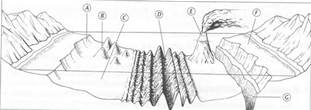
What is letter A?
a)
Cont. Shelf
b)
Cont. Slope
c)
Seamount
d)
Abyssal Plain
85.
In addition to salinity, what factor affects the density of seawater?
a)
depth
b)
latitude
c)
temperature
d)
salt content
86.
Seawater is typically denser than freshwater due to seawater’s —
a)
Greater depth
b)
Lower freezing point
c)
Smaller mass
d)
Higher salinity
87.
What happens to pressure as you go deeper into the ocean? 
a)
increases
b)
decreases
c)
stays the same
d)
doubles
88.
The higher the salt content in the ocean the ________ dense the water will be.
a)
less
b)
more
c)
nothing happens
89.
If I have freshwater that is less dense, what will it do in comparison to salt water that is more dense?
a)
The more dense water will float and the less dense water will sink.
b)
The more dense water will sink and the less dense water will float
c)
Nothing they will mix evenly.
90.
Deep Ocean currents are a result of
a)
Global Wind Patterns
b)
Earth's Rotation
c)
Density
d)
All of the above
91.
The Coriolis Effect is caused by
a)
Earth rotating around the sun
b)
Earth rotating on its axis
c)
The tides
d)
Gravity
92.
The Gulf stream carries _____________ water from the east coast of The United States to the West coast of Europe.
a)
Cold
b)
Warm 
c)
Freezing
d)
Fresh
93.
Warm ocean currents generally come from
a)
The North Pole
b)
The South Pole
c)
The Equator
d)
Both A and B
94.
A strong surface current that runs along the east coast of the United States and carries warm water to Europe.
a)
California Current
b)
Global Conveyor Belt
c)
Gulf Stream
d)
Surface Current
95.
What process brings the deep cold ocean currents up to the surface?
a)
Conduction
b)
Global Wind Patterns
c)
Convection Currents
d)
Temperature and salinity
96.
Why are surface currents at the surface of the ocean?
a)
colder temperature
b)
colder temperature & more salinty
c)
warmer temperature & less salinty
d)
less salinty
97.
Which three factors are most important in determining the composition of ocean water?
a)
Salinity, mass, density
b)
Temperature, salinity density
c)
Volume, density, temperature
d)
Density, temperature, mass
98.
Why are people not able to scuba dive to the deepest parts of the ocean?
a)
As you go deeper into the ocean, temperature decreases and pressure increases too much for a body to withstand.
b)
As you go deeper into the ocean, temperature and pressure increase too much for a body to withstand.
c)
As you go deeper into the ocean, temperature and pressure decrease too much for a body to withstand.
d)
As you go deeper into the ocean, temperature increases and pressure increases too much for a body to withstand.
99.
What is it called when plants give off water vapor as a waste product?
a)
condensation
b)
evaporation
c)
sublimation
d)
transpiration
100.
During which stage do clouds form?
a)
condensation
b)
evaporation
c)
precipitation
101.
When water _________, dew forms.
a)
Melts
b)
Evaporates
c)
Condenses
d)
Precipitates
102.
Dew also forms directly onto items, as water droplets.  What part of the water cycle is this?
a)
run-off 
b)
condensation
c)
evaporation
d)
precipitation
103.
What is water doing when it is changed to water vapor?
a)
evaporating
b)
condensing
c)
transpiring
d)
freezing
104.
On which kind of day would you expect the most evaporation from the surface of a  pond?
a)
sunny and hot
b)
sunny and cold
c)
rainy and hot
d)
rainy and cold
105.
What is water that flows in rivers and streams into the oceans and lakes?
a)
evaporating
b)
condensing
c)
precipitating
d)
runoff
106.
What is the periodic rise and fall of the water level in the oceans?
a)
Tide
b)
Tidal range
c)
Spring Tide
d)
Neap Tide
107.
What type of tides would this arrangement of earth-moon-sun create?
a)
neap tide
b)
spring tide
c)
new moon tide
d)
full moon tide
108.
What causes tides?
a)
gravity
b)
wind
c)
spring
d)
neap
109.
If tides alternate from high to low and there are two of each type of tide a day, about how many hours will generally be between each different tide?
a)
2 hours
b)
6 hours
c)
12 hours
d)
24 hours
110.
How many low tides and high tides happen in a day?
a)
1 low tide, 1 high tide
b)
4 low tides, 4 high tides
c)
3 low tides, 3 high tides
d)
2 low tides, 2 high tides
111.
You visited the beach at 12 pm (noon) and it is high tide. If you return 6 hours later what tide will you see? 
a)
high 
b)
low 
c)
none
d)
spring 
112.
What do we call the small tides that happen when the sun and moon are at right angles to each other?
a)
Neap Tide
b)
Spring Tide
c)
Larger Change
d)
Smaller Change
113.
The Moon has a greater influence on Earth tides than the Sun because...
a)
it is smaller than the Sun
b)
it revolves around the Earth
c)
it is closer to the Earth
114.
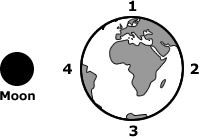
The diagram below shows Earth and the moon.In which position(s) will Earth's tidal bulge(s) occur?
a)
4 only
b)
1 and 4
c)
3 and 4 
d)
2 and 4
115.
Two types of water currents are
a)
local and global
b)
sea and land
c)
surface and deep
d)
warm and cold
116.
The surface of the world is covered in what percent of water? 
a)
78%
b)
90%
c)
97%
d)
70%
117.
The majority of the water in the world is stored in _______. 
a)
oceans
b)
the atmsosphere
c)
the ground
d)
rivers
118.
What percent of water is salt water?
a)
97%
b)
90%
c)
4% 
d)
3%
119.
There is about 2% of the Earth's freshwater frozen in icebergs.
a)
True
b)
False
120.
There is only about 1% of freshwater available for use on Earth.
a)
True
b)
False
121.
Which represents the distribution of water on Earth?
a)
3% freshwater, 97% salt water
b)
97% freshwater, 3% salt water
c)
71% freshwater, 29% salt water
d)
29% freshwater, 71% salt water
122.
Where is most of the freshwater found on Earth?
a)
lakes
b)
glaciers
c)
oceans
d)
rivers
123.
The supply of freshwater under the Earth's surface.
a)
watershed
b)
mouth
c)
headwaters
d)
groundwater
124.

Groundwater accounts for _________percent of the freshwater.

a)

10

b)

40

c)

20

d)

30

125.

What happens to water density, when temperature drops?

a)

Water becomes less dense

b)

Water becomes more dense

126.

What happens to water density, if salinity increases ( amount of salt dissolved in water)?

a)

Density will increase

b)

Density will decrease

127.

Dew ( water droplets on plants) usually happens in the morning

a)

True

b)

False

128.
The symbol on a weather map for a cold front is what?
a)
a line with triangles on it
b)
a line with semi-circles on it
c)
a line with squares on it
d)
a line with circles on it
129.
When a cold front is approaching, what happens?
a)
warm air is pushing under cold air causing humid weather and lower temperatures
b)
warm air is pushing under cold air causing humid weather and higher temperatures
c)
warm air rises, cools, and causes rain and thunderstorms
d)
cold air is pushed over warm air causing rain and thunderstorms
130.
Which system results in rainy or stormy weather?
a)
high pressure
b)
low pressure
c)
hurricane
d)
weather system
131.
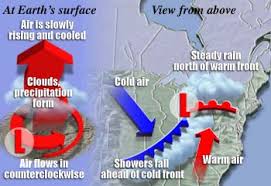
This is the symbol for which type of front?
a)
cold front
b)
warm front
c)
stationary front
d)
occluded front
132.
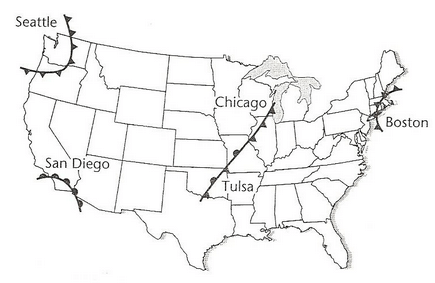
Which type of front is near Seattle?
a)
cold front
b)
warm front
c)
occluded front
d)
stationary front
133.
Which type of front is located near Boston?
a)
warm front
b)
cold front
c)
stationary front
d)
occluded front
134.
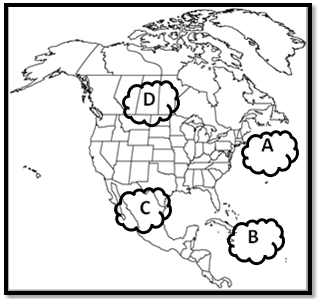
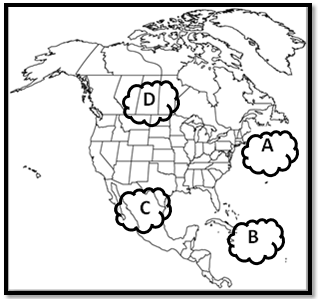
Which type of air would you find at air mass A?
a)
cold, dry
b)
warm, humid
c)
warm, dry
d)
cold, humid
135.
Which type of air would you find at air mass D?
a)
cold, dry
b)
warm, humid
c)
warm, dry
d)
cold, humid
136.
What type of storm front is this? 
a)
warm front
b)
cold front
c)
stationary front
d)
occluded front
137.
What characteristics are used to classify air masses?
a)
temperature and humidity
b)
pressure and temperature
c)
latitude and longitude
d)
wind speed and location 
138.
A wet, cold air mass would be - 
a)
maritime tropical 
b)
maritime polar
c)
continental tropical 
d)
continental polar
139.
Where would you find a tropical maritime air mass?
a)
over the ocean, near the equator
b)
over the ocean, near the poles
c)
over a continent, near the equator
d)
over a continent, near the poles
140.
Which type of weather is associated with a cold front?
a)
heavy rain, snow, thunderstorms, and snow for short periods of time 
b)
Steady, light rain or snow can occur for longer periods of time 
141.
what is an air mass?
a)
a large body of air that is made of the same temperature and moisuture
b)
when two air masses meet 
142.

What makes a tornado?

a)

warm front

b)

cold front

c)

when warm and cold fronts come together

143.

Tornadoes form when warm, moist air from the Gulf of Mexico and cool, dry air from Canada meet

a)

True

b)

False

144.
What model is where the earth is in the middle of our universe?
a)
Heliocentric Model
b)
Geocentric Model
c)
Moon phases
d)
Tidal Phases
145.
What Model is where the sun is the center of the universe?
a)
Geocentric
b)
Heliocentric
c)
Earth's rotations
d)
Earth's planets
146.
  What does "geo-" mean?
a)
Earth
b)
sun
c)
Center
147.
This image shows the:
a)
Geocentric Solar System
b)
Heliocentric Solar System
148.
The sun centered view of the universe
a)
Galaxy
b)
Geocentric
c)
Astonomy
d)
Heliocentric
149.

What is the name of this model?

a)

Heliocentric Model

b)

Geocentric Model

c)

Circle Model

d)

Aristotle Model

150.

what does helio mean

a)

Sun

b)

Earth

c)

Moon

151.
How long does it take for the earth to make 1 rotation?
a)
One year
b)
One hour
c)
24 hours
d)
One minjute
152.
How long does it take the earth to make 1 revolution
a)
One year
b)
One day
c)
One hour
d)
One minute
153.
What causes day and night?
a)
A rotation
b)
A revolution
c)
A season
d)
One day
154.
What model is where the earth is in the middle of our universe?
a)
Heliocentric Model
b)
Geocentric Model
c)
Moon phases
d)
Tidal Phases
155.
What Model is where the sun is the center of the universe?
a)
Geocentric
b)
Heliocentric
c)
Earth's rotations
d)
Earth's planets
156.
Earth's ________ on its axis causes day and night.
a)
rotation
b)
revolution
c)
phase
d)
comet
157.

Kepler's first law states that the orbits of the planets are in the shape of a/an...

a)

perfect circle

b)

ellipse

c)

spiral

158.
Why did people believe in the Geocentric vs the Heliocentric solar system?
a)
Geocentric system had been around for a LONG time.
b)
People don't like change.
c)
There wasn't enough proof  to support the Heliocentric system.
d)
all of these answers are correct.
159.

What invention help support the Heliocentric?

a)

Telescope

b)

Books

160.

What is a scientific Theory?

a)

AN EXPLANATION TO A PHENOMENON THAT IS SUPPORTED WITH EVIDENCE

b)

AN BELIEVE IN FOLKLORE

161.

Most scientists believe the Big Bang Theory explains which of the following questions?

a)

How our planets and moons formed

b)

How our universe began

c)

How the sun turns hydrogen into helium

d)

How fast light travels through space
162.
Which of the following is evidence of the Big Bang Theory?
a)
Cavemen heard a loud bang at the beginning of time.
b)
The universe isn't moving
c)
The universe is expanding
d)
The universe is getting smaller
164.
Which is NOT a type of galaxy?
a)
Elliptical
b)
Spiral
c)
Oblong
d)
Irregular
164.
Which is NOT a type of galaxy?
a)
Elliptical
b)
Spiral
c)
Oblong
d)
Irregular
165.
What shape is the Milky Way galaxy?
a)
Elliptical
b)
Spiral
c)
Irregular
166.
What shape is the Milky Way galaxy?
a)
Elliptical
b)
Spiral
c)
Irregular
167.
The closer a planet is to the sun...
a)
the faster it travels
b)
the slower it travels
168.
What keeps a planet moving on its path around the sun
a)
gravity & inertia
b)
heat & pressure
c)
inertia & pressure
d)
gravity & heat
169.
Which statement best describes a galaxy?
a)
a cluster of millions of stars held together by gravity
b)
a star, with planets, moons and other small space bodies revolving around it
c)
all known objects
d)
all of the above
170.
What is a common characteristic of the inner  planets?
a)
Gaseous
b)
Distance between them is longer
c)
Rings
d)
Distance between them is shorter
171.
What is located between the inner and outer planets.
a)
Sun
b)
Asteroid belt
c)
Uranus
d)
Moons
172.
A force of attraction between any two objects is called _____________.
a)
static electricity 
b)
rotation
c)
gravity
d)
orbit
173.
The idea that an object in motion will stay in motion unless acted upon is known as
a)
gravity
b)
inertia
c)
pressure
d)
heat
174.
Which planet is closest to the sun?
a)
Uranus
b)
Mercury
c)
Neptune
d)
Earth
175.
Which planet is farthest from the sun?
a)
Neptune
b)
Pluto
c)
Earth
d)
Uranus
176.
A ball of ice and dust with a tail of gas and dust pointing away from the sun.
a)
Asteroid
b)
Comet
c)
Moon
d)
Meteor
177.
A small object that appears as a streak of light as it enters earth's atmosphere.
a)
Asteroid
b)
Comet
c)
Moon
d)
Meteor
178.
A small rocky object orbiting the sun.
a)
Asteroid
b)
Comet
c)
Moon
d)
Meteor
179.
Which of the following is best shown in the picture?
a)
Earth's revolution
b)
A month on Earth
c)
A year on Earth
d)
Earth's rotation
180.
Which of the following do the blue arrows represent in the picture?
a)
A day on Earth
b)
Earth's rotation around the Sun
c)
Earth's revolution around the Sun
d)
A month on Earth
181.
Earth revolves around ________, because it has the __________ in the solar system.
a)
the moon; most gravitational force
b)
the sun; least gravitational force
c)
Jupiter; most gravitational
d)
the sun; most gravitational force
182.
List the following items from smallest to largest.
a)
universe, solar system, galaxy
b)
galaxy, solar system, universe
c)
solar system, galaxy, universe
d)
solar system, universe, galaxy
183.
Which set of planets is in order, from largest to smallest?
a)
Jupiter, Mars, Mercury
b)
Jupiter, Venus, Earth
c)
Uranus, Saturn, Mars
d)
Uranus, Mars, Venus
184.
The picture shows the position of the Sun, Earth, and the Moon on one night.  What moon phase did people on Earth see on this night?
a)
New Moon
b)
First Quarter
c)
Full Moon
d)
Third Quarter
185.
Melinda learned that days in some seasons have more daylight hours than in other seasons. Which season receives the MOST hours of sunlight in the Northern Hemisphere?
a)
Fall
b)
Spring
c)
Summer
d)
Winter
186.
Natalie observed the Moon over a couple of weeks.  Each night, the Moon appeared a little fuller.  Natalie wants to predict which phase of the moon she can expect to see in the next few days. Based on Natalie’s observations, which phase of the moon will appear next?
a)
1st Quarter
b)
Full Moon
c)
Waxing Crescent
d)
New Moon
187.
A _______ is a burning body of matter that has entered Earth's atmosphere; "shooting star"
a)
Meteor
b)
Comet
c)
Asteroid
d)
Solar Flare
188.
Which phase of the Moon is this?
a)
Full Moon
b)
First Quarter
c)
Last Quarter
d)
New Moon
189.
When the moon is over 50% illuminated it is called a ____________.
a)
Full Moon
b)
New Moon
c)
Crescent
d)
Gibbous
190.
Which phase of the moon is this?
a)
Full Moon
b)
Waxing Crescent
c)
Waning Crescent
d)
Waxing Gibbous
191.
When the sun, earth, and moon form a 90 degree angle, we have _____________.
a)
Neap Tides
b)
Spring Tides
c)
Medium Tides
d)
Winter Tides
192.
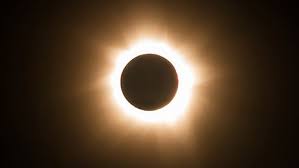
A solar eclipse only happens during a ________ moon.
a)
New
b)
Cresent
c)
Gibbous
d)
Full
193.
In order to have an eclipse, the Moon, Sun and Earth have to be?
a)
Below each other
b)
Above each other
c)
In alignment
194.
Which type of eclipse occurs when the Moon comes directly between Earth and the Sun?
a)
Lunar eclipse
b)
Solar eclipse
195.
During a solar eclipse...
a)
The sun is blocked by the moon
b)
The Earth is blocked moon
c)
The moon is blocked by the sun
d)
You are blocked
196.
What is the order during a lunar eclipse
a)
sun, moon, earth
b)
sun, earth, moon
197.
A lunar eclipse occurs when the line up is this:
a)
Sun -Earth-Moon
b)
Moon, Sun, Earth
c)
Earth-Sun-Moon
d)
Sun-Moon-Earth
198.
The line up for a solar eclipse is: 
a)
Sun-Earth-Moon
b)
Earth-Sun-Moon
c)
Sun-Moon-Earth
d)
Earth-Moon-Mars
199.
A solar eclipse only happens during a ________ moon.
a)
New
b)
Cresent
c)
Gibbous
d)
Full
200.
A lunar eclipse only happens during a ________ moon.
a)
New
b)
Cresent
c)
Gibbous
d)
Full
201.

What factor limits the number of eclipses per year?

a)

Distance between the moon and the earth

b)

Tilt of the moon's orbit around the earth

c)

Distance between the earth and the sun

d)

Tilt of the earth's axis of rotation

202.
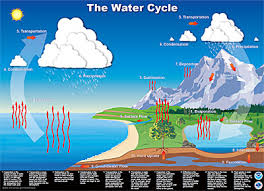
What part of the water cycle does this picture show?
a)
condensation
b)
precipitation
c)
evaporation
203.
Which is the opposite of condensation?
a)
runoff
b)
evaporation
c)
precipitation
d)
transpiration
204.
What follows evaporation during the water cycle? How does this occur?
a)
Water evaporates into water vapor
b)
Water vapor condenses and forms a  cloud
c)
Water precipitates to the ground
d)
Water runs down into the hydrosphere
205.
When water _________, dew forms.
a)
Melts
b)
Evaporates
c)
Condenses
d)
Precipitates
206.
What is the energy source for the water cycle?
a)
the sun
b)
the earth
c)
water
d)
the moon
207.
Evaporation happens when the sun ___________ water and turns it into vapor.
a)
cools
b)
heats up
c)
freezes
d)
lights up
208.
What is a layer of rock or sediment that holds water?
a)
glacier
b)
well
c)
aquifer
d)
natural spring
209.
What is is called when water turns into a vapor?
a)
EVAPORATION
b)
PRECIPITATION
c)
TRANSPIRATION
210.
Precipitation occurs because 
a)
the droplets evaporate in the air
b)
the droplets are too light for the air to hold
c)
the droplets are too heavy for the air to hold
211.
What is the process during which water cools and turns from a gas to a liquid?
a)
Codensation
b)
Runoff
c)
Precipitation
d)
Evaporation
212.
What happens during the process of evaporation?
a)
gas to liquid
b)
liquid to gas
c)
gas to solid
d)
liquid to solid
213.
When a warm air mass is colliding with a cold air mass. What is the border between the two air masses called?
a)
weather map
b)
front
c)
high pressure
d)
thunderstorm
214.
Which most likely produces clear, cool weather?
a)
zero air pressure
b)
stable air pressure
c)
a low pressure system
d)
a high pressure system
215.
_____________ air is more dense and tends to sink
a)
cold
b)
warm
c)
moist
d)
dry
216.
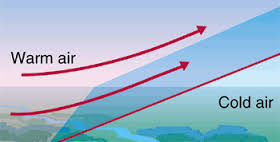
Which type of front is pictured?
a)
Cold front
b)
Warm front
c)
Occluded front
d)
Stationary front
217.
Which system results in rainy or stormy weather?
a)
high pressure
b)
low pressure
c)
hurricane
d)
weather system
218.
Which system results in drier, fairer weather?
a)
high pressure
b)
low pressure
c)
hurricane
d)
weather system
219.
How are fronts formed?
a)
When two air masses meet
b)
when two winds meet
c)
when two clouds meet