
 Worksheets
Enthalpy, Entropy, and Gibbs Free Energy
Total questions: 15
Worksheet time: 14mins
Which reaction has the greatest increase in entropy?
2H20 (l) --> 2H2 (g) + O2 (g)
2H2O(g)--> 2H2(g) + O2(g)
H2O(g) --> H2O(l)
H2O(l) H2O(s)
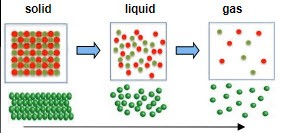
Which process is accompanied by a decrease in entropy?
boiling of water
condensing of water vapor
subliming of iodine (solid directly to gas)
melting of ice
Systems in nature tend to undergo changes toward
lower energy and less disorder
lower energy and more disorder
higher energy and less disorder
higher energy and more disorder
Given the change of phase:
CO2(g) —> CO2(s)
As CO2(g) changes to CO2(s), the entropy of the system
decreases
increases
remains the same
Which phase change represents a decrease in entropy?
solid to liquid
gas to liquid
liquid to gas
solid to gas
Identify whether the following result in an increase or decrease in entropy:
Gas --> Liquid --> solid
increase
decrease

1. Given the following information, calculate ΔG0 for the reaction below at 250C:
SnCl4(l) + 2 H20(l) → SnO2(S) + 4HCl(g),
ΔH0=133.0 kJ and ΔS0 =401.5 J/K
-252.6 kJ
-13.4 kJ
13.4 kJ
252.6 kJ
For which of these processes is the value of ΔH expected to be negative?
1. The temperature increases when calcium chloride dissolves in water.
2. Steam condenses to liquid water
3. Water boils
4. Dry ice sublimates
1 and 2 only
3 and 4 only
2 and 3 only
1 only

