wayground logo

Free Printable Worksheets

Font size

S
M
L
XL
Worksheets

Astronomy Test

Total questions: 131

Worksheet time: 2hrs 3mins

Name
Class
Date
1.

Earths axis cause what?

a)

Seasons

b)

Seasoning

c)

Sea Kings

d)

Day and Night

2.

Earths axis is titled at an angle of?

a)

25 degrees

b)

90 degrees

c)

23.5 degrees

d)

20.6 degrees

3.

N. Hemisphere pointing towards the sun and gets the most direct sunlight causes what season?

a)

Fall

b)

Summer

c)

Spring

d)

Winter

4.
Which is the largest object in our solar system?
a)
Sun
b)
Jupiter
c)
Earth
d)
Pluto
5.
Which planet is closest to the sun?
a)
Uranus
b)
Mercury
c)
Neptune
d)
Earth
6.
Which is the second closest planet to the sun?
a)
Earth
b)
Saturn
c)
Venus
d)
Mercury
7.
A small rocky object orbiting the sun.
a)
Asteroid
b)
Comet
c)
Moon
d)
Meteor
8.
A ball of ice and dust with a tail of gas and dust pointing away from the sun.
a)
Asteroid
b)
Comet
c)
Moon
d)
Meteor
9.
The moon is a natural  ______ of Earth.
a)
comet
b)
axis
c)
satellite
d)
space probe
10.
Earth's ________ on its axis causes day and night.
a)
rotation
b)
revolution
c)
phase
d)
comet
11.
One full orbit of an object around another object is called a ________.
a)
axis
b)
rotation
c)
revolution
d)
satellite
12.
The __________ has planets, moons, comets, and asteroids.
a)
solar system
b)
earth
c)
rotation
d)
United States
13.
One of the main differences between the outer and inner planets is __________.
a)
The inner planets all have water
b)
the inner planets are much bigger than the outer planets
c)
the outer planets are gas planets
d)
the outer planets have rings, and the inner planets don't
14.
Where is the asteroid belt found?
a)
between earth and mars
b)
Between Uranus and Neptune
c)
Between Mercury and Venus
d)
Between Mars and Jupiter
15.
Select the order from smallest to largest.
a)
Sun, Milky Way, solar system, universe
b)
Sun, Milky Way, universe, solar system
c)
Sun, solar system, Milky Way, universe
d)
Sun, solar system, universe, Milky Way
16.
Why does Earth have different seasons? 
a)
because of the distance between Earth and the sun 
b)
because of the speed of Earth as it rotates on its axis 
c)
because of the amount of light blocked by the moon on its axis 
d)
because of the tilt of Earth on its axis as it moves around the sun 
17.
Which factor makes Earth different from all the other planets in the solar system in its ability to support life? 
a)
The Earth is exposed to rays from the sun. 
b)
The Earth has only one moon that orbits around it. 
c)
The Earth rotates in an elliptical orbit around the sun. 
d)
The Earth has a breathable atmosphere. 
18.
Which best explains why the moon has phases?
a)
The moon’s position changes in relation to the sun and Earth. 
b)
The sun’s position changes in relation to the moon and Earth. 
c)
The Earth casts a shadow on the moon as it rotates. 
d)
The moon rotates along its axis
19.
Day and night is caused by the _____________ of earth on its axis.
a)
revolution
b)
orbit
c)
rotation
20.
As the Earth travels around the sun, this tilt causes different areas of the Earth’s surface to get different amounts of daylight at different times of the year. The angle of the Sun’s rays to the surface also causes areas to have more or less of the Sun’s energy. This causes the ________.
a)
months
b)
day and night
c)
seasons
d)
years
21.
Which outer planets have rings?
a)
Just Saturn
b)
Saturn and Jupiter
c)
Jupiter, Neptune, and Saturn
d)
all 4 of them
22.
a pattern of stars that form an imaginary picture or design in the sky
a)
Orbit
b)
Rotate
c)
constellation
d)
Milky Way
23.
A spiral galaxy of stars that contains our Sun
a)
Planisphere
b)
Intensity
c)
Star
d)
Milky Way
24.
The pattern of stars in a constellation stays the same, but a planet can be seen in different locations at different times because _______________.
a)
Stars don't move; planets revolve and rotate
b)
Stars and planets revolve and rotate.
c)
Stars not planets move
d)
Planets don't move; Stars revolve and rotate.
25.
Which of the following is an accurate model of how the Sun, Earth, and Moon move?
a)
Sun and moon orbit Earth
b)
Earth and moon orbit Sun
c)
Earth orbit's the Sun and the moon orbits Earth
d)
Earth and sun orbit moon
26.
What planet is eighth in the Solar System?
a)
Uranus
b)
Jupiter
c)
Neptune
d)
Mars
27.
Which planet is the largest in the solar system?
a)
Earth
b)
Venus
c)
Saturn
d)
Jupiter
28.
How many days does it take the Earth to revolve around the Sun?
a)
30 days
b)
365 days
c)
 100 days
d)
40 days
29.
What is the fourth planet from the Sun?
a)
Earth
b)
Mars
c)
Jupiter
d)
Mercury
30.
Complete the analogy. Planet is to Earth, as satellite is to:
a)
star
b)
sun
c)
moon
d)
asteroid
31.
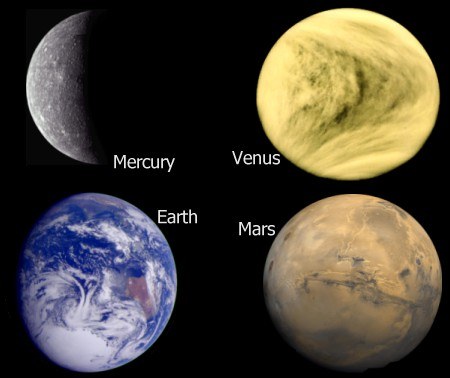
What is the nickname of Mercury, Venus, Earth, and Mars?
a)
rocky planets
b)
rock stars
c)
first four
d)
final four
32.
A student made a model of how the Earth, Moon, and Sun orbit. She used ping-pong balls
to represent each one. She painted each one a different color. Then, she placed the Moon
and Earth close together and the Sun much further away.What is one limitation of the student's model?
a)
She used the same size balls.
b)
She made earth orbit the sun.
c)
She moved the Sun away from the Earth and Moon.
33.
The moon is a natural  ______ of Earth.
a)
comet
b)
axis
c)
satellite
d)
space probe
34.
Earth and the other planets closest to the Sun are made mostly of _______
a)
gas
b)
metal
c)
water
d)
rock
35.
The __________ has planets, moons, comets, and asteroids.
a)
solar system
b)
earth
c)
rotation
d)
United States
36.
One of the main differences between the outer and inner planets is __________.
a)
The inner planets all have water
b)
the inner planets are much bigger than the outer planets
c)
the outer planets are gas planets
d)
the outer planets have rings, and the inner planets don't
37.
Where is the asteroid belt found?
a)
between earth and mars
b)
Between Uranus and Neptune
c)
Between Mercury and Venus
d)
Between Mars and Jupiter
38.
The moon is a natural  ______ of Earth.
a)
comet
b)
axis
c)
satellite
d)
space probe
39.

Where are the asteroids?

a)

Between Jupiter and Saturn

b)

Between Mars and Jupiter

c)

Between Saturn and Uranus

40.

Which is the hottest planet?

a)

Mercury

b)

Venus

c)

Mars

41.

Which planet is called "The Red Planet"?

a)

Venus

b)

Saturn

c)

Mars

42.

How many moons does Jupiter have?

a)

69

b)

5

c)

47

43.

What is the rotational period of the Earth?

a)

12 hours

b)

8 hours

c)

24 hours

44.

Which is the largest planet?

a)

Uranus

b)

Jupiter

c)

Venus

45.

Which is the coldest planet?

a)

Uranus

b)

Neptune

c)

Saturn

46.

What is the Sun?

a)

a planet

b)

a star

c)

a rock

47.

What attracts a body toward any other object in space

a)

the sun

b)

satellites

c)

gravity

d)

astroid belt

48.

Which of the following demonstrates how a rotating object spins.

a)

spinning top

b)

falling pebble

c)

bouncing basketball

d)

air hockey puck

49.

What causes the changes from night to day on Earth?

a)

Earth's tilt

b)

Earth's orbit of the sun

c)

The moon orbiting Earth

d)

Earth rotating on its axis

50.

Do the inner or outer planets have more moon?

a)

inner

b)

outer

51.

Are the inner or outer planets made up of mostly rock?

a)

inner

b)

outer

52.

Do the inner or outer planets have rings?

a)

inner

b)

outer

53.

Do the inner or outer planets revolve around the sun faster?

a)

inner

b)

outer

54.

Which of the following is NOT a reason why Earth is the only planet with life as we know it?

a)

It's atmosphere

b)

It has water

c)

It's distance from the sun

d)

It's moon

55.

What is the second planet from the sun?

a)

Mercury

b)

Earth

c)

Jupiter

d)

Venus

56.
A force of attraction between any two objects is called _____________.
a)
static electricity 
b)
rotation
c)
gravity
d)
orbit
57.
Earth completes one full ___________ on its axis every 24 hours.
a)
rotation
b)
revolution
c)
resolution
d)
reservation 
58.
The moon is a natural  ______ of Earth.
a)
comet
b)
axis
c)
satellite
d)
space probe
59.
What is the nickname of Mercury, Venus, Earth, and Mars?
a)
rocky planets
b)
rock stars
c)
first four
d)
final four
60.
A small body that orbits a planet is a(n)
a)
comet
b)
moon
c)
asteroid
d)
exoplanet
61.
Which planet in our solar system is closest to the Sun?
a)
Earth
b)
Jupiter
c)
Mercury
d)
Saturn
62.
Which is the sixth planet from the sun?
a)
Earth
b)
Uranus
c)
Saturn
d)
Neptune
63.
Which planet is fifth from the sun?
a)
Saturn
b)
Jupiter
c)
Mars
d)
Earth
64.
Which is the fourth planet from the sun?
a)
Mars
b)
Saturn
c)
Earth
d)
Jupiter
65.
Which planet is third from the sun?
a)
Mars
b)
Pluto
c)
Venus
d)
Earth
66.

the sun looks bigger than other stars why

a)

the sun is closer

b)

the sun is bigger

c)

the sun is brighter

67.

the sun is the biggest star

a)

true

b)

false

68.

Is Pluto a planet

a)

TRUE

b)

FALSE

69.

What are stars

a)

Hot exploding balls of gas

b)

Bright things in the sky

c)

small parts of the sun

d)

All of the above

70.
They are sometimes called shooting stars
a)
interplanetary dust
b)
asteroids
c)
comets
d)
meteors
71.
A meteorite is DIFFERENT from a comet mainly because
a)
has a tail of ice and gas
b)
is found in orbit between Jupiter and Mars
c)
enters the Earth's atmoshere
d)
has a nucleus mad of rock and snow.
72.
Sometimes I am called a "dirty snowball". I have a hydrogen cloud, coma, and a nucleus. I am invisible except when near the sun. What am I?
a)
Asteroid
b)
Star
c)
Meteor
d)
Comet
73.
The tail of a comet usually faces
a)
toward the sun
b)
toward the Earth
c)
away from the Sun
d)
away from the Earth
74.
What do we call the visible streak of light created by space debris entering Earth's atmosphere?
a)
meteor
b)
meteorite
75.
One similarity between asteroids, comets and meteoroids is that they all:
a)
are made of rock
b)
come from the Asteroid Belt
c)
come from the Oort Cloud
d)
orbit the sun
76.
Ceres is...
a)
The largest asteroid in the Kuiper Belt
b)
The largest asteroid in the asteroid belt
c)
An asteroid in the Oort cloud
d)
A comet in the Oort cloud
77.
A planet is a ______ _______ moving in an elliptical orbit around the star.
a)
celestial body
b)
piece of rock
78.
AU is used to measure the distance from  _________ to the sun.
a)
planets
b)
stars
c)
comets
79.
The revolution of a planet is equal to a _____ Earth year.
a)
full
b)
half
80.
Our solar system is located in the _______ ____ galaxy.
a)
Milky way
b)
candy bar
c)
snickers
81.
Our solar system is ________ shaped.
a)
oval
b)
spiral
c)
twisty
82.
A hot, glowing ball of gases is a ______.
a)
planet
b)
gravity
c)
telescope
d)
star
83.
A large, ball-shaped body that revolves, or travels around, the sun
a)
moon
b)
star
c)
sun
d)
planet
84.
the closet star to Earth
a)
milky way 
b)
sun
c)
planet
d)
light-year
85.
Planets that are closer to the sun
a)
take more time to orbit
b)
take less time to orbit
86.
The order of the planets is:
a)
Mars,Venus,Earth,
Mercury,Saturn
Jupiter, Uranus, Neptune
b)
Earth,Venus,Mars
Jupiter, Neptune,
Mercury,Saturn,
Uranus
c)
Mercury,Venus,Earth
Mars,Jupiter,
Saturn,Uranus
Neptune
87.
Which planet is the largest?
a)
Jupiter
b)
Saturn
c)
Uranus
d)
Neptune
88.
Which planet is seventh from the sun?
a)
Saturn
b)
Earth
c)
Venus
d)
Uranus
89.
Which is the fourth planet from the sun?
a)
Mars
b)
Saturn
c)
Earth
d)
Jupiter
90.
Which is the second closest planet to the sun?
a)
Earth
b)
Saturn
c)
Venus
d)
Mercury
91.
Day and night is caused by the _____________ of earth on its axis.
a)
revolution
b)
orbit
c)
rotation
92.
The earth orbits around...
a)
the sun.
b)
the moon
c)
other planets
d)
the Milky Way
93.
What are the reasons for the seasons?
a)
Earth's tilt and rotation.
b)
Earth's rotation and revolution.
c)
Earth's tilt and revolution.
d)
Earth's tilt and resolution
94.
True or False
The Earth is the center of the solar system.
a)
True
b)
False
95.

what planets have rings?

a)

inner planets

b)

outer planets

96.
True or False
The planets are all equally distanced from each other.
a)
True
b)
False
97.
Uranus spins on its ____
a)
Top
b)
Side
98.
Venus is the _____ planet
a)
Coldest
b)
Hottest
99.
Scientists have been able to find no atmosphere around this planet because it has little gravity and is closest to the sun.
a)
Mars
b)
Venus
c)
Mercury
d)
Earth
100.
True or False
The Earth is the center of the solar system.
a)
True
b)
False
101.
The inner planets are also called...
a)
terrestrial planets
b)
gas giants
102.
The inner planets are closer to the sun so
a)
they take longer to orbit the sun.
b)
they orbit the sun faster.
103.
Planets that are closer to the sun
a)
take more time to orbit
b)
take less time to orbit
104.
The order of the planets is:
a)
Mars,Venus,Earth,
Mercury,Saturn
Jupiter, Uranus, Neptune
b)
Earth,Venus,Mars
Jupiter, Neptune,
Mercury,Saturn,
Uranus
c)
Mercury,Venus,Earth
Mars,Jupiter,
Saturn,Uranus
Neptune
105.
Which planet is the largest?
a)
Jupiter
b)
Saturn
c)
Uranus
d)
Neptune
106.
The order of the planets is:
a)
Mars,Venus,Earth,
Mercury,Saturn
Jupiter, Uranus, Neptune
b)
Earth,Venus,Mars
Jupiter, Neptune,
Mercury,Saturn,
Uranus
c)
Mercury,Venus,Earth
Mars,Jupiter,
Saturn,Uranus
Neptune
107.
What is a common characteristic of the inner planets?
a)
Large
b)
Gaseous
c)
Rings
d)
Rocky Surface
108.
What is NOT a common characteristic of the outer planets?
a)
Gaseous
b)
Giant
c)
Rings
d)
Smaller than Earth
109.
True or False
The planets are not lined up in a perfectly straight line
a)
True
b)
False
110.
True or False
The planets are all equally distanced from each other.
a)
True
b)
False
111.
Which planet has no atmosphere and looks like our moon?
a)
Mercury
b)
Venus
c)
Earth
d)
Mars
112.
Which planet has a thick atmosphere and is the hottest planet?
a)
Mercury
b)
Venus
c)
Earth
d)
Mars
113.
Which planet has iron in its soil and is the red planet?
a)
Mercury
b)
Venus
c)
Earth
d)
Mars
114.
Which planet is Earth's sister planet?
a)
Mercury
b)
Venus 
c)
Earth
d)
Mars
115.
Which planet is the smallest?
a)
Mercury
b)
Venus
c)
Earth
d)
Mars
116.
Which planet is the largest?
a)
Jupiter
b)
Saturn
c)
Uranus
d)
Neptune
117.
Which planet has the biggest rings?
a)
Jupiter
b)
Saturn
c)
Uranus
d)
Neptune
118.
Which planet rotates on its side?
a)
Jupiter
b)
Saturn
c)
Uranus
d)
Neptune
119.
Which planet has a Great Dark Spot?
a)
Jupiter
b)
Saturn
c)
Uranus
d)
Neptune
120.
Which planet has hurricanes and one large one that makes up the Great Red Spot?
a)
Jupiter
b)
Saturn
c)
Uranus
d)
Neptune
121.
What force keeps the planets orbiting the sun?
a)
Gravity
b)
Magnetism
c)
Electricity
d)
Friction
122.
Which of the following is referred to as a “shooting star”?
a)
asteroids
b)
comets
c)
meteors
d)
planets
123.
What planets are Mercury, Venus, Earth, & Mars considered?
a)
inner
b)
outer
c)
dwarf
124.
Which of the following orbits the sun?
a)
asteroids
b)
comets
c)
planets
d)
all of the above
125.
What type of planets are Jupiter, Saturn, Uranus, & Neptune considered?
a)
inner
b)
outer
c)
dwarf
126.
Which land feature is sometimes made when a meteorite lands on Earth?
a)
canyon
b)
crater
c)
river delta
d)
mountain range
127.
The innermost planets have what type of physical composition?
a)
gaseous
b)
terrestrial
c)
liquid
128.
What is found in a belt between the orbits of Mars and Jupiter?
a)
asteroid
b)
comet
c)
meteor
129.
What is found in the Earth’s atmosphere?
a)
asteroid
b)
comet
c)
meteor
130.
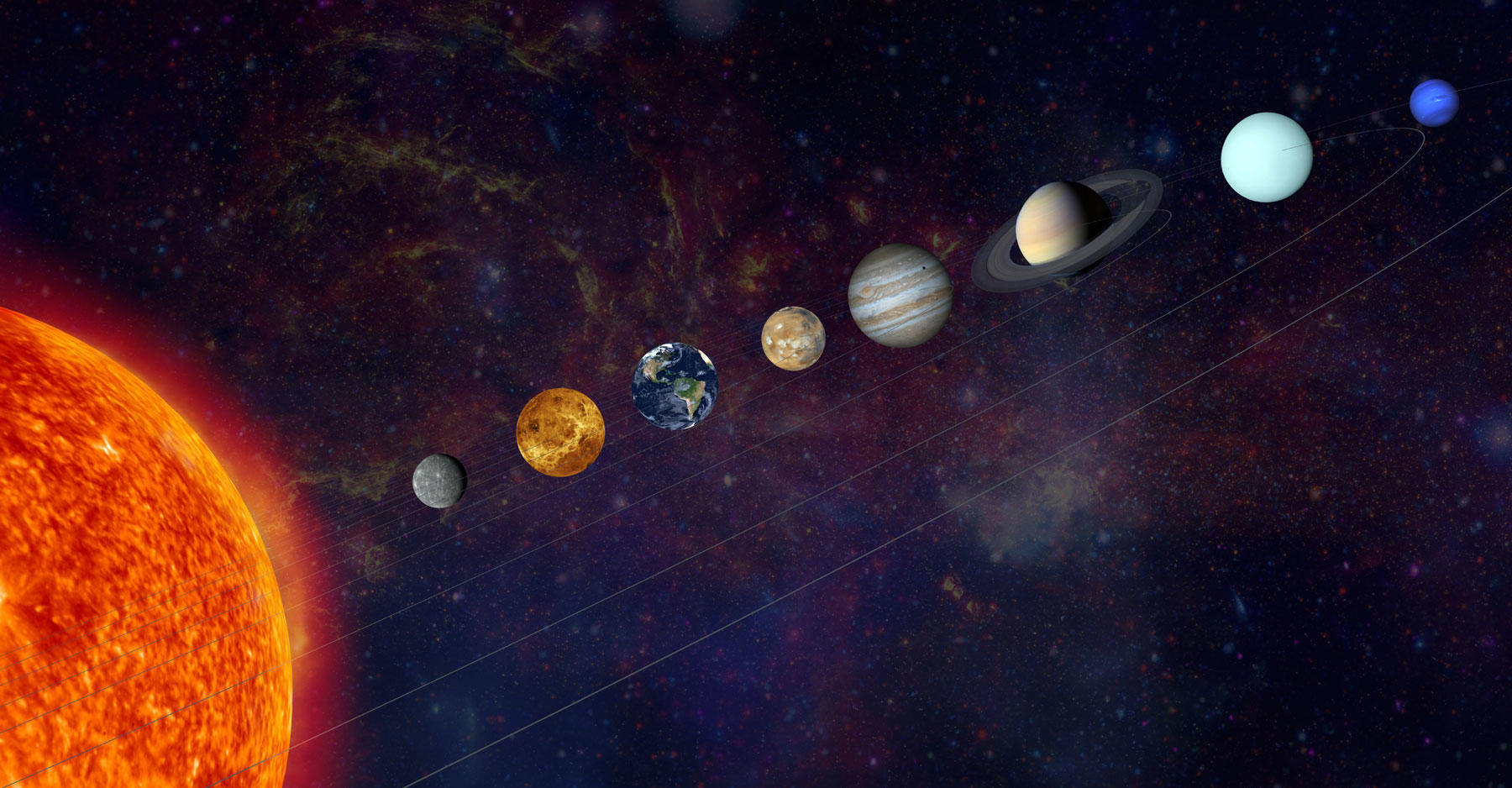
Where does the Asteroid Belt fall in the picture?
a)
between venus and earth
b)
between earth and mars
c)
between mars and jupiter
d)
between jupiter and saturn
131.
What 4 planets make up the outer planets?
a)
mercury, venus, earth, mars
b)
jupiter, saturn, uranus, venus
c)
mercury, venus, earth, saturn
d)
jupiter, saturn, uranus, neptune