
 Worksheets
CA7 review
Total questions: 47
Worksheet time: 50mins
Name
Class
Date
1.
Which of the following is NOT a property of ionic compounds?
a)
They conduct electricity when molten
b)
They conduct electricity when in solution
c)
They have high boiling points
d)
They are insoluble in water
2.
How many valence electrons does calcium have?
a)
2
b)
4
c)
6
d)
7
3.
A(n) _________ is an ion with a positive (+) charge.
a)
anion
b)
cation
c)
ion
d)
solute
4.
When an atom loses an electron, it becomes a:
a)
positive ion
b)
negative ion
c)
neutral ion
d)
neutral atom
5.
Why do ionic bonds form?
a)
so the number of protons equals the number of electrons
b)
to fill the outermost energy level
c)
so an atom can become unstable
6.
if METALS are more likely to LOSE electrons, they will form ...
a)
anions
b)
neutral atoms
c)
positive ions
d)
negative ions
7.
If an aluminum atom has 13 protons (+) and 10 electrons (-), what is it's charge?
a)
Al3+
b)
Al13+
c)
Al10+
d)
Al10-
8.
In a covalent bond , electrons are ________
a)
transferred
b)
shared
9.

In a double bond, ________ are shared
a)
4 protons
b)
4 electrons
c)
4 neutrons
10.
What two types of atoms make a covalent bond?
a)
2 Nonmetals
b)
1 Nonmetal and 1 Metal
c)
2 Metals
d)
2 Noble Gases
11.
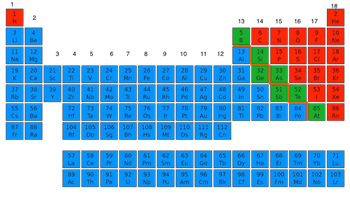
Where are the nonmetals located on the periodic table?
a)
Blue
b)
Red
c)
Green
12.

What is the correct formula for this molecule?
a)
NH
b)
N3H
c)
NH3
d)
NH4
13.
4. Which of the following statements is most accurate regarding melting and boiling points?
a)
a) Substance with simple covalent bonding have higher melting and higher boiling points than substances with ionic bonding.
b)
b) Substance with simple covalent bonding have higher melting and lower boiling points than substances with ionic bonding.
c)
c) Substance with simple covalent bonding have lower melting and higher boiling points than substances with ionic bonding.
d)
d) Substance with simple covalent bonding have lower melting and lower boiling points than substances with ionic bonding.
14.
Balance this equation-
__P4 + __O2 --> __P2O3
__P4 + __O2 --> __P2O3
a)
it is already balanced
b)
2, 1, 3
c)
1, 2, 3
d)
1, 3, 2
15.
Balance this equation.
_CH4 + _O2 --> _CO2 + _H2O
_CH4 + _O2 --> _CO2 + _H2O
a)
1,2,1,1
b)
2,1,2,1
c)
1,2,1,2
d)
0,2,0,2
16.
Balance this equation.
_CF4 + _Br2 -- _CBr4 + _F2
_CF4 + _Br2 -- _CBr4 + _F2
a)
2,1,2,1
b)
1,2,2,1
c)
1,2,1,2
d)
2,2,2,2
17.
Balance this equation-
_SeCl6+_O2>_SeO2+_Cl2
_SeCl6+_O2>_SeO2+_Cl2
a)
1,2,1,2
b)
1,1,1,3
c)
1,2,1,1
d)
2,1,1,1
18.
What does the Law of Conservation of Mass state?
a)
Matter cannot be gained or lost in a chemical reaction.
b)
Matter can only be lost in a chemical reaction.
c)
Matter can only be gained in a chemical reaction.
d)
Matter can be gained and lost in a chemical reaction.
19.
What is the arrow in a chemical equation...
H2 + O --> H2O
H2 + O --> H2O
a)
Reactants
b)
Products
c)
Yields
d)
Chemical Equation
20.
At the end of chemical reactions, what is the total mass of the reactants compared to the total mass of the products?
a)
the product is doubled
b)
the product is half the mass of the reactants
c)
the mass is the same
d)
the mass changes depending on the reaction
21.
How many atoms of aluminum are on each side of the following equation: 4Al + 3O2 --> 2Al2 O3
a)
2
b)
6
c)
1
d)
4
22.
Two Reactants and One Product
a)
Decomposition
b)
Synthesis
c)
Combustion
d)
Single Replacement
23.
One reactant into several products.
a)
Decomposition
b)
Synthesis
c)
Combustion
d)
Single Replacement
24.
One element replaces another in a compound.
a)
Synthesis
b)
Combustion
c)
Single Replacement
d)
Double Replacement
25.
Ions in two compounds switch.
a)
Synthesis
b)
Combustion
c)
Single Replacement
d)
Double Replacement
26.
3Ca + 2AlCl3 --> 3CaCl2 + 2Al
a)
Synthesis
b)
Decomposition
c)
Single Displacement
d)
Double Displacement
27.
4Si + S8 --> 2Si2S4
a)
Synthesis
b)
Decomposition
c)
Single Displacement
d)
Double Displacement
28.
2Pb(NO3)2 --> 2PbO + 4NO2 + O2
a)
Synthesis
b)
Decomposition
c)
Single Displacement
d)
Combustion
29.
The following is what type of reaction:
PbCl2 + AgNO3 → Pb(NO3)2 + AgCl
PbCl2 + AgNO3 → Pb(NO3)2 + AgCl
a)
Synthesis
b)
Decomposition
c)
Single Replacement
d)
Double Replacement
30.
Which of the following is a property of an ionic compound?
a)
high melting point
b)
soft
c)
malleable
d)
liquid at room temperature
31.
How does dissolving an ionic compound in water increase electrical conductivity?
a)
The water molecules remove heat to break the ionic bonds in the crystal and let the ions move freely.
b)
The water molecules electrostatically interact with the ions in the crystal and let the ions move freely.
c)
The water molecules chemically react with the ions in the crystal and let the ions move freely.
d)
The water molecules apply heat to break the ionic bonds in the crystal and let the ions move freely.
32.
Which of the following statements explains why ionic compounds are brittle?
a)
When a force is applied to the crystal, the strong electrostatic interactions cause similar ions to repel and shatter the crystal lattice.
b)
When a force is applied to the crystal, the strong electrostatic interactions cause similar ions to attract and shatter the crystal lattice.
c)
When a force is applied to the crystal, the weak electrostatic interactions cause opposite ions to attract and shatter the crystal lattice.
d)
When a force is applied to the crystal, the weak electrostatic interactions cause similar ions to repel and shatter the crystal lattice.
33.
Which of the following compounds would have the lowest melting point?
a)
aluminum oxide
b)
potassium chloride
c)
sucrose
d)
sodium chloride
34.

Where are the nonmetals located on the periodic table?
a)
Blue
b)
Red
c)
Green
35.
What is the formula of calcium oxide?
a)
CaO2
b)
CaO
c)
Ca2O
d)
CO
36.
Ionic compounds are formed when one or more valence electrons are transferred from _____
a)
a nonmetal atom to a metal atom
b)
a nonmetal atom to a nonmetal atom
c)
a metal atom to a nonmetal atom
d)
a metal atom to a metal atom
37.
Sr(OH)2
a)
Strontium Hydroxide
b)
Strontium Hydride
c)
Strontium Dihydroxide
d)
Strontium Dioxygen Dihydride
38.
Li+ combines with P3- to form
a)
LiP
b)
Li3P
c)
LiP3
d)
Li3P3
39.
The chemical formula for an ionic compound of potassium and oxygen is
a)
KO.
b)
K2O.
c)
K2O2.
d)
KO2.
40.
What is the correct chemical formula for Nitrogen Triiodide?
a)
NI3
b)
N3I3
c)
NOI
d)
NeI3
41.
A binary covalent bond exists between
a)
2 metals
b)
1 metal and 1 nonmetal
c)
2 nonmetals
d)
Any 2 elements
42.
What is the correct name for C4H6?
a)
Carbon Hexahydride
b)
Pentacarbon Pentahydride
c)
Hexacarbon Tetrahydride
d)
Tetracarbon Hexahydride
43.
What is the chemical formula for Fluorine trisulfide ?
a)
S3F
b)
FS3
c)
FS
d)
none of the above
44.

BrO3
a)
bromine oxide
b)
monobromine trioxide
c)
bromine trioxide
d)
bromine (III) oxide
45.
Which of the following is NOT a characteristic of IONIC COMPOUNDS?
a)
High melting point
b)
Conducts electricity
c)
Strong bonds
d)
Low boiling points
46.
Which of the following is NOT a characteristic of a COVALENT COMPOUNDS?
a)
High melting point
b)
Contains only nonmetals
c)
Low boiling point
d)
All solids
47.

A solid that is formed in a solution during a double replacement reaction.
a)
precipitation
b)
precipitate
c)
aqueous
d)
catalyst
100 %

