
Font size
 Worksheets
Thermal Energy Review
Total questions: 38
Worksheet time: 20mins
the ability of a substance to absorb heat
conduction
specific heat
convection
evaporation
tool used to measure temperature
thermometer
spring scale
ruler
radiation
phase change from liquid to gas at the surface of the liquid
condensation
boiling point
evaporation
sublimation
material that does not allow heat to pass easily
insulator
conductor
convection
condensation
material that does allow heat to pass easily
specific heat
heat
insulator
conductor
almost all substances do this when cooled
insulate
contract
expand
conduct
nearly all substances do this when heated
expand
contract
calorie
energy of moving molecules
sound
heat
vibration
solid
transfer of heat by objects that are touching
convection
condensation
conduction
radiation
transfer of heat through space and air
conduction
radiation
heat
convection
transfer of energy through liquids or gases
conduction
convection
radiation
measure of how fast or slow molecules are
heat energy
temperature
specific heat
liquid to solid
sublimating
boiling
melting
freezing
solid to liquid
evaporate
boil
melt
freeze
solid to gas
sublimation
deposition
melt
freeze
gas to liquid
boiling
evaporation
condensation
sublimation
liquid to gas with added heat
evaporate
boil
melt
freeze
what are the particles in a solid like?
Far apart
Wiggly and not close together
Close together
They don't have particles.

What state of matter is a guitar
Liquid
Particles
Gas
Solid
What are the three states of matter?
Melting, Freezing, and Particles
Solid, Liquid, and Gas
Ice Cube, Rock, and rock
Three states of matter

What type of heat transfer is shown here?
convection
conduction
radiation
sun shining

Which type of heat transfer is shown?
convection
conduction
radiation
ironing

Which type of heat transfer is shown?
convection
conduction
radiation
stir frying
True or false? Conduction involves DIRECT CONTACT between two objects?
True
False
What does "the law of conservation of energy" mean?
Energy can be created
Energy cannot be created but can be destroyed.
Energy can be destroyed and created.
Energy can never be created or destroyed.


Is the substance gaining or losing energy? (Diagram D)
Gaining
Losing

Which line segment demonstrates vaporization occurring? (Diagram E)
B-C
C-D
D-E
E-F

How long does it take this substance to change from a liquid to a gas? (Diagram E)
1 minute
2 minutes
10 minutes
15 minutes

**An ice cube feels cold when we hold it. Which of the following best explains why?
Heat moves from our hands into the ice cube.
Cold moves from our hands into the ice cube.
Heat moves from the ice cube into our hands.
Cold moves from the ice cube into our hands.

A glass of water is placed in a very cold freezer. Every 5 minutes the temperature of water is measured and recorded: If the pattern continues, which statement correctly describes the water after 20 minutes?
The water temp is 2ºC and the water is still liquid
The water temp is 1ºC and the water is still liquid
The water temp is 1ºC and the water is freezing
The water temp is 0ºC and the water is freezing
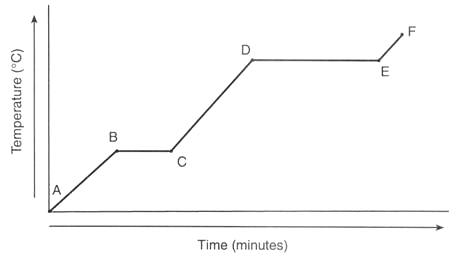
Is the substance gaining or losing energy?
Gaining
Losing
Are the particles moving faster or slower as time goes on?
Faster
Slower

Where on the graph are phase changes taking place?
1
2
3
4
5

