wayground logo

Free Printable Worksheets

NEW

Font size

S
M
L
XL
Worksheets

Biosphere Unit Review

Total questions: 33

Worksheet time: 23mins

Name
Class
Date
1.
Which of the following is a term for a group of similar organisms that can reproduce fertile offspring?
a)
individual
b)
population
c)
species
d)
fossil
2.
The difference in the physical traits of an individual from those of other individuals in a group is called a(n)
a)
change
b)
adaption
c)
species
d)
variation
3.
what did Charles Darwin observe in finch populations of the Galapagos Islands off the coast of South America?
a)
different species on different islands
b)
all species on one of the islands
c)
identical species on all the islands
d)
the same species as North America
4.
In natural selection, the selective agent is the
a)
humans
b)
mutations
c)
breeders
d)
environment
5.
a bird that can easily outcompete other birds for food and that can produce many eggs has a high
a)
life expectancy
b)
mutation rate
c)
fitness
d)
adaptability
6.

Which of the following describes natural selection?

a)

it acts on genetic material directly

b)

it acts on existing physical traits

c)

it forms new traits

d)

it forms new genetic material

7.

which of the following is an example of a vestigial structure?

a)
the wings of a red-tailed hawk
b)
the hind limbs of a house cat
c)
the fins of sharks
d)
the wings of an ostrich
8.

What is suggested by the anatomical similarity of different species of vertebrates?

a)

no evolutionary relationships between the groups

b)

recent common ancestry

c)

similar environments in the past

d)

evolution from a distant common ancestor

9.
Some organisms that share a common ancestor have features that have different functions, but similar structures.  These are known as
a)
vestigial structures
b)
analogous structures
c)
homologous structures
d)
fossil structures
10.
If an organism has a vestigial structure, that structure likely once had a function in a(n)
a)
close relative
b)
early ancestor
c)
unrelated organism
d)
embryological stage
11.
Two organisms that are closely related would have
a)
very similar DNA sequence
b)
exactly the same DNA sequences
c)
no proteins in common
d)
completely different DNA sequence
12.
Genetic variation can arise from a random change in the DNA of a gene.  The change is called a(n)
a)
mutation
b)
gene flow
c)
gene pool
d)
allele
13.
What is speciation?
a)
combining of tow species to form one with different traits
b)
isolation that affects mating behaviors
c)
timing of mating that prevents normal sexual selection
d)
divergence of two or more species from an existing one
14.
An earthquake causes an ocean channel top open and separate an island into two.  the species on each section are now in
a)

geographic isolation

b)
behavioral isolation
c)
disruptive selection
d)
temporal isolation
15.
two species are in different environments and look very similar.  However, that are not closely related (analogous).  Their resemblance is most likely an example of.
a)
sexual selection
b)
temporal isolation
c)
convergent evolution
d)
divergent evolution
16.

What is the term for a feature that allows an organism to survive better in its environment?

a)

variation

b)

adaptation

c)

homologous structure

d)

vestigial structure

17.
What is the process in which humans breed organisms for certain traits?
a)
natural selection
b)
inheritance
c)
artificial selection
d)
descent withOUT modification
18.
Who was the naturalist that traveled the world to study plants and animals?
a)
Albert Einstein
b)
Charles Darwin
c)
Charles Barkley
d)
Isaac Newton
19.
The gradual change in species over time is...
a)
Evolution
b)
Nucleotide 
c)
Adaptation
d)
Natural Selection
20.
To adjust to a changing environment
a)
Mutation
b)
Adapt
21.
Darwin wrote that organisms with traits that are best suited to the environment will ________________
a)
increase in number
b)
become extinct
22.
What characteristic did Darwin observe about the finches on the Galapagos Islands?
a)
Their feathers 
b)
Genotypes 
c)
Their beaks
d)
Their body sizes
23.
Which term refers to the process by which individuals that are better suited to the environment survive and reproduce therefore passing down their genes to their offspring? 
a)
Evolution 
b)
Variation 
c)
Adaptation
d)
Natural Selection 
24.
What is the advantage of having different shaped beaks?
a)
To look different from other species.
b)
To be able to eat the food readily available in the environment.
c)
To protect itself against predators.
d)
To protect itself against prey.
25.
A well-tested concept that explains a wide range of observations is called a(an):
a)
hypothesis
b)
experiment
c)
cause and effect
d)
scientific theory
26.
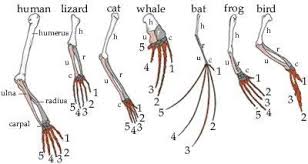
What is this an example of?
a)
vestigial structures
b)
embryology
c)
homologous structures
d)
fossil record
27.
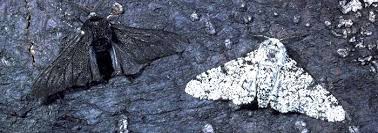
Predict which moth would increase in population
a)
light 
b)
dark
28.
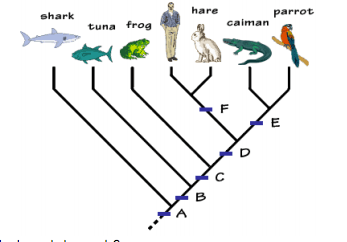
On the cladogram, which organism is the closest relative of the human?
a)
Frog
b)
Hare
c)
Caiman
d)
Parrot
29.
The physical appearance of an organism based on traits
a)
Genotype
b)
Phenotype
c)
Meiosis
d)
Genetics
30.

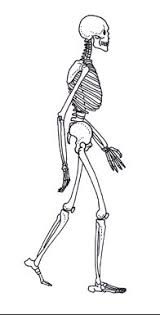
The ability to walk upright on two legs is called:

a)

bipedalism

b)

quadropedalism

c)

bicyclepedalism

d)

tripedalism

31.

What characteristic did early hominins share with modern humans?

a)

Speech and language

b)

The inability to live in groups

c)

Small brains

d)

Bipedalism

32.

Evidence shows that the earliest hominids evolved where?

a)

Plumstead Twp.

b)

Russia

c)

Asia

d)

Africa

33.

What MAJOR piece of evidence did Darwin not know about while he was conducting his research?

a)

Common Ancestry

b)

DNA

c)

Plate Tectonics

d)

Weather Patterns