

wayground logo

Free Printable Worksheets

NEW

Font size

S
M
L
XL
Worksheets

Formation of our Solar System DE

Total questions: 35

Worksheet time: 1hrs 23mins

Name
Class
Date
1.

Which of the following planets has the longest orbit?

a)

Mercury

b)

Earth

c)

Neptune

d)

Mars

2.

The orbits of all planets are ___________.

a)

parabolic

b)

rectangular

c)

elliptical

d)

circular

3.

What is the name of the area between Mars and Jupiter?

a)

the milky way

b)

galaxy

c)

the asteroid belt

d)

Kuiper belt

4.

Our ______is made up of all the planets and their moons all in orbit around the Sun.

a)

Solar System

b)

Milky Way

c)

Galaxy

d)

Universe

5.

Jupiter is farther from the sun than Earth is. Based on this fact, what can you conclude about the lengths and durations of Jupiter's orbit?

a)

Jupiter has a larger orbit, and it takes longer time to travel around the sun.

b)

Jupiter has a larger orbit, and it takes less time to travel around the sun.

c)

Jupiter has a smaller orbit, and it takes a longer time to travel around the sun.
6.
What planet is eighth in the Solar System?
a)
Uranus
b)
Jupiter
c)
Neptune
d)
Mars
7.
Which planet is the largest in the solar system?
a)
Earth
b)
Venus
c)
Saturn
d)
Jupiter
8.
How many days does it take the Earth to revolve around the Sun?
a)
30 days
b)
365 days
c)
 100 days
d)
40 days
9.
What is the fourth planet from the Sun?
a)
Earth
b)
Mars
c)
Jupiter
d)
Mercury
10.
Complete the analogy. Planet is to Earth, as satellite is to:
a)
star
b)
sun
c)
moon
d)
asteroid
11.
Which planet in our solar system is closest to the Sun?
a)
Earth
b)
Jupiter
c)
Mercury
d)
Saturn
12.
Earth and the other planets closest to the Sun are made mostly of _______
a)
gas
b)
metal
c)
water
d)
rock
13.
The moon is a natural  ______ of Earth.
a)
comet
b)
axis
c)
satellite
d)
space probe
14.
Earth's ________ on its axis causes day and night.
a)
rotation
b)
revolution
c)
phase
d)
comet
15.
One full orbit of an object around another object is called a ________.
a)
axis
b)
rotation
c)
revolution
d)
satellite
16.
The __________ has planets, moons, comets, and asteroids.
a)
solar system
b)
earth
c)
rotation
d)
United States
17.
Why does Earth have different seasons? 
a)
because of the distance between Earth and the sun 
b)
because of the speed of Earth as it rotates on its axis 
c)
because of the amount of light blocked by the moon on its axis 
d)
because of the tilt of Earth on its axis as it moves around the sun 
18.
Which factor makes Earth different from all the other planets in the solar system in its ability to support life? 
a)
The Earth is exposed to rays from the sun. 
b)
The Earth has only one moon that orbits around it. 
c)
The Earth rotates in an elliptical orbit around the sun. 
d)
The Earth has a breathable atmosphere. 
19.
Which best explains why the moon has phases?
a)
The moon’s position changes in relation to the sun and Earth. 
b)
The sun’s position changes in relation to the moon and Earth. 
c)
The Earth casts a shadow on the moon as it rotates. 
d)
The moon rotates along its axis
20.
Day and night is caused by the _____________ of earth on its axis.
a)
revolution
b)
orbit
c)
rotation
21.
As the Earth travels around the sun, this tilt causes different areas of the Earth’s surface to get different amounts of daylight at different times of the year. The angle of the Sun’s rays to the surface also causes areas to have more or less of the Sun’s energy. This causes the ________.
a)
months
b)
day and night
c)
seasons
d)
years
22.
Which outer planets have rings?
a)
Just Saturn
b)
Saturn and Jupiter
c)
Jupiter, Neptune, and Saturn
d)
all 4 of them
23.
Which is the largest object in our solar system?
a)
Sun
b)
Jupiter
c)
Earth
d)
Pluto
24.
Which is the second closest planet to the sun?
a)
Earth
b)
Saturn
c)
Venus
d)
Mercury
25.
A small object that appears as a streak of light as it enters earth's atmosphere.
a)
Asteroid
b)
Comet
c)
Moon
d)
Meteor
26.
Nebula's are mixtures of gases and what?
a)
clouds
b)
stars
c)
tiny particles
d)
dust
27.
What force acted on the massive nebula to collapse it and eventually form our sun?
a)
electrostatic force
b)
strong force
c)
 weak force
d)
gravity
28.
A cloud of gas and dust from which bodies in space are formed
a)
photosphere
b)
nebula
c)
solar flare
d)
Sunspot
29.
How old is our solar system?
a)
4.6 billion years
b)
13.8 billion years
c)
6,000 years
d)
15,000 years
30.
A celestial cloud of dust and gas is called . . .
a)
nebula
b)
supernova
c)
accretion disc
d)
bombardment
31.
Smaller particles collecting together into larger and larger objects is called . . .
a)
accretion
b)
contraction
c)
explosion
d)
rotation
32.
Why is Mercury covered with craters, but Earth is not?
a)
Earth's atmosphere protects and weathers
b)
Earth's moon blocks asteroids
c)
asteroids just missed Earth
d)
most asteroids land in Earth's oceans
33.

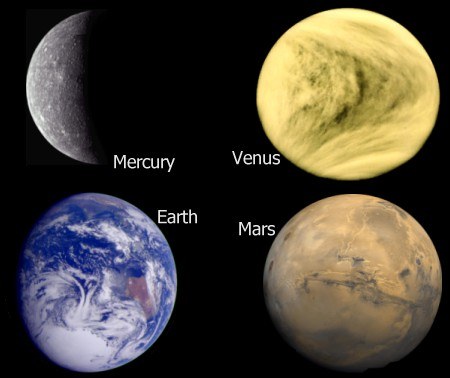
The group of inner planets are known as:

a)

The Terrestrial Planets

b)

The Gas Giants

c)

The Outer Planets

d)

The Hallow Planets

34.
The group of outer planets are known as:
a)
The Terrestrial Planets
b)
The Gas Giants
c)
The Inner Planets
d)
The Rocky Planets
35.
Earth's period of revolution is about
a)
one day
b)
one week
c)
One year
d)
One hour
